Corded vs Cordless Robotic Pool Cleaners for Commercial & Multi-Pool Properties: A Buyer's Guide
Introduction
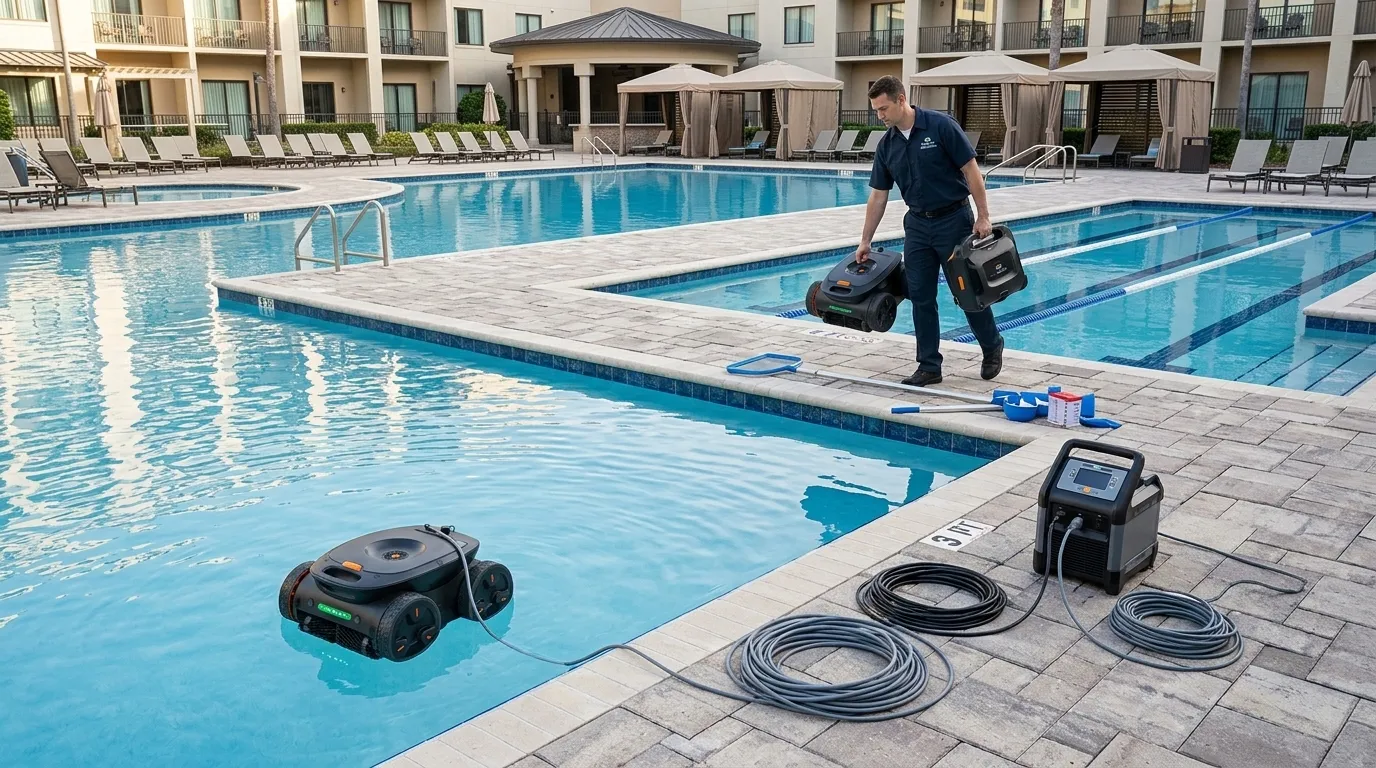
Most corded-versus-cordless comparisons are written for a single homeowner with one backyard pool. That's a straightforward decision. It looks completely different once you're responsible for a hotel pool, an apartment complex with three pools, an HOA community with a lap pool and a kiddie pool, or a route of a dozen client pools serviced by the same maintenance crew. At that scale, the question isn't "which one do I personally prefer" — it's which setup keeps labor costs down, keeps downtime low, and holds up under daily use by people who aren't the ones who bought the machine.
This guide walks through the corded and cordless decision specifically from that operator's perspective: property managers, HOA boards, hospitality facilities, and pool service companies managing multiple pools rather than one.
Why Commercial and Multi-Pool Properties Need a Different Answer Than Homeowners
A homeowner runs one robot on one pool, usually on a set schedule, usually retrieved and stored by the same person every time. None of that holds at scale. A property with multiple pools needs a cleaning solution that survives being moved between locations, handled by different staff members or contractors, and used far more frequently than a residential unit ever would be. Decisions that barely matter for a backyard pool — cord length, charging turnaround, how easy the unit is to hand off between shifts — become the deciding factors for a commercial operation.
The Corded Case for Commercial Properties
Continuous Runtime Without Battery Cycling
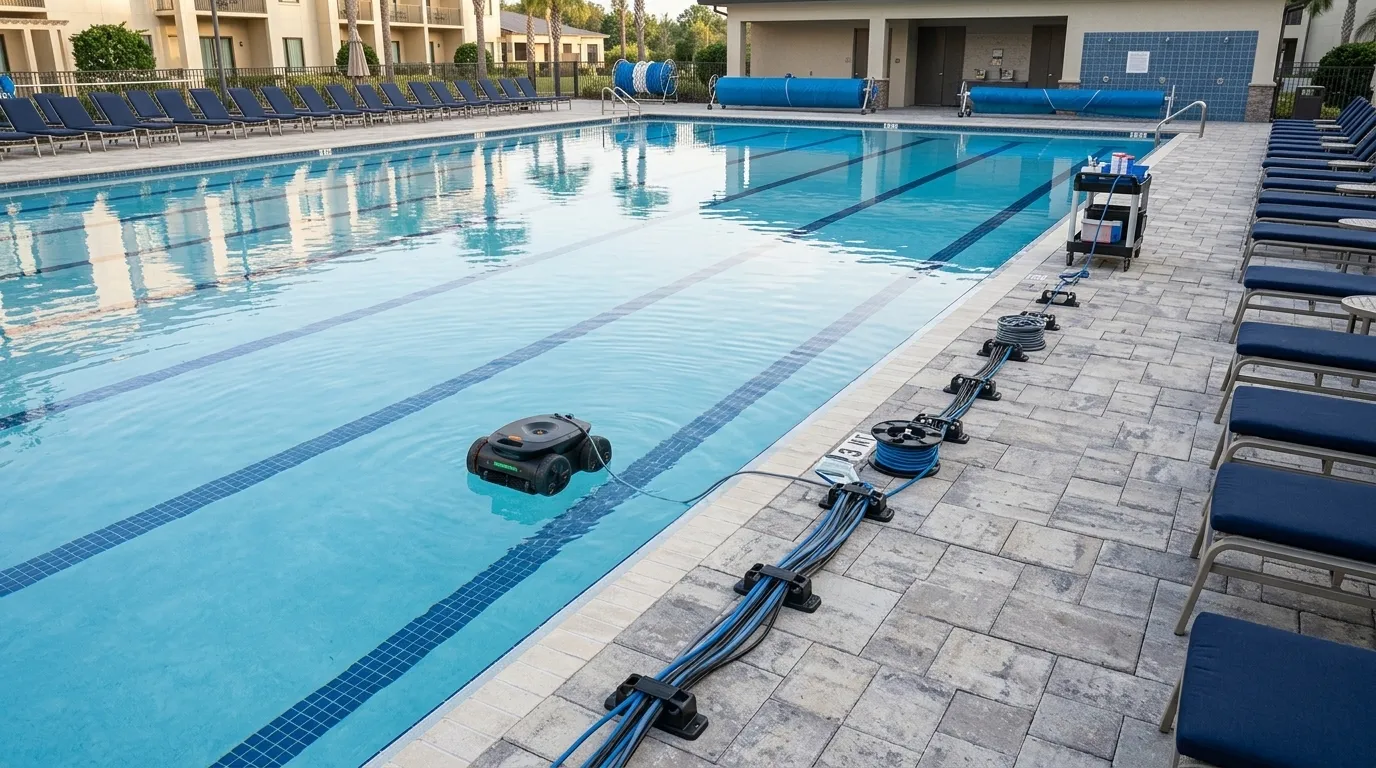
A corded pool cleaner draws power directly, so it can run a full cleaning cycle on a large commercial pool without worrying about a battery running out mid-session. For big lap pools or resort-style pools where a single cleaning pass can take well over an hour, this removes a real operational headache — no interrupted cycles, no needing to restart a robot that died halfway across the pool floor.
Lower Long-Term Operating Cost at Scale
Because a corded unit has no battery pack to degrade, it avoids one of the most common wear-and-tear costs in a cordless pool robot's lifespan. For a property running a robot daily or near-daily across a busy season, skipping periodic battery replacement across a fleet of units adds up to meaningful savings over several years, even though the corded units themselves may cost more upfront.
Simplified Fleet Maintenance
Maintenance crews servicing multiple properties benefit from consistency. A fleet of corded units all draw power the same way, all lack a battery to monitor for charge cycles or degradation, and all fail in more predictable, diagnosable ways. That consistency matters when the same technician is responsible for a wholesale buying guide's worth of equipment across many sites rather than one machine in one backyard.
The Cordless Case for Commercial Properties
Faster Redeployment Across Multiple Pools
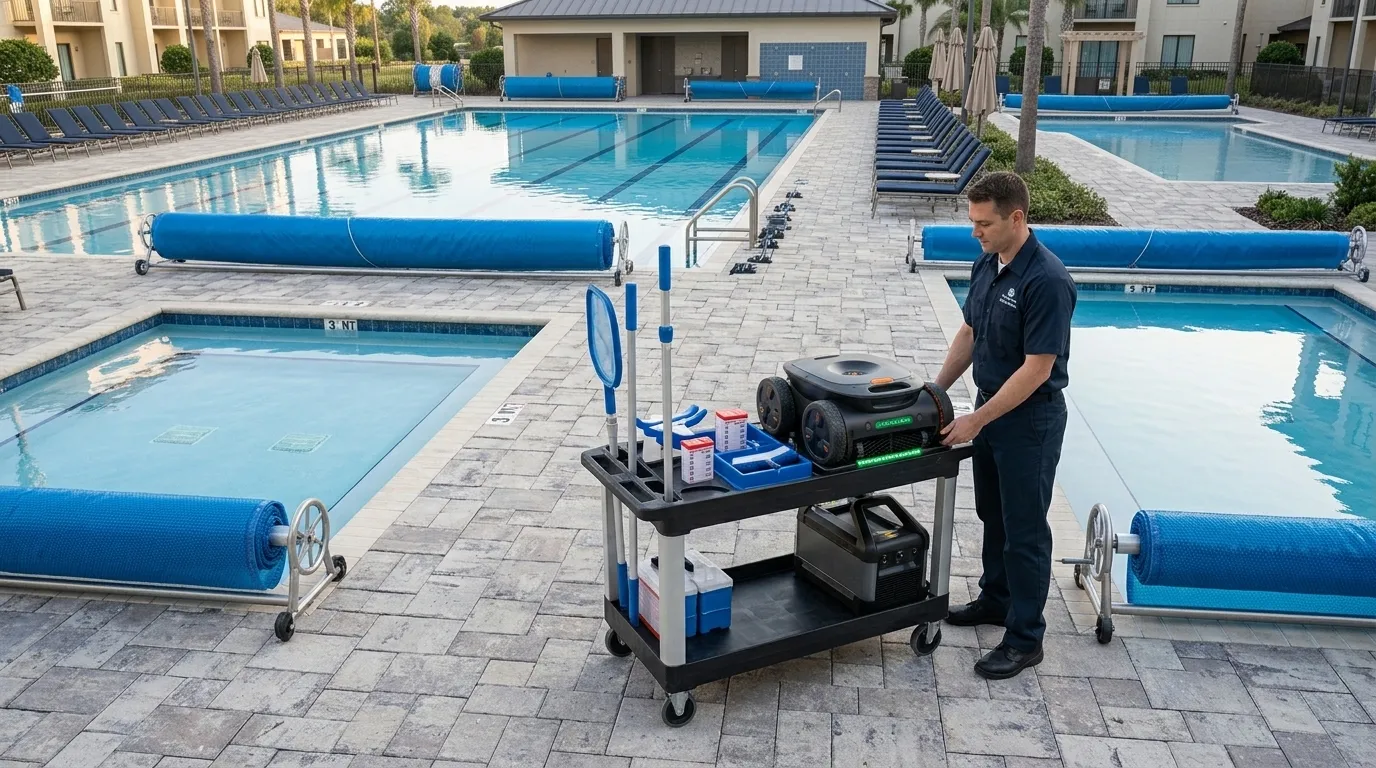
This is where cordless pool robots have a clear edge for multi-pool properties. A cordless unit can be pulled from one pool, moved to the next, and dropped in within minutes, with no cord to detach, coil, and re-run. For a property with three or four pools serviced back-to-back by the same crew, that time savings across dozens of cleaning cycles per week is significant.
No Cord Tangling or Trip Hazards in High-Traffic Areas
Hotels, apartment complexes, and HOA amenity areas all deal with heavier foot traffic around the pool deck than a private backyard. A power cord running from an outlet to the pool edge is a liability concern in a way it typically isn't for a homeowner — it's a trip hazard for guests and residents, and it has to be actively managed by staff during business hours. A cordless robot removes that risk entirely, which matters more for liability exposure than for convenience.
Easier Staff Training and Handling
Cordless units are generally simpler to hand to a rotating staff or a junior maintenance worker: there's no cord management, no worrying about outlet placement relative to the pool, and less that can go visibly wrong in front of guests or residents. For properties with staff turnover, this lowers the training burden for each new hire who ends up responsible for pool equipment.
Key Decision Factors for Property Managers
Number of Pools and Cleaning Frequency
A single large pool cleaned once a day favors corded, since runtime and power reliability matter more than portability. A property with several smaller pools cleaned in sequence by the same crew favors cordless, since redeployment speed compounds across every pool on the route.
Pool Size and Cord Reach Limitations
Cord length becomes a real constraint on oversized commercial pools or unusually shaped resort pools, where an outlet may be too far from parts of the pool for a corded unit to reach comfortably. Cordless units sidestep this, but their trade-off is battery runtime — for very large pools, confirm the unit's rated coverage area against your actual pool size before committing to a cordless fleet.
Staffing Model: In-House vs Contracted Cleaning Crews
Properties with in-house maintenance staff who are on-site daily can more easily manage the extra steps corded units require — running the cord, monitoring the cycle, coiling it back up. Properties relying on a contracted pool cleaning business that visits multiple client sites per day tend to benefit more from cordless units, since faster setup and teardown directly reduces billable time per stop.
Safety and Liability Considerations
Beyond the trip-hazard issue already mentioned, properties should confirm that any unit being used, corded or cordless, meets recognized robotic pool cleaner certifications for electrical safety around water. This matters more at commercial scale than for a single homeowner, since a safety incident at a shared amenity carries more liability exposure than one in a private backyard.
Total Cost of Ownership: Corded vs Cordless at Scale
For a single unit, the price difference between corded and cordless options is usually modest. At fleet scale, the math shifts. Cordless fleets carry ongoing battery replacement costs and, over several years, that per-unit cost multiplied across a dozen or more machines becomes a real budget line — though it's often offset by the labor hours saved from faster pool-to-pool redeployment. Corded fleets avoid the battery replacement cost but require more staff time per cleaning cycle to manage cords safely, and cord damage from repeated coiling and uncoiling is itself a recurring minor repair cost. Energy-efficient pool robots on either power type will also reduce electricity costs across a large property, which is worth factoring in alongside upfront and battery costs when comparing bids from different manufacturers or a wholesale buying guide for equipping multiple sites at once.
A Simple Decision Framework for Multi-Pool Operators
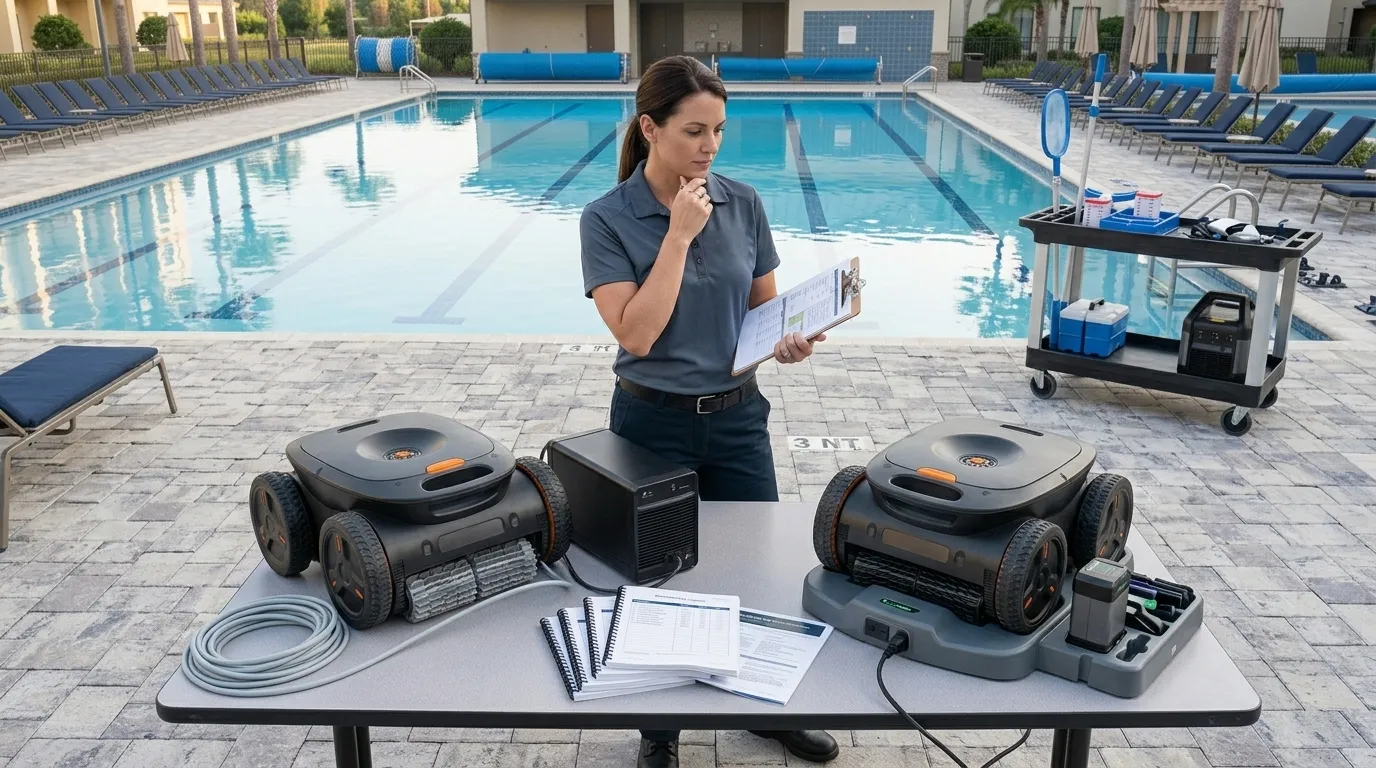
If your property has one or two large pools cleaned in place by on-site staff, lean corded — you get uninterrupted runtime and lower long-term battery costs, and the trip-hazard concern is manageable with a dedicated, less-trafficked cleaning window.
If your property has three or more pools, especially smaller ones serviced back-to-back by the same crew or contractor, lean cordless — the time saved on redeployment and the reduced liability exposure from cords in high-traffic areas usually outweighs the higher long-term battery cost.
If you're unsure, a mixed fleet is a reasonable middle ground: corded units for the largest, least-trafficked pools, cordless units for smaller amenity pools and high-traffic areas where speed and safety matter more than raw runtime.
Frequently Asked Questions
Q1: Can the same brand supply both corded and cordless models for a mixed fleet?
A: Most established manufacturers offer both power types across their lineup, which makes standardizing on one brand for a mixed fleet easier — you get consistent parts, consistent app or control systems, and one point of contact for support, even if individual units on-site differ between corded and cordless.
Q2: Do commercial pools require different certifications than residential pools for robotic cleaners?
A: Commercial and shared-use pools are often subject to stricter local or state electrical safety codes than private residential pools, so it's worth confirming that any unit you're deploying carries recognized robotic pool cleaner certifications and, if applicable, meets your jurisdiction's specific commercial pool equipment requirements before installation.
Q3: How many units should a multi-pool property keep on hand as backups?
A: A common approach is one spare unit for every four to six active pools, which covers routine downtime for charging, maintenance, or repair without leaving a pool uncleaned. Properties with tighter cleaning schedules or contracted service routes often keep a slightly higher spare ratio to avoid schedule disruptions.
Q5: Can robotic pool cleaners be used in saltwater or heavily chlorinated commercial pools without extra equipment?
A: Most modern robotic pool cleaners are built to handle both saltwater and standard chlorinated water without additional equipment, but it's worth confirming the specific model's water chemistry tolerance, since heavily chlorinated commercial pools can accelerate wear on seals and housings faster than a typical residential pool.
Q6: What's the typical lead time when ordering units in bulk for a new property?
A: Lead times vary by supplier and order size, but bulk orders through a manufacturer or distributor commonly take several weeks longer than a single retail purchase, especially for larger quantities or customized fleet configurations. Building in extra lead time is worth doing when opening a new property or property season.
Q7: Should property managers buy directly from a manufacturer or through a distributor?
A: Direct manufacturer purchasing tends to offer better per-unit pricing at higher volumes and more consistent access to replacement parts, while distributors can offer faster regional delivery and more flexible smaller-batch ordering. Which is better depends mostly on how many units you're purchasing and how quickly you need them on-site.
Conclusion
The corded-versus-cordless decision changes shape once you're managing more than one pool. Runtime, battery cost, and cord safety all carry more operational weight across a fleet than they do for a single backyard unit, and the right answer depends less on personal preference and more on pool count, staffing model, and how much liability a busy pool deck actually carries. For most multi-pool operators, that means matching the unit to the pool rather than standardizing on one power type across every site — corded where runtime and cost matter most, cordless where speed and safety around foot traffic matter most.