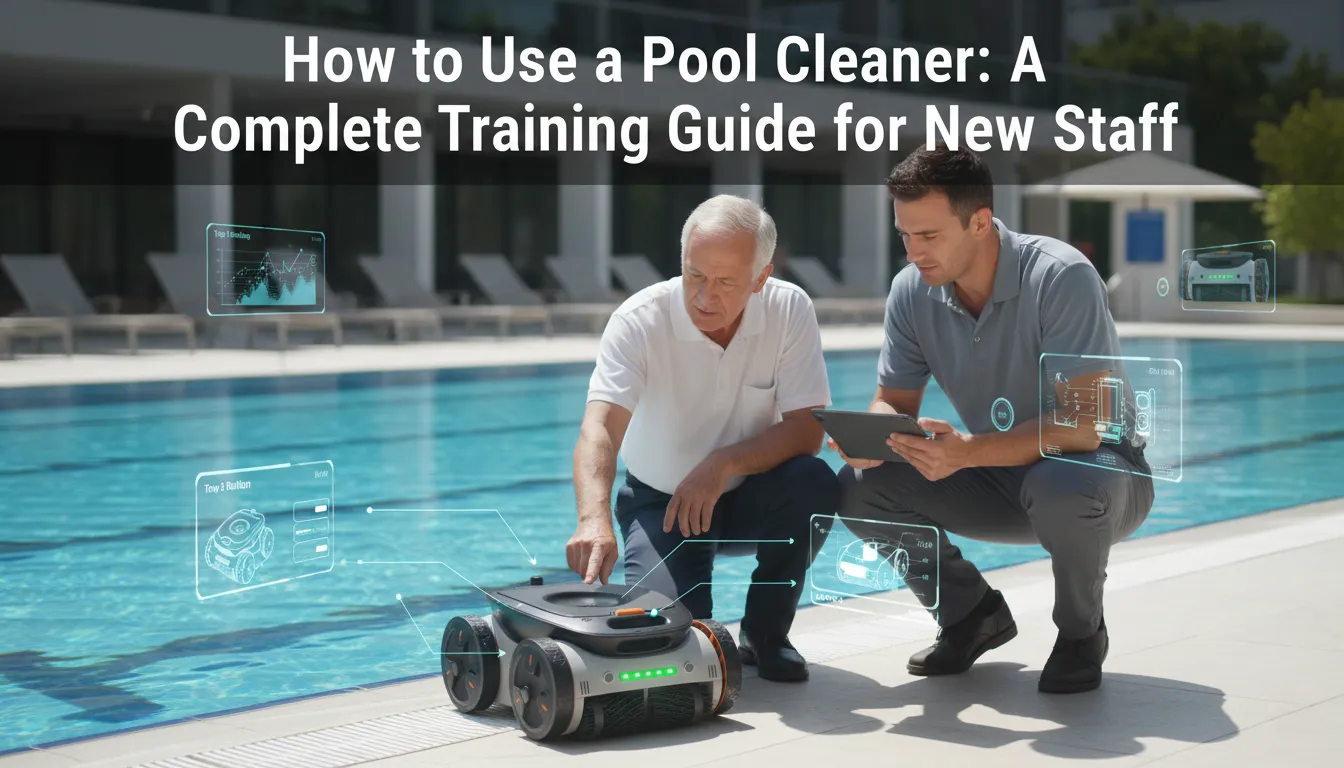
How to Use a Pool Cleaner: A Complete Training Guide for New Staff
pool cleaner training
commercial pool maintenance
robotic pool cleaner
Introduction:A Training Guide Your Staff Will Use Every Day
For pool service companies, hotels, property management teams, and commercial facility operators, one of the biggest operational challenges is training new employees. Many new staff members have experience with manual brushing or vacuuming, but have never used a robotic pool cleaner.
Inconsistent training leads to:
Incorrect cleaning routes
Damage to robots
Higher maintenance cost
Shortened equipment lifespan
Customer complaints due to incomplete cleaning
To help business owners standardize their training, this guide explains exactly how to use a pool cleaner, especially modern commercial robotic pool cleaners such as:
Hydro Puls-Smart
Hydro Pro-Smart
Hydro SP-Smart
Hydro S-Smart / SU-Smart
Hydro-Smart (Base Model)
Cordless Robotic Pool Skimmer
All explanations follow a B2B-friendly, step-by-step format suitable for onboarding new team members.
You may share or print this guide internally for staff training.
Chapter 1:Understanding the Types of Pool Cleaners
Before teaching a new employee how to use a pool cleaner, it’s important that they understand the three main categories.
1. Manual Cleaners (Least Efficient)
Includes nets, poles, brushes, and suction vacuums.
Labor-intensive
Takes 1–2 hours per pool
High inconsistency
Not scalable for service companies
2. Automatic Suction / Pressure Cleaners
Connected to the pool system.
Moderate cleaning ability
Cannot manage walls or deep corners
Requires pump running
3. Robotic Pool Cleaners (Best for Commercial Use)
These operate independently using motors, pumps, sensors, and AI navigation.
Fast cleaning
High debris collection
Precise coverage
Works during closed hours
Low labor cost
Purily’s commercial models add advantages such as:
AI Motion Control
Signal Buoy & Cleaning Buoy
AC/DC hybrid working mode
Deep pool compatibility
Long runtime batteries
For commercial pool operators, robots are now the standard, and training staff on proper operation ensures maximum ROI.
Chapter 2:Preparing the Pool Before Cleaning
Even the best robotic cleaner works better when the pool is prepared.
1. Remove large floating items
Leaves, plastic cups, large branches, or packaging.
(If not removed, they may clog the basket.)
2. Ensure water level is normal
Robots require a standard waterline for proper navigation.
3. Turn off swimmers, jets, fountains
This avoids interference and ensures optimal coverage.
4. Verify chemical levels (optional but recommended)
Robots perform best when sanitization level is balanced.
5. For Purily models with buoys
Ensure there is enough surface space for:
Signal Buoy (Hydro S-Smart, Puls-Smart)
Cleaning Buoy (Hydro Pro-Smart, SU-Smart, Puls-Smart)
These buoys improve navigation accuracy and deep-water stability.
Chapter 3:Step-by-Step: How to Use a Robotic Pool Cleaner
This is the main section for staff training.
Step 1:Check the Robot Before Use
Create a daily checklist:
Battery level (Cordless mode)
Power supply (AC/DC mode for Pro-Smart / Puls-Smart)
Cable condition (if applicable)
Filter basket emptiness
Propellers and brushes (not tangled)
Buoy light and wireless connection
Body condition (no cracks, no loose parts)
A well-maintained robot reduces breakdowns and increases lifespan.
Step 2:Choose Working Mode
For Purily Hybrid Models (Pro-Smart / SP-Smart / Puls-Smart)
Employees can choose:
✔ Cordless Mode
– Best for daily cleaning
– Free movement without cable
✔ AC/DC Mode
– Best for long continuous operation
– Ideal for pool service companies doing 6+ pools per day
Explain to staff:
Cordless for flexibility, AC/DC for endurance.
Step 3:Place the Robot into the Water
Teach new employees: Do NOT throw the robot.
Correct method:
Hold both sides of the handle
Place it gently into the water
Let it sink naturally
Allow air to escape (tilt slightly)
Confirm buoy is active (if available)
This protects the motor and sensors.
Step 4:Select or Start Cleaning Mode
Depending on the model:
Hydro S-Smart / SU-Smart:
AI full pool mode
Wall mode
Floor-only mode
Hydro SP-Smart / Pro-Smart / Puls-Smart:
AI Smart Full Coverage
Ultra Mode (for commercial deep cleaning)
Quick Mode (for daily hotel morning cleaning)
ECO Mode (water-saving facilities)
Staff should select the mode based on pool size and customer needs.
Step 5:Monitor the Robot (Optional for New Staff)
Once employees gain experience, they no longer need to stand by the pool.
But for new trainees:
Watch for stuck situations
Ensure buoy stays upright
Check that the robot climbs walls correctly
Confirm the cable (if any) stays untangled
Step 6:Remove the Robot After Cleaning
Correct method:
Bring the robot to waterline
Lift using handle—not the cable
Let it drain for 10–20 seconds
Place it on dry ground
This avoids damage and protects internal components.
Step 7:Clean the Filter Basket
One of the most critical training tasks.
Explain to staff:
The dirtier the basket, the lower the suction power.
Steps:
Open the top cover
Remove the debris basket
Wash with hose
Remove hair and leaves
Air dry before next use
For models like Hydro SU-Smart or Hydro Pro-Smart, the large basket allows longer operation with fewer cleanings—an important B2B advantage.
Step 8:Charge or Store the Robot
Cordless Mode:
Charge immediately after use
Avoid storing in low battery state
AC/DC Mode:
Disconnect cables
Store power box in dry environment
General Storage Rules:
Never leave wet
Avoid direct sunlight
Don’t store inside pool
Chapter 4:How to Use a Cordless Pool Skimmer (Surface Robot)
Purily’s Cordless Robotic Pool Skimmer is used differently from floor-cleaning robots.
Main Features to Highlight for Staff
Ultrasonic radar detection
Shallow-water bumper rods
UV-resistant body
Large debris basket
Screening surface leaves and insects
Operation Steps
Make sure the pool surface is free of large floating objects
Turn on the skimmer
Place it gently on the water
It will automatically navigate using ultrasonic sensors
Empty the debris basket every 1–2 hours
This robot is ideal for hotels or morning cleaning before guests arrive.
Chapter 5:Training Tips for Business Owners
1. Provide a Standard Operating Procedure (SOP)
We recommend you print this article as your SOP.
2. Train with real robots
Hands-on training is more effective.
3. Assign a “Robot Supervisor”
One experienced employee can maintain and manage 6–10 robots.
4. Track performance
Record:
Cleaning time
Filter cleaning frequency
Battery performance
Failure rate
5. Choose robots designed for commercial use
Consumer-grade robots break frequently and increase cost.
Purily’s Puls-Smart and Pro-Smart models are engineered for heavy, daily, professional work.
FAQ:Training & Operation Questions
1. How often should staff clean the filter basket?
Daily. For heavy leaf seasons, twice per day.
2. Can robots be used while swimmers are inside?
No. For safety reasons.
3. Which model is best for training new workers?
Hydro SP-Smart and Hydro Pro-Smart—simple controls + AI navigation.
4. Can robots replace manual cleaning completely?
No. Employees still need to manage water chemistry and remove oversized debris.
5. How long does training usually take?
1–2 hours is sufficient for basic operation.
6. How do I reduce robot downtime?
Always train staff to:
Clean baskets
Charge batteries
Avoid throwing the robot
Check buoys
Conclusion:A Trained Staff = A More Profitable Cleaning Business
Robotic pool cleaners are the future of commercial pool maintenance. But the key to maximizing ROI is proper staff training. With the right teaching material, new employees learn faster, make fewer mistakes, and keep your equipment in excellent working condition.
This guide gives your company:
A repeatable training process
Standardized instructions
Reduced risk of robot damage
Improved customer satisfaction
Extended robot lifespan
Commercial pool cleaning is becoming more competitive, and companies with trained staff and modern equipment—such as Purily’s Hydro Puls-Smart, Pro-Smart, and SP-Smart—are leading the market.