Pool Filter vs. Skimmer: How They Work, Key Differences, and Why You Need Both

A swimming pool depends on more than chemicals to stay clean. Water must also move through the circulation system, floating debris must be removed from the surface, and suspended particles must be captured before they continue circulating through the pool.
That is where the pool filter vs. skimmer question comes in.
Although they work together, a pool filter and a pool skimmer perform different jobs. A pool skimmer primarily collects surface water and floating debris, while the pool filter removes suspended particles from water moving through the circulation system. The pump connects these functions by moving water between the pool and the equipment.
In simple terms:
The skimmer collects from the surface. The filter cleans the circulating water. The pump keeps the entire system moving.
Neither component should normally be viewed as a replacement for the other. Understanding the difference helps pool owners troubleshoot circulation problems, choose maintenance equipment, and build a more efficient cleaning routine.

What Is the Difference Between a Pool Filter and a Skimmer?
The simplest way to distinguish the two is by looking at where they work and what they are designed to remove.
A pool skimmer is installed around the pool's upper wall, near the normal waterline. It draws surface water toward the circulation system and captures larger floating debris in a skimmer basket.
A pool filter is part of the equipment pad or filtration system. Water pushed through the filter passes through a filtering medium or element designed to remove suspended particles from the circulating water.
The pump provides the suction and pressure that move water through these components.
Feature | Pool Skimmer | Pool Filter |
|---|---|---|
Primary function | Surface water collection | Water filtration |
Main location | Pool wall near waterline | Equipment area |
Main target | Floating and larger debris | Suspended and finer particles |
Typical collection component | Skimmer basket | Filter media or cartridge |
Works with pool pump | Yes | Yes |
Handles leaves at surface | Yes | Not its primary function |
Handles settled pool-floor dirt | No | Not directly |
Removes suspended particles | Limited by basket function | Yes |
Requires routine maintenance | Yes | Yes |
Replaced by robotic cleaner? | No | No |
The distinction becomes even clearer when you follow the path of the water:
Pool → Skimmer → Pump → Filter → Treatment Equipment → Return Jets → Pool
The actual plumbing arrangement can vary between pool designs, but the basic relationship remains the same. Pentair describes the pump as the component that moves water through skimmers, filters, heaters, and other pool equipment, while its skimmer documentation explains that pump suction draws surface water and floating debris into the skimmer basket.
What Does a Pool Skimmer Do?
The primary pool skimmer function is surface debris removal and surface-water collection.
Because a swimming pool is open to the environment, leaves, insects, pollen, grass, dust, and other contaminants can land directly on the water. Some of this material stays at the surface long enough to be captured by the skimmer.
How Does a Pool Skimmer Work?
A typical skimmer has an opening positioned close to the waterline. When the pump is operating, suction draws water into that opening.
A floating skimmer weir helps control the movement of surface water into the skimmer. As the water moves inward, floating debris is carried along with it.
The larger material is then trapped in the skimmer basket.
Pentair's U-3 skimmer documentation describes this process directly: pump suction pulls water through the skimmer, floating leaves and similar debris enter the skimmer and are trapped in the basket, while smaller material such as dust and body oils continues through toward the pool filter. The same documentation notes that the floating weir enhances surface flow and skimming action.
This is the central idea behind pool skimming:
A skimmer is not the complete filtration system. It is the intake and surface-debris collection point that feeds the circulation system.
What Does a Pool Skimmer Remove?
A pool skimmer is best suited to material that is floating on or moving near the surface.
Typical examples include:
Leaves
Insects
Grass
Pollen
Hair
Small pieces of floating debris
Larger organic material
A skimmer is much less effective once material has settled on the pool floor.
This is an important reason not to treat a skimmer as a substitute for vacuuming, brushing, or robotic pool cleaning.
What Is a Skimmer Basket?
The pool skimmer basket sits inside the skimmer housing and collects larger debris.
Its job is partly preventive. By catching leaves and larger material before they move deeper into the circulation system, the basket helps reduce the amount of debris reaching the pump and filter.
A basket that is heavily loaded with debris can restrict normal flow. Pentair's maintenance materials emphasize routine inspection and cleaning of skimmer and pump baskets as part of maintaining proper equipment operation.
Why Is Surface Skimming Important?
Surface water is not just where leaves happen to float.
Surface contaminants can include oils, sunscreen residues, and other materials introduced by swimmers or the surrounding environment. CDC aquatic guidance emphasizes the importance of effective surface-water removal in skimmer-based circulation systems because pollutants can be concentrated near the water surface.
For that reason, effective skimming contributes to both cleaner-looking water and better overall circulation.

What Does a Pool Filter Do?
The main pool filter function is to remove suspended particles from the water that passes through the filtration system.
Unlike a skimmer basket, which mainly catches larger material, the filter is designed to clean the circulating water itself.
Pentair describes pool filters as a primary system for filtering debris from pool water and identifies three common filter technologies: diatomaceous earth (D.E.), cartridge, and sand filters. The basic concept is the same: the pump moves pool water through the filter, where the filtration medium or element captures particles before the water returns to the pool.
How Does a Pool Filter Work?
The exact mechanism depends on the filter type.
However, the basic sequence is:
Water is drawn from the pool through skimmers and other intake points.
The pump moves the water through the circulation system.
Water enters the filter.
The filter media or element captures suspended particles.
Cleaner water leaves the filter.
Water continues through treatment equipment and returns to the pool.
The filter therefore operates within the circulation loop.
It does not normally sit at the water surface like a skimmer.
What Does a Pool Filter Remove?
A pool filter is designed to capture particles that remain suspended in the water.
Depending on the filtration technology and system condition, this may include:
Fine dirt
Dust
Suspended debris
Organic particles
Small contaminants
Material that passes through the skimmer basket
The filter is not designed to physically scrub the pool floor or walls.
That distinction matters when diagnosing a pool that still has visible dirt despite apparently clean water.
A filter may be doing its job correctly while the pool floor still needs vacuuming or robotic cleaning.
What Are the Main Types of Pool Filters?
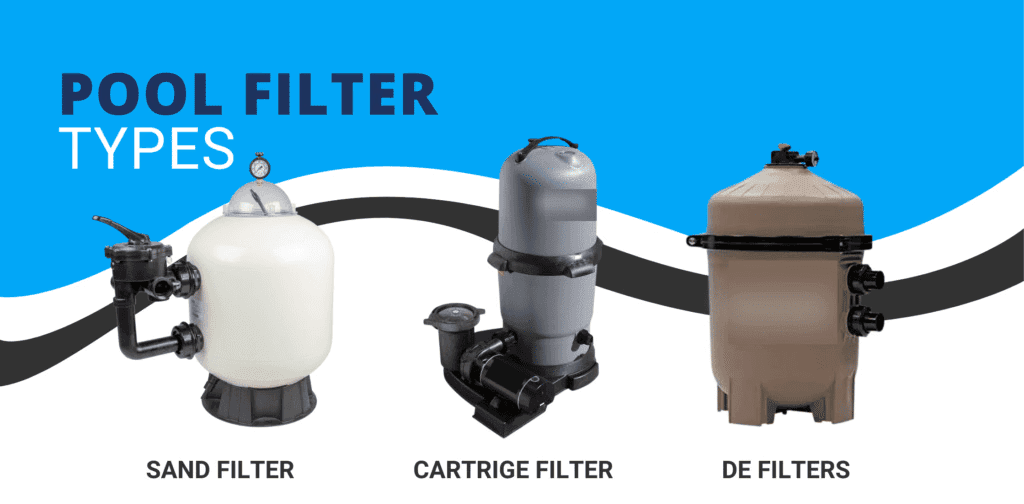
The three common pool filter technologies are cartridge, sand, and D.E. filters.
Each uses a different filtration medium or element, so maintenance procedures and operating characteristics differ.
Cartridge Pool Filters
A cartridge filter uses a removable filter cartridge or element to capture suspended particles.
One advantage is that cartridge filters do not normally require the backwashing process used by many sand and D.E. systems. Instead, the cartridge is removed and cleaned according to the equipment manufacturer's maintenance procedure.
Cartridge condition should be monitored rather than relying on an arbitrary calendar interval.
Sand Pool Filters
A sand filter uses specially selected filter media contained inside a filter tank.
Water passes through the media, and particles are retained within the filter bed.
When the filter requires cleaning, a compatible multiport or valve system can be used to backwash the filter according to the manufacturer's operating instructions.
D.E. Pool Filters
A diatomaceous earth filter uses D.E. media as the filtration material.
D.E. systems have specific operating and maintenance procedures, including pressure relief and appropriate handling of the filter media.
Because filter tanks can operate under pressure, owners should always follow the manufacturer's instructions when opening, cleaning, or servicing these systems.
Pentair's filter safety guidance explicitly instructs users to shut down the pump and relieve filter pressure before servicing pressure-containing filter equipment.
How Do a Pool Skimmer and Filter Work Together?
This is the most important part of the pool filter vs. skimmer comparison.
They are not two separate systems competing for the same function.
They are different stages of the same circulation process.
A simplified system looks like this:
1. The skimmer collects surface water.
Floating debris enters through the skimmer opening.
2. The skimmer basket catches larger debris.
Leaves and other larger material are held in the basket.
3. The pump moves the water.
Pump suction draws water from the skimmer and pushes it through the circulation equipment.
4. The filter captures suspended particles.
Material that passed through the skimmer basket can be removed by the filtration media or cartridge.
5. Treated water returns to the pool.
The return jets distribute water back into the swimming area.
This division of labor is why you normally need both.
The skimmer protects the circulation system from larger floating debris while directing surface water into the system. The filter then deals with suspended particles in the circulating water.
Pentair's pool-equipment overview describes this broader relationship between pump, skimmers, filter, heater, and chlorinator as an integrated circulation system.
Pool Filter vs. Skimmer: What Can Each One Clean?
One of the easiest ways to understand the difference is to compare cleaning targets.
Pool Condition or Debris | Skimmer | Pool Filter | Robotic Pool Cleaner |
|---|---|---|---|
Floating leaves | ✓ | Not primary | Not primary |
Floating insects | ✓ | Not primary | No |
Pollen at surface | ✓ | ✓ if suspended | No |
Suspended fine dirt | Limited | ✓ | Limited |
Dirt on pool floor | No | No | ✓ |
Debris on walls | No | No | Depending on model |
Waterline deposits | No | No | Depending on model |
Water circulation | ✓ | ✓ | No |
Surface-water intake | ✓ | No | No |
Water filtration | No | ✓ | No |
Physical surface cleaning | No | No | Depending on model |
This table highlights a critical point:
There is no single component responsible for all pool-cleaning tasks.
The skimmer, filter, pump, and physical cleaning equipment each address different parts of the problem.
Do You Need Both a Pool Skimmer and a Pool Filter?
For a conventional residential pool circulation system, the answer is generally yes.
A skimmer and filter solve different problems.
Removing the skimmer would mean losing the normal mechanism for drawing and capturing surface water and larger floating debris at the pool wall.
Removing the filter would mean losing the dedicated filtration stage that removes suspended particles from circulating water.
A pool can potentially have different hydraulic designs or specialized circulation systems, so equipment should always be evaluated as a complete system rather than by assuming one configuration applies to every pool.
But for a conventional skimmer-based pool, replacing one component with the other is not a practical solution.
Can a Pool Skimmer Replace a Pool Filter?
No.
The skimmer basket is not designed to perform the same filtration function as a pool filter.
It catches larger debris but does not provide the same type of particulate filtration as a sand, cartridge, or D.E. filter.
If a pool owner notices that large debris is being removed but the water remains cloudy, the problem may involve filtration, circulation, chemistry, or several factors at once.
Can a Pool Filter Replace a Pool Skimmer?
Generally, no.
A filter can capture suspended particles, but it does not replace the surface-water collection function of a pool skimmer.
Leaves, insects, and other floating debris can remain at the water surface even when the filter itself is functioning correctly.
This is why the two components should be viewed as complementary.
Pool Skimmer vs. Pool Filter vs. Robotic Pool Cleaner
For PURILY, this is an important distinction because many pool owners use all three concepts when thinking about maintaining a swimming pool.
Pool Skimmer
The skimmer primarily handles:
Surface water + floating debris
It is part of the hydraulic circulation system.
Pool Filter
The filter primarily handles:
Circulating water + suspended particles
It is responsible for mechanical filtration.
Robotic Pool Cleaner
A robotic pool cleaner primarily handles:
Physical cleaning of submerged pool surfaces
Depending on its design and cleaning cycle, a robotic cleaner may clean the pool floor, walls, and waterline and collect debris into its internal filter basket.
This makes robotic cleaning complementary to both skimming and filtration.
A useful way to think about the three systems is:
Skimmer = surface collection
Filter = water filtration
Robotic cleaner = physical surface cleaning
A robotic pool cleaner should therefore not be presented as a replacement for the pool's hydraulic skimming or filtration equipment.
Instead, it can reduce the manual work associated with maintaining the surfaces that the circulation system does not physically scrub.
Can a Robotic Pool Cleaner Replace a Skimmer?
Usually, no.
A robotic cleaner and a skimmer operate differently.
The robotic cleaner travels through the pool and physically collects debris. The skimmer remains integrated into the pool's plumbing system and draws surface water toward the filter.
Even a highly capable pool-cleaning robot does not normally replace the hydraulic role of the skimmer.
This is particularly important because the skimmer continues to process surface water while the robotic cleaner is not operating.
Can a Robotic Pool Cleaner Replace a Pool Filter?
No.
A robotic cleaner typically collects debris inside its own filter basket or filtration compartment, but that does not make it a substitute for the pool's circulation filtration system.
The pool filter processes water that is continuously circulated through the equipment system.
A robotic cleaner is instead an additional physical cleaning layer.
For a homeowner trying to reduce maintenance time, this distinction is useful: automation can reduce manual vacuuming and brushing without eliminating the need to maintain the pump, skimmer, filter, and water chemistry.
Pool Skimmer and Filter Maintenance: What Should You Check?
A well-designed pool system can still perform poorly if the basic components are neglected.
Pool Skimmer Maintenance
Regularly inspect:
Skimmer basket
Skimmer weir
Skimmer lid
Skimmer opening
Water level
Visible suction behavior
Visible damage
If the basket becomes packed with leaves and debris, empty it rather than allowing the restriction to continue.
The CDC Model Aquatic Health Code specifies that skimmer water levels should remain near the middle of the openings in skimmer systems, that skimmer flow should maintain effective surface skimming, that baskets should be cleaned as needed, and that weirs should remain in place and operational. These provisions apply to aquatic facilities and local codes may impose different requirements on residential pools, so homeowners should follow the requirements applicable to their pool.
Pool Filter Maintenance
Filter maintenance depends on the filter technology.
Check:
Filter pressure
Water flow
Filter condition
Cartridge condition, where applicable
Sand or D.E. media condition
Manufacturer-recommended cleaning intervals
Signs of leaks or abnormal operation
Do not open a pressurized filter tank while the system is under pressure.
Pentair's filter safety documentation repeatedly emphasizes shutting down the pump and relieving pressure before opening or servicing the filter.
Why Is My Pool Skimmer Not Working?
A skimmer that appears to have weak suction does not necessarily have a damaged skimmer body.
The problem may be elsewhere in the circulation system.
Check these items first:
Water level: Low water can interfere with skimmer operation.
Skimmer basket: A blocked basket restricts flow.
Pump basket: Debris in the pump basket can reduce flow.
Filter: A dirty filter can affect circulation.
Valves: Incorrect valve positions can alter flow between suction points.
Weir: A damaged or stuck weir can interfere with surface skimming.
Suction line: A blockage or other hydraulic problem can reduce suction.
Pump: Air entering the system, loss of prime, or other pump problems can affect water movement.
Pentair's equipment troubleshooting guidance lists low water level, debris in skimmer or pump baskets, a clogged impeller, suction leaks, incorrect valve positions, and a dirty filter among possible causes of inadequate water flow.
The practical lesson is important:
Do not replace the skimmer simply because the skimmer seems weak. Diagnose the entire water-flow path first.
Why Is My Pool Filter Not Cleaning the Water?
If the water remains cloudy or dirty even though the pump and filter are running, several factors should be considered.
The Filter May Need Cleaning
As filtration media or a cartridge loads with debris, hydraulic resistance can change.
Follow the filter manufacturer's cleaning procedure and monitor the pressure gauge where applicable.
The Skimmer May Be Restricted
A blocked skimmer basket can reduce the volume of water reaching the circulation system.
Check the intake side before assuming the filter itself has failed.
The Pool May Have a Water-Chemistry Problem
Mechanical filtration is only one part of maintaining pool water.
The CDC identifies chlorine and pH as key defenses against germs in residential pools and recommends maintaining pool pH between 7.0 and 7.8 while regularly testing chlorine and pH.
This does not mean a filter can correct poor chemistry. It means physical filtration and chemical treatment have different roles.
The Circulation System May Not Be Moving Enough Water
A pump problem, air leak, valve position, plumbing restriction, or other hydraulic issue can prevent the filter from receiving water at the expected rate.
That is why troubleshooting should start with the complete system rather than focusing on a single component.

Common Mistakes When Maintaining a Pool Filter and Skimmer
Even a good filtration system can underperform when basic maintenance is overlooked.
Avoid these mistakes:
Letting the skimmer basket become completely full
Running the pool with an excessively low water level
Ignoring a damaged skimmer weir
Assuming a clear filter means the entire pool is clean
Treating the skimmer basket as the main pool filter
Using the pool filter to solve dirt that has settled on the pool floor
Ignoring abnormal pressure or flow readings
Opening a pressurized filter without properly shutting down and relieving pressure
Replacing equipment without checking the complete hydraulic system
Assuming a robotic pool cleaner eliminates the need for filtration
The most common maintenance mistakes come from confusing different functions.
Once you understand what each component is designed to do, troubleshooting becomes much more logical.
How to Improve Your Pool Cleaning System
A more efficient pool maintenance strategy is usually based on division of labor, not on finding one device that does everything.
Use the Skimmer for Surface Debris
Keep the skimmer basket clear and allow the circulation system to collect floating material.
Maintain the Filter for Water Clarity
Monitor filter condition and follow the correct cleaning procedure for cartridge, sand, or D.E. systems.
Maintain the Pump and Circulation System
The pump connects the skimmer, filter, and other equipment.
If flow is poor, investigate the hydraulic system rather than looking only at the cleaning equipment.
Use a Robotic Pool Cleaner for Physical Cleaning
A robotic cleaner can take over much of the repetitive work associated with collecting debris from the pool floor and, depending on the model, walls and waterline.
This can be especially useful for pools that collect significant amounts of dirt or require frequent physical cleaning.
Keep Water Chemistry Separate From Mechanical Cleaning
A clean pool is not simply a pool with no visible leaves.
Water chemistry, filtration, circulation, and physical cleaning all need to work together.
The CDC recommends regular testing and adjustment of chlorine and pH for residential pools and notes that pH outside the recommended range can affect both disinfection performance and equipment conditions.
A Simple Pool Maintenance Workflow
For most pool owners, the following sequence is a practical way to diagnose and maintain the system:
Check the water level.
Inspect and empty the skimmer basket.
Check the pump basket for debris.
Observe water flow through the circulation system.
Check filter pressure or filter condition according to the equipment design.
Clean or service the filter when required by the manufacturer's instructions.
Check the pool's water chemistry.
Remove debris from pool surfaces with brushing, vacuuming, or a robotic pool cleaner.
Inspect equipment for leaks, unusual noise, or abnormal flow.
Arrange professional service when the problem involves pressurized equipment, electrical components, underground plumbing, or a condition that cannot be safely diagnosed.
This workflow works because it follows the actual logic of the pool system rather than treating every cleaning problem as a filter problem.
What Should You Know Before Replacing a Pool Filter or Skimmer?
Replacing either component requires more than matching the physical size.
Before selecting replacement equipment, consider:
Existing plumbing configuration
Flow requirements
Connection size
Pool size and hydraulic design
Filter type
Manufacturer specifications
Available replacement parts
Installation requirements
Maintenance requirements
Local code requirements
For a skimmer, check the opening dimensions, housing configuration, plumbing ports, basket, weir, and connection arrangement.
For a filter, check the filtration technology, flow requirements, operating pressure, tank dimensions, connection configuration, and manufacturer's service requirements.
When in doubt, use the original equipment documentation rather than guessing from appearance.
Residential Pool vs. Commercial Pool Considerations
The basic principles of pool filter vs. skimmer remain the same, but maintenance requirements can be different depending on the application.
A residential pool may be operated by the homeowner, with maintenance scheduled according to personal use and environmental conditions.
Commercial and public pools are subject to applicable health codes and operational requirements. The CDC recommends that public-pool operators maintain filtration and recirculation systems according to manufacturer recommendations and follow state and local requirements.
The CDC Model Aquatic Health Code also contains more detailed provisions governing skimmer flow, water levels, baskets, weirs, circulation, and filtration for aquatic facilities.
Therefore, public-pool requirements should not simply be copied into a residential pool maintenance schedule.
Frequently Asked Questions
What is the difference between a pool filter and a skimmer?
A pool skimmer collects surface water and floating debris, while a pool filter removes suspended particles from water circulating through the filtration system. They perform different but complementary functions.
What does a pool skimmer do?
A pool skimmer draws surface water into the circulation system and captures larger floating debris in its basket. Leaves, insects, pollen, and similar material are common examples.
What does a pool filter do?
A pool filter removes suspended particles from circulating pool water. Common filtration technologies include cartridge, sand, and diatomaceous earth filters.
Do you need both a pool skimmer and a filter?
For a conventional residential pool circulation system, both are normally needed because they perform different jobs. The skimmer collects surface water and larger debris, while the filter handles suspended particles in the circulating water.
Can a pool skimmer replace a filter?
No. A skimmer basket is designed primarily for larger debris collection and does not perform the same filtration function as a cartridge, sand, or D.E. filter.
Can a pool filter replace a skimmer?
Generally, no. A filter does not replace the skimmer's role in collecting surface water and floating debris.
How does a pool skimmer work with a pool filter?
The pump draws water through the skimmer. Larger debris is captured by the skimmer basket, while the water continues through the circulation system to the pool filter, where suspended particles are removed.
Does a pool skimmer filter the water?
A skimmer basket provides a basic form of debris screening, but it is not the same as the main pool filtration system. Fine or suspended particles that pass through the basket are normally handled by the pool filter.
Does a pool filter remove leaves?
A pool filter may capture smaller particles, but leaves are primarily handled by the skimmer basket or other physical cleaning equipment. Large leaves should not be treated as the pool filter's main cleaning load.
Can a robotic pool cleaner replace a pool skimmer?
Normally, no. A robotic pool cleaner physically travels through the pool to collect debris, while a skimmer is part of the pool's hydraulic circulation system and continuously collects surface water when operating.
Can a robotic pool cleaner replace a pool filter?
No. A robotic cleaner's internal filter basket is part of the cleaner itself and does not replace the pool's circulation filtration system.
Why is my pool skimmer not suctioning?
Possible causes include low water level, a full skimmer basket, a blocked pump basket, incorrect valve settings, a dirty filter, air entering the system, or a restriction in the suction line. Check the full circulation path before replacing the skimmer.
Why is my pool filter not cleaning the water?
Possible causes include a dirty or improperly serviced filter, inadequate circulation, restricted suction, incorrect water chemistry, or a problem elsewhere in the pool system. Mechanical filtration is only one part of pool water maintenance.
How often should I clean my pool filter?
The correct interval depends on the filter technology, operating conditions, debris load, pressure readings, and manufacturer instructions. Follow the specific maintenance procedure for your cartridge, sand, or D.E. filter rather than using one universal schedule.
How often should I clean my pool skimmer basket?
Inspect the basket regularly and empty it whenever debris accumulates enough to restrict normal flow. Pools surrounded by trees or exposed to heavy debris may require much more frequent cleaning.
Conclusion
The pool filter vs. skimmer comparison becomes much easier once you look at their actual functions.
A pool skimmer is primarily responsible for collecting surface water and floating debris. Its weir and basket help remove leaves, insects, pollen, and other larger material before that debris travels deeper into the circulation system.
A pool filter performs a different job. It processes circulating water and removes suspended particles through a cartridge, sand, D.E., or other filtration medium.
The pump connects the two.
Skimmer → Pump → Filter → Treatment → Return
Then there is another layer: the robotic pool cleaner. Rather than replacing the skimmer or filter, a robotic cleaner can complement them by physically removing dirt and debris from submerged pool surfaces, depending on its capabilities.
That is the more useful way to think about pool maintenance. Instead of asking which component should do everything, ask what each component is designed to accomplish.
For a well-maintained pool, surface skimming, mechanical filtration, water circulation, water chemistry, and physical surface cleaning should work together.
Keep Your Pool Cleaning System Working as a System
PURILY focuses on automated pool cleaning solutions designed to make routine physical pool maintenance easier. A robotic pool cleaner can complement your existing skimmer and filtration system, helping reduce the manual effort required to keep pool surfaces clean.
When selecting or upgrading pool-cleaning equipment, look at the entire system—not just one component. The right combination of skimming, filtration, circulation, and automated cleaning can make everyday pool maintenance more consistent and manageable.