How to Vet a Pool Robot Factory: 12 Checks Before Deposit
Factory
Quality Control
OEM

Introduction
Most buyers vet a factory after something goes wrong. At that point the deposit is gone, the moulds are cut, and the only leverage left is a lawyer in a jurisdiction you have never visited.
The deposit is the real decision point. Before it, you can walk away at zero cost. After it, every conversation about defects, delays and certification is a negotiation rather than a choice.
This guide is a working checklist rather than a pitch. Each of the twelve checks below answers three questions: what to look at, how to look at it, and what a bad answer looks like. Where a supplier can fake something, the fake is described too, because the fakes are the reason the check exists.
It is written for distributors, private-label brands and regional agents placing a first or second order — the stage where a wrong factory costs a season rather than an afternoon.
One assumption runs through all of it: you are buying a machine that goes into water with a lithium battery inside it. That combination makes a handful of checks non-negotiable, and they are not the checks most buyers spend their time on.
Why the Deposit Is the Moment That Matters
A pool robot order has an unusual cost structure. Tooling, certification and the first production run are all paid before you have a single unit in hand, and the amortisation only works if the factory delivers a machine that does not come back.
That means the useful question is not "can they build a sample" — almost any factory can build one good sample. It is "can they build the thousandth unit the same way", which is a question about process control, not about sample quality.
Everything in this checklist is aimed at that second question.
Four Checks You Can Do Without Leaving Your Desk
1. Business Licence, Export Rights and Customs Registration
Ask for the business licence and check four things: the registered name matches the name on the quotation, the registered capital is plausible for the equipment claimed, the business scope includes manufacturing (生产) rather than only trading (贸易), and the licence is not about to expire.
Then ask for the customs registration number and the exporter code. A factory that has never exported will not have them, which is fine — but it changes who handles the paperwork and who is liable when the container is held.
Common fake: a licence belonging to an affiliated trading company, presented as the factory. The tell is the address — compare it with the address on the quotation and with the location shown in any video call.
2. Certification: Verify the Number, Not the PDF
Certificate PDFs are easy to edit and the copies you are sent are usually the ones that were edited. Never accept a PDF as evidence; take the certificate number and look it up on the issuing body's own database — UL Product iQ, the TÜV SÜD certificate search, the FCC ID database, SGS's verification portal.
Check three fields while you are there: the applicant name (should be the factory, not a customer), the model designation (should match the model you are ordering), and the scope (a certificate for a power supply is not a certificate for a pool robot).
This is where most first orders go wrong: the supplier genuinely has certification, but it covers a component or an older model. The certification scope for pool robots is usually narrower than the sales deck implies.
3. Battery Cells and UN38.3
A pool robot is a lithium battery in a waterproof box. Ask which cell manufacturer supplies the pack, what the cycle-life claim is based on, and whether the pack has a UN38.3 test summary.
UN38.3 is a transport requirement, not a quality certificate, but the test summary (often called the TS document) names the cell model and the pack configuration. If the factory cannot produce one that matches the pack they are shipping, the goods are not legally air-freightable and may be refused by the carrier.
Common fake: a UN38.3 report for a single cell presented as if it covers a finished pack. Those are different tests, and the freight forwarder will notice.
4. Audit Reports and Customer References
Third-party audit reports (BSCI, Sedex, ISO 9001 surveillance) are useful mainly because they are hard to fake convincingly — the auditing body can confirm the report number. Ask for the report number and the audit date, then check whether the scope covers the product line you are buying.
Customer references are weaker evidence, but two questions make them useful: which markets do those customers sell into, and can you speak to one buyer who has taken more than three containers.
The supplier landscape is uneven enough that a shortlist built on these four checks will already exclude most of the risk. A comparison of pool robot manufacturers is only useful after you know what you are comparing.

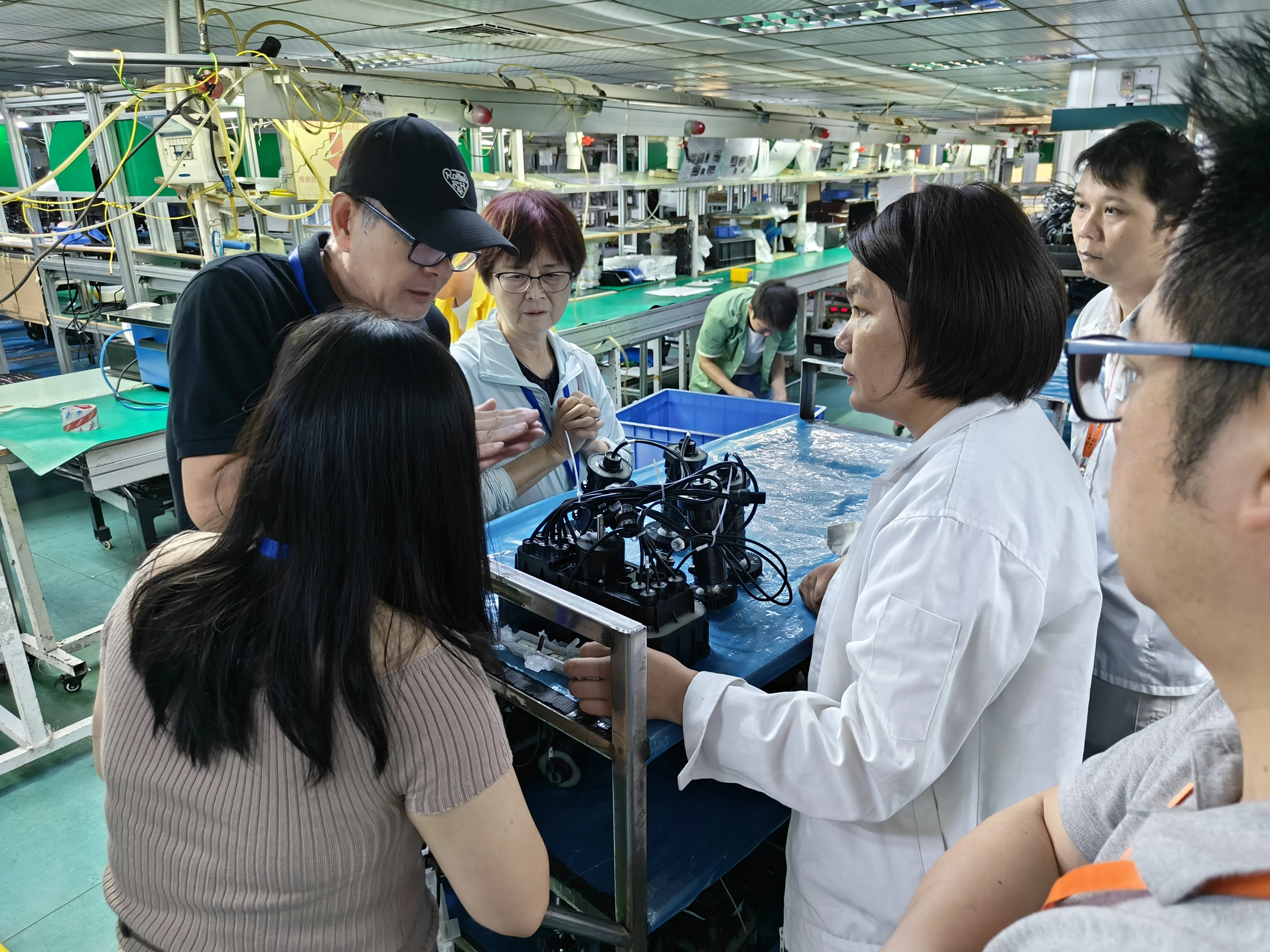
Four Checks That Require the Building
5. What Is Actually Made In-House
Ask which processes happen under that roof: injection moulding, SMT for the control board, final assembly, waterproof sealing, packaging. The answer defines the failure modes you inherit.
A factory that moulds its own shells controls wall thickness and sealing tolerances. A factory that buys shells controls neither, and every leak becomes a dispute about whose fault it is.
Walk the line and count. One injection machine and a shared SMT line is a different supplier from eight machines and two lines. Photograph the nameplate on each machine — model and tonnage — and compare with what was claimed.
Common fake: a "factory tour" that visits a partner's plant. The tell is that nobody on the floor knows the product name, and the machines are running someone else's mould.
Where the tooling sits also decides who owns it. Automatic pool cleaner manufacturers that mould in-house can usually tell you the mould number and the cavitation without checking with anyone.
6. Ageing Test: Hours, Logs, Serial Numbers
Ask how long each unit runs before packing, and ask to see the log. A credible answer is a burn-in of 24 to 72 hours with a record per serial number: start time, end time, result, operator.
Then ask what happens to a unit that fails. If the answer is "we fix it and ship it", ask whether the fix is recorded against the serial number. A factory with a real ageing process can answer that without leaving the room.
Common fake: an ageing room that is switched off during your visit, or racks of units with no labels. Both mean the process exists for photographs rather than for production.
Battery behaviour is the usual reason ageing matters. Cordless pool cleaner manufacturers who skip burn-in tend to discover cell imbalance at the customer's pool rather than at the factory.
7. IPX8: The Tank Test Nobody Films
IPX8 is not a single fixed test. IEC 60529 leaves the depth and duration to the manufacturer to declare, so "IPX8" on a datasheet tells you almost nothing until you ask: at what depth, for how long, on how many units, and at what point in production.
Ask to see the tank. A factory claiming a 3 m rating needs a tank deeper than 3 m, or a pressure vessel. If the deepest water on site is a 1.2 m test tank, the rating is a calculation, not a test.
Then ask how the test is sampled: one unit per batch, one per shift, or one during certification and never again. The last is the most common answer and the least useful.
Common fake: a tank test video showing a unit submerged for a few seconds with no pressure and no timer. Ask for the test report with date, depth, duration and unit serial.
8. In-House Lab or Borrowed Equipment
A real lab is recognisable: environmental chamber, salt spray or at least a humidity cabinet, a pressure or depth rig, a battery cycler, a torque and pull tester. Ask who runs it and whether the calibration certificates are current.
If the answer is "we send everything to a third-party lab", that is not disqualifying — it is actually a cleaner answer than a lab nobody uses. What matters is frequency and whether the reports are per batch or per model.
Common fake: a lab room with equipment still in its shipping crates, or an environmental chamber used as storage. Look for wear on the handles and a logbook on the wall.
Four Checks That Live in the Process
9. IQC Records
Incoming quality control is where a robotic cleaner is quietly won or lost: shells, motors, pumps, seals, cells, boards. Ask to see the last three months of IQC records for the pump motor and the shell, and ask what the rejection rate was.
A factory with real IQC knows its rejection rates by component and can show a trend. A factory without it will show you a sample inspection report dated the week you asked.
10. AQL Sampling and Defect Classification
Ask which AQL standard is used (ISO 2859-1 is the common one), what the inspection levels are, and how critical, major and minor defects are defined for this product.
A credible answer names numbers: for example critical 0, major 1.0, minor 2.5, general inspection level II. A weak answer is "we check everything", which is not a sampling plan and usually means nobody checked.
Get the sampling plan written into the purchase order, alongside the MOQ and price breaks. The MOQ and wholesale terms are the only place where an inspection standard has any force.
11. Spare Parts Stock
Ask what percentage of one order's value they recommend holding as spare parts, and what the lead time is for the three most-replaced components: pump motor, brush set and battery pack.
Then ask whether the spares are from the same production batch as the machines. Spares from a different batch can fail differently, which makes warranty analysis meaningless.
This is where the total cost of ownership hides. A cheap machine with a 12-week motor lead time costs more than an expensive one with spares on the shelf, and the cost math behind robot lifespan is mostly a spares-availability calculation.
12. Real Export Markets
Ask which countries they shipped to in the last twelve months, in what volumes, and whether any of those shipments were rejected at customs. Then ask for a redacted bill of lading or a customs declaration — not to see the customer, but to see the destination port and the HS code.
A factory that has shipped to Germany has solved CE and packaging waste; one that has shipped to the US has solved FCC and, if relevant, UL. A factory whose only export experience is a single container to a trading company has solved neither.
Market mix matters for product spec too. Pool vacuum robot market trends differ enough between the US, EU and Middle East that a spec tuned for one market underperforms in another.
The Questions to Ask on the Floor
These are the questions that separate a factory from a trading company in about ten minutes. Ask them in the building, not by email, and watch who answers.
Question | A good answer sounds like | Red flag |
|---|---|---|
Which machine moulds the shell, and what is the cavitation? | A machine number, tonnage and cavity count, without asking anyone | "We cooperate with a moulding partner" and no name |
How long is the burn-in, and where is the log? | 24–72 hours, per-serial log, a named operator | "Every unit is tested" with no record |
What depth and duration is the IPX8 rating based on? | A number in metres, a duration, and a tank you can walk to | "IPX8" repeated without numbers |
Who supplies the cells, and can I see the UN38.3 summary for this pack? | A cell brand and a document matching the pack | A cell-level report offered as a pack report |
What is your IQC rejection rate on the pump motor? | A percentage and a trend | "No defects" |
Which markets did you ship to last year? | Countries, volumes, a bill of lading | "All over the world" |
Why a Video Tour Is Not an Audit
A video call shows you what someone decided to point a phone at. It cannot show you the IQC records from March, the rejection trend, or the serial-numbered burn-in log — and those are the three things that predict whether the second container matches the first.
Video is still useful for one thing: confirming the address and the size of the building. Ask the person to walk to the loading bay and show you the street sign. It is a small test, but trading companies fail it.
If you cannot visit, the practical substitute is a third-party inspection with a defined checklist — not a general "factory audit", but a document review of the twelve items above, with photographs of the logs and the nameplates.
The Three Things Buyers Most Often Miss
After the obvious checks, three items account for most of the surprises in the first year.
The first is the sealing process rather than the seal. Ask how the housing is closed — ultrasonic welding, adhesive, gasket with defined torque — and what the rework procedure is when a unit fails the tank test. Factories that rework by hand often rework without a second test.
The second is the software. Ask who wrote the navigation firmware, whether it is shared with other brands, and how an OTA update is issued and rolled back. A white-label robot with a bug in its path planning is a warranty problem you cannot fix locally.
The third is training. A distributor who cannot train the end customer ends up running the after-sales desk for free. Ask what commercial pool cleaner training the factory provides, in what language, and whether it covers diagnosis as well as operation.
Frequently Asked Questions
How long should a factory vetting take?
For a first order, two to four weeks is realistic: one week for document checks, one for a sample and its test data, and one to two for a visit or a third-party inspection. Compressing it below two weeks usually means skipping the document review, which is where most of the risk sits.
Do I need to visit the factory in person?
Not always. A third-party inspection with a specific checklist covers most of it, but nothing replaces walking the line once if the order is large enough to justify the trip. If you cannot visit, insist on documents per batch rather than per model.
Is a trading company always a bad choice?
No. A good trading company with a long relationship with two factories can be more reliable than a marginal factory, and it will handle export paperwork better. The risk is that you lose visibility of process control, so the checklist shifts towards audit reports and batch records.
What deposit terms are normal?
Thirty percent deposit and seventy percent before shipment is common. For a first order, tie the balance to an inspection report rather than to a shipping date, and keep the mould ownership clause in writing if you pay for tooling.
Which certification matters most for a first order?
It depends on the destination market: FCC for the US, CE for the EU, and a safety mark such as cTUVus or UL for retail channels that require it. Verify the certificate number on the issuer's site rather than trusting the PDF.
How do I check that the IPX8 rating is real?
Ask for the depth, the duration, the number of units tested and the production stage at which testing happens. Then ask to see the tank. A rating without those four answers is a marketing claim.
What should be in the first inspection report?
Nameplates on the main machines, the burn-in log with serial numbers, three months of IQC records, the AQL plan in writing, the IPX8 test report, and photographs of the spare-parts shelf. Anything that cannot be photographed probably does not exist.
When should I walk away?
When the name on the certificate does not match the name on the quotation, when the burn-in log cannot be produced, or when the answer to a simple process question changes between two people on the same visit.
Conclusion: Vet the Process, Not the Sample
A sample proves that one machine can be built well. A process proves that the next thousand will be. The twelve checks above are all attempts to see process, because that is the only thing that survives contact with production.
If you take one thing from this guide, make it the document-per-batch habit: burn-in logs, IQC records, tank reports and AQL plans, each tied to a batch rather than a model. Suppliers who can produce these are usually the ones who do not need to be chased.
PURILY manufactures robotic pool cleaners for distributors and private-label brands, including commercial configurations such as the Hydro Pro commercial pool cleaning robot. Factory documentation, test records and certification scopes are available on request for buyers evaluating a first order.