How Does a Robotic Pool Cleaner Work? A Complete Guide to the Technology Inside
Introduction
Cleaning a swimming pool is more complicated than simply removing leaves from the water. Dust settles on the bottom, algae and dirt can accumulate along the walls, and debris may remain at the waterline or float on the surface. Traditional cleaning methods can handle these tasks, but they often require manual labor, external pumps, or a combination of different tools.
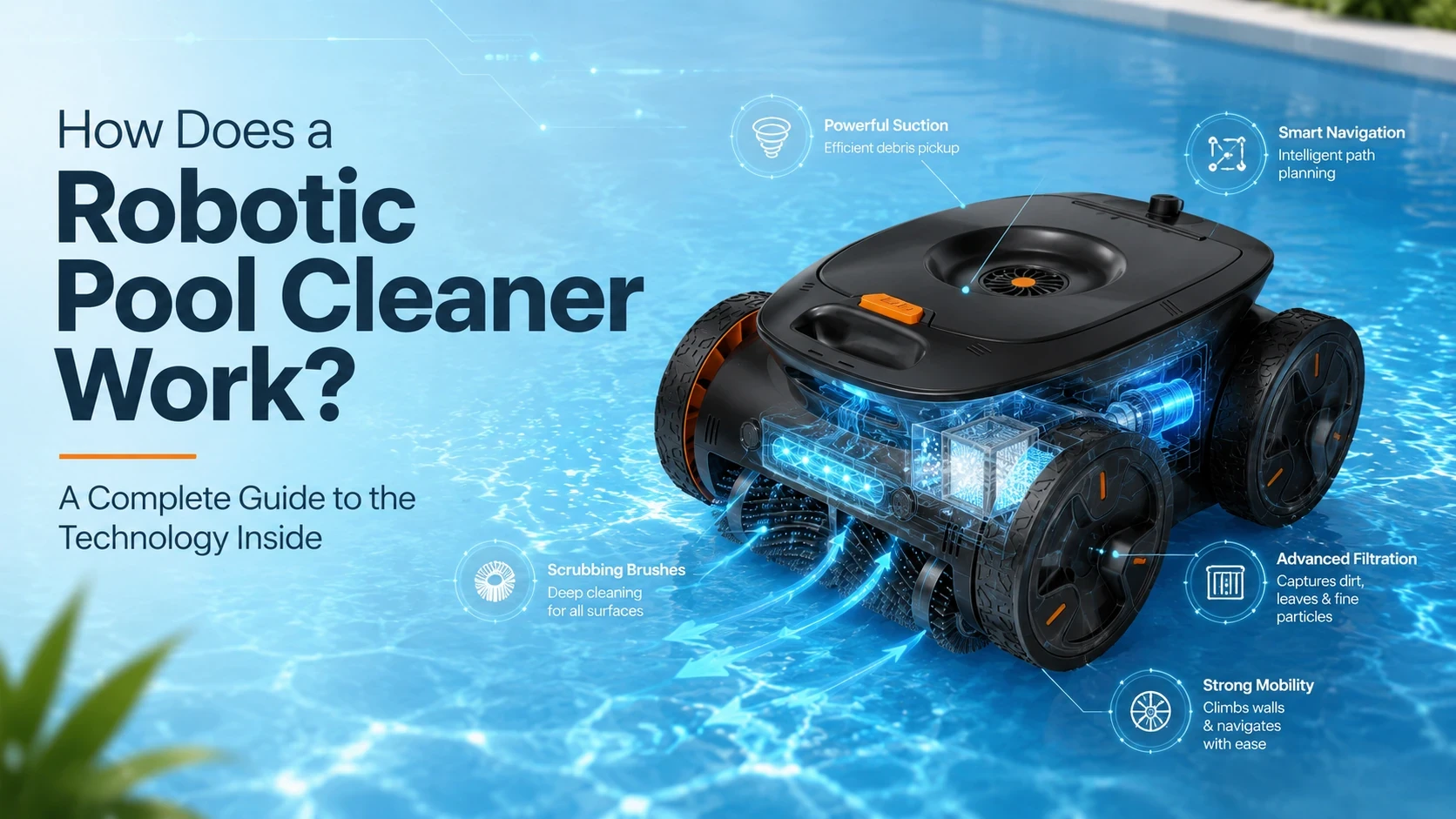
A robotic pool cleaner approaches the problem differently. Instead of relying entirely on the pool's circulation system, it uses its own motors, brushes, suction system, navigation technology, and power supply to move through the pool and collect debris. Some advanced systems can also combine an underwater cleaning robot with a floating cleaning buoy to cover different areas of the pool.
So, how does a robotic pool cleaner actually work? The answer depends on how several systems work together: underwater sensing, movement and traction, cleaning brushes, debris collection, filtration, and power management. Understanding these systems also helps pool owners, distributors, and equipment buyers evaluate whether a robotic cleaner is suitable for a particular pool.
What Is a Robotic Pool Cleaner?
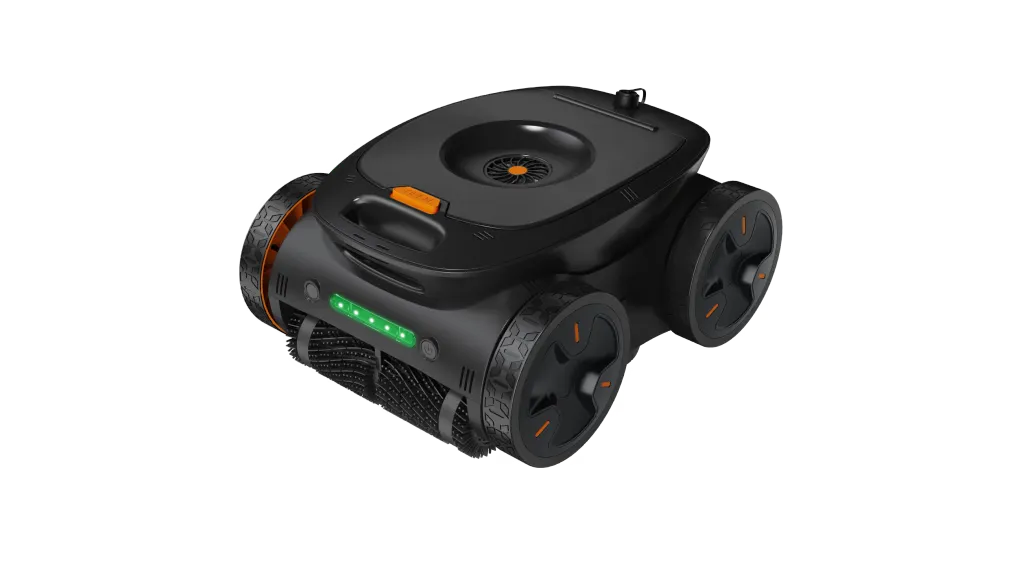
A robotic pool cleaner is a self-powered cleaning device designed to operate inside a swimming pool. Unlike a traditional suction cleaner, it does not simply depend on the pool's main circulation pump to move water and collect debris. The robot carries its own drive system and cleaning mechanism, allowing it to move independently across the pool surface.
The basic principle is straightforward: the robot moves across the pool, brushes dirt from the surface, draws debris into its collection system, and filters the water before releasing it back into the pool.
The engineering challenge lies in making this process work reliably in an underwater environment.
A pool is not a flat, predictable surface. A cleaner may need to move across the floor, change direction, approach a wall, climb a vertical surface, and continue cleaning along the waterline. Different pool surfaces also create different levels of traction. A robot that moves well on a flat concrete floor may require a different level of grip when climbing a smooth tiled wall.
This is why a modern robotic pool cleaner is more than a motorized brush. It is an integrated system that combines movement, sensing, cleaning, filtration, and power management.
For example, PURILY's Hydro product line includes different configurations designed around these requirements, including cordless models, corded and cordless systems, and products equipped with additional cleaning accessories such as floating cleaning buoys. This allows the technology to be adapted to different pool sizes, cleaning requirements, and operating conditions.
The Main Systems Inside a Robotic Pool Cleaner
Although the design varies between products, most advanced robotic pool cleaners rely on several key systems.
The drive system provides the force required to move the robot across the pool. In models using four-wheel drive, independently driven wheels can help the cleaner turn and maneuver more effectively, including turning within a limited area.
The cleaning system uses brushes to loosen dirt and debris from the pool surface. This is particularly important for particles that are attached to the floor or walls rather than simply floating freely in the water.
The suction and filtration system then collects the loosened debris. Larger debris, such as leaves, and smaller particles, such as dust and sand, place different demands on the collection and filtration system.
Finally, the navigation and control system determines how the robot moves through the pool. More advanced systems can use ultrasonic sensing and path-planning technology to organize the cleaning route instead of relying only on random movement.
The basic working process can therefore be understood as: Detect the environment → Plan movement → Drive across the surface → Brush and collect debris → Filter the water
The effectiveness of the robot depends on how well these stages work together.
How Does a Robotic Pool Cleaner Navigate Underwater?
One of the most important differences between a basic pool cleaner and a more advanced robotic system is how the robot determines where it is and where it should move next.
A random-moving cleaner may change direction whenever it reaches a wall or obstacle. This approach can eventually cover part of the pool, but it does not provide the same level of control over the cleaning route. The robot may pass over the same area multiple times while leaving other areas untouched for longer periods.
For a large pool, this can make cleaning efficiency difficult to predict.
Ultrasonic Sensing for Underwater Navigation
Underwater navigation presents a unique challenge. The robot cannot rely on ordinary visual conditions in the same way a land-based robot can. Water clarity, reflections, pool surfaces, and changing underwater conditions can all affect how the environment is detected.
This is where ultrasonic sensing can be used.
PURILY describes its pool cleaning robots as using self-developed ultrasonic sensors for underwater navigation. The system is designed to help the robot obtain information about its surroundings and support more precise movement through the pool.
The purpose is not simply to detect an obstacle after the robot has already hit it. More accurate environmental sensing can help the cleaner identify the surrounding pool structure and make its movement more systematic.
This becomes especially important when the robot transitions between different areas of the pool.
A pool floor requires one type of movement. A wall requires another. When the robot approaches the edge of the pool, it must be able to change its direction and, in suitable models, maintain contact with the vertical surface.
Systematic Cleaning Paths Instead of Purely Random Movement
Navigation is also closely connected to cleaning efficiency.
PURILY describes S-shaped path planning for pool floors and N-shaped path planning for walls. These routes are designed around the different geometries of horizontal and vertical pool surfaces.
On the pool floor, an S-shaped route allows the robot to move across the cleaning area in a systematic pattern. Rather than repeatedly changing direction without a clear route, the cleaner can work through sections of the pool in an organized manner.
Wall cleaning presents a different problem. The robot must maintain contact with a vertical surface while moving upward, downward, or across the wall. An N-shaped path can provide a structured route for covering the wall area.
The importance of this technology is easy to understand when compared with random movement. A random path may still clean a pool, but the user has less control over where the robot has already been and how efficiently the available cleaning time is being used.
For robotic pool cleaners, navigation is therefore not an isolated feature. It directly affects cleaning coverage, movement efficiency, battery usage, and the time required to complete a cleaning cycle.
Navigation determines where the robot should go, but movement determines whether it can actually get there.
A robotic pool cleaner may need to travel across smooth tiles, textured concrete, vinyl surfaces, or other pool finishes. These surfaces do not provide the same level of traction. The challenge becomes even greater when the robot moves from the pool floor to a vertical wall.
Four-Wheel Drive and Surface Traction
Four-wheel drive can provide a more stable way for a robotic pool cleaner to move across the pool.
In a four-wheel-drive system, the wheels can generate traction across the pool surface while also helping the robot change direction. Some advanced designs allow the robot to turn within a limited area rather than requiring a wide turning radius.
This is particularly useful in pools with narrow sections or complex shapes.
For wall cleaning, traction becomes even more important. The robot must maintain sufficient contact with the surface while its brushes continue to work against the wall. If the drive system loses grip, the robot may slide down instead of continuing its cleaning path.
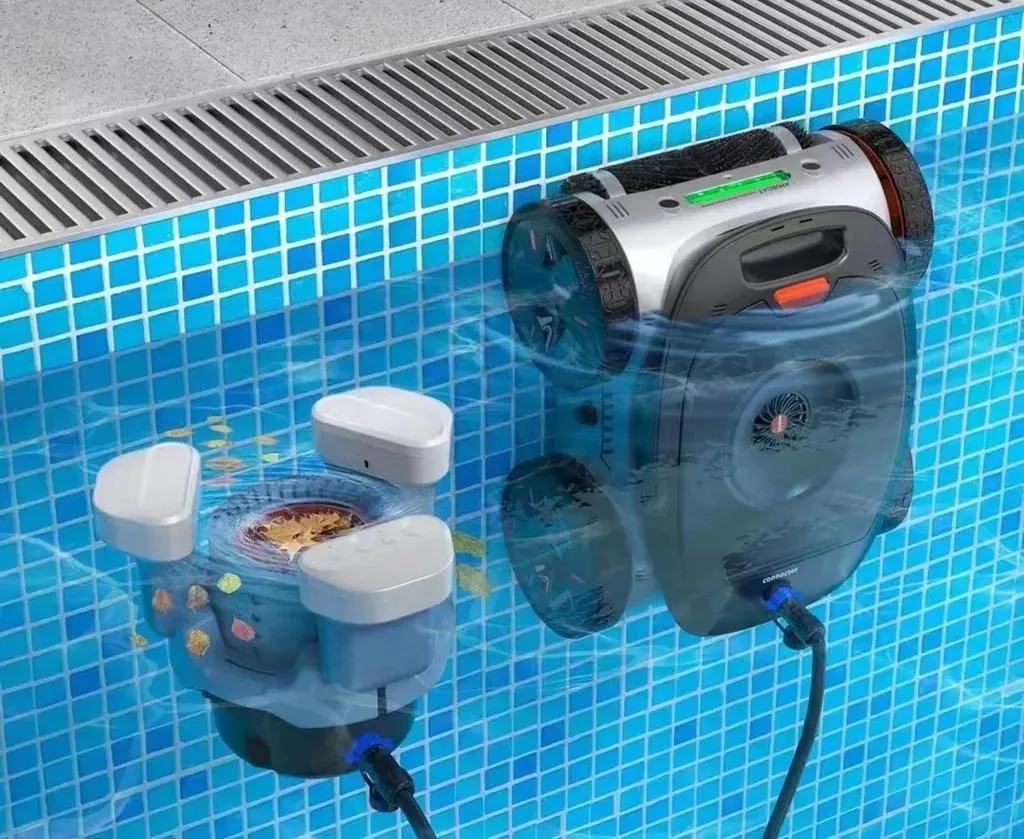
PURILY's Hydro series uses four-wheel drive technology as part of its movement system, supporting floor cleaning as well as wall and waterline cleaning in applicable models.
The key point is that wall cleaning is not simply a matter of adding more motor power. The drive system, wheel design, surface contact, and overall weight distribution all affect whether the robot can maintain stable movement.
How Does a Robotic Pool Cleaner Remove Dirt and Debris?
Once the robot reaches the cleaning area, it needs to perform two different tasks.
First, it must remove dirt from the surface.
Second, it must collect that dirt before it spreads back into the surrounding water.
This is why robotic pool cleaners generally combine brushes with a suction and filtration system.
Brushing and Debris Collection
Pool dirt does not always remain loose on the surface. Fine particles can settle into small surface textures, while algae and other contaminants may adhere to the pool floor or walls.
A brush helps loosen this material as the robot moves.
The loosened debris is then drawn into the robot's intake system. The effectiveness of the cleaning process depends not only on the strength of the suction motor, but also on the design of the intake and filtration system.
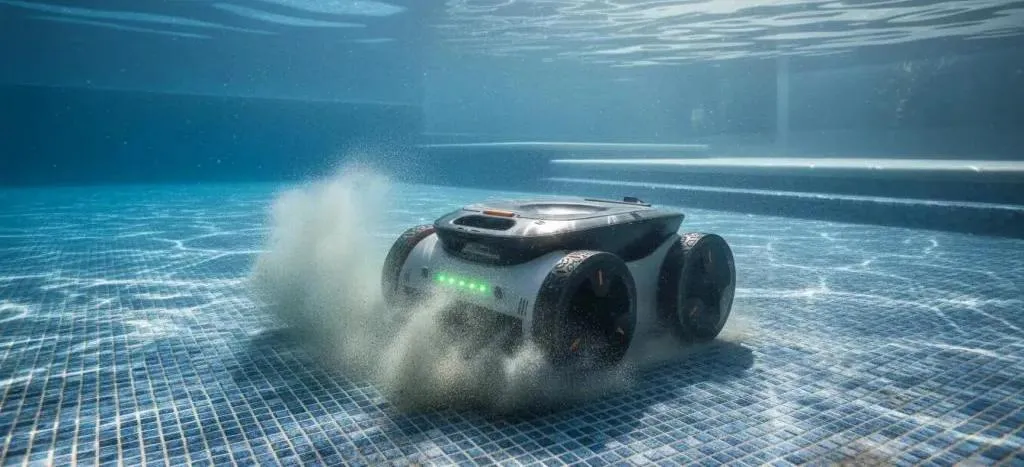
PURILY describes its robotic pool cleaning systems as using a dual-intake design to improve debris collection and help reduce the disturbance of dust and sand during underwater cleaning.
This is an important distinction between simply moving water and actually collecting debris. A cleaner may have strong water flow, but if particles are not captured effectively, they can simply become suspended in the pool again.
Why Filtration Matters
The debris found in a pool can vary considerably in size.
Leaves and larger particles require a collection system capable of handling bulky debris. Fine dust and sand, on the other hand, require filtration that can retain smaller particles.
For this reason, advanced robotic pool cleaners may use multiple filtration stages or dual-filtration systems to handle different types of debris.
The filtration system also affects how often the cleaner needs to be emptied and maintained. For pool owners and commercial operators, this is a practical consideration that can influence the overall convenience of the cleaning process.
Why Do Some Robotic Pool Cleaners Use Both Cordless and Corded Power?
Power supply is another major design decision in robotic pool cleaning.
Cordless robots provide freedom of movement, while corded systems can operate for longer periods without depending entirely on battery capacity. Each approach solves a different problem.
Cordless Operation
A battery-powered robotic pool cleaner does not require a power cable to be dragged across the pool during cleaning.
This makes setup simpler and gives the robot greater freedom to move. For regular residential pool cleaning, cordless operation can be particularly convenient.
However, battery capacity places a practical limit on operating time. The larger the pool or the longer the cleaning cycle, the more important runtime becomes.
Corded Operation for Extended Cleaning
A corded power system can provide continuous operation for applications where the cleaning session needs to last longer than a single battery cycle.
This can be useful for larger residential pools, commercial pools, or operators who need to complete extended cleaning cycles without stopping to recharge the robot.
The trade-off is that the cable must be managed during operation. Cable design and anti-tangling features therefore become important parts of the overall system.
Combining Both Power Options
Some modern robotic pool cleaners combine cordless and corded operation to provide greater flexibility.
PURILY's Hydro Pro, for example, is designed with both cordless and AC/DC power options. This allows users to select battery operation when mobility is the priority and connected power when longer operating time is more important.
For distributors and OEM/ODM buyers, this type of dual-power architecture can also expand the potential application range of the product. A single platform can be positioned for users who prioritize convenience as well as users who require longer continuous cleaning sessions.
Why Is a Floating Cleaning Buoy Used with an Underwater Robot?
A conventional underwater robotic cleaner and a floating cleaning system do not solve exactly the same problem.
The underwater robot is designed to move through the pool and clean submerged surfaces. However, debris can also accumulate on the surface of the water.
Leaves, insects, and other floating contaminants may remain outside the cleaning path of an underwater robot.
This is where a floating cleaning buoy can extend the cleaning system.
Underwater Cleaning and Surface Cleaning
PURILY's cleaning buoy is designed to work at the water surface, while the robotic cleaner operates underwater. The two systems address different areas of the pool rather than attempting to perform the same task.
The concept is relatively straightforward. While the underwater robot focuses on cleaning submerged surfaces such as the pool floor, walls, and waterline, the floating cleaning buoy is designed to handle debris that remains on the water's surface. By combining the two, the cleaning system can cover different areas of the pool and address different types of debris more effectively than a single underwater robot operating alone.
This approach provides a broader cleaning strategy than relying on a single underwater device.
For larger pools, hospitality facilities, and commercial applications, this type of system can be particularly relevant because different types of debris may accumulate in different parts of the pool.
How Are Robotic Pool Cleaners Controlled?
Modern robotic pool cleaners may provide several ways for users to control and monitor operation.
Depending on the product configuration, control options can include physical buttons, remote controls, Bluetooth connectivity, Wi-Fi connectivity, and mobile applications.
These functions are useful for more than simply starting and stopping the robot.
Users may be able to select cleaning modes, control the robot manually, or adjust operation without physically entering the pool area.
PURILY's product and technology systems include Wi-Fi and Bluetooth connectivity, together with app-based control options on applicable models.
For a consumer, this can make everyday operation more convenient. For distributors and OEM/ODM buyers, connectivity can also become part of the product's broader user experience and brand ecosystem.
How Should You Choose a Robotic Pool Cleaner?
The right robotic pool cleaner depends on the pool and the intended cleaning requirements.
For a small residential pool, a cordless model may provide the simplest operating experience. For larger pools or longer cleaning cycles, a system with extended runtime or AC/DC power may be more suitable.
The pool surface also matters. If wall and waterline cleaning are required, the robot must have sufficient traction and a drive system designed for vertical movement.
Buyers should also consider the type of debris commonly found in the pool. A pool surrounded by trees may require stronger large-debris collection, while a pool exposed to dust or fine particles may place greater demands on filtration.
For distributors and OEM/ODM buyers, the evaluation process is broader. In addition to cleaning performance, factors such as product configuration, connectivity, power options, customization capabilities, certifications, spare parts, and after-sales support may influence the suitability of a robotic pool cleaner for a particular market.
Frequently Asked Questions
Q: How does a robotic pool cleaner know where to move?
A: Different robotic pool cleaners use different navigation technologies. Advanced systems may use sensors and motion-detection technologies to identify the surrounding pool environment and support systematic cleaning paths.
Q: Can a robotic pool cleaner clean walls?
A: Some robotic pool cleaners are designed to clean pool walls and waterlines. Their ability to do this depends on the drive system, surface traction, and product design.
Q: Why is four-wheel drive useful in a pool cleaning robot?
A: Four-wheel drive can improve traction and maneuverability. It may help the robot move more effectively across the pool floor, change direction, and maintain contact with surfaces during wall cleaning.
Q: Is a cordless pool cleaner better than a corded model?
A: Neither option is universally better. Cordless models provide greater freedom of movement, while corded systems can provide longer continuous operation. Dual-power models combine both options for greater flexibility.
Q: What is the purpose of a cleaning buoy?
A: A cleaning buoy is designed to address floating debris at the surface of the pool. When used with an underwater robotic cleaner, it can help cover different areas of the pool at the same time.
Conclusion
A robotic pool cleaner is the result of several systems working together. Navigation technology determines how the robot moves through the pool, the drive system provides traction, brushes loosen debris, suction collects it, and filtration separates particles from the water.
More advanced systems can also combine different power options and extend cleaning coverage with floating cleaning devices.
For pool owners, the right choice depends on the pool's size, surface, debris, and cleaning requirements. For distributors and OEM/ODM buyers, the evaluation also includes product configuration, technology, customization, and long-term support.
Understanding how these systems work makes it easier to compare robotic pool cleaners based on their actual capabilities rather than relying on a single feature or marketing term.
For businesses looking for robotic pool cleaning solutions, PURILY provides pool cleaning robot products and OEM/ODM cooperation options for different market requirements.