How to Raise Pool Alkalinity with Baking Soda: Dosage Guide | PURILY

If your pool’s total alkalinity is too low, baking soda—sodium bicarbonate—is one of the standard ways to raise it.
The most useful dosing rule is simple:
About 1.4 lb (635 g) of sodium bicarbonate per 10,000 gallons of pool water raises total alkalinity by approximately 10 ppm.
That figure comes directly from CDC Model Aquatic Health Code guidance.
So if a 10,000-gallon pool has a total alkalinity of 60 ppm and you want to reach 90 ppm, you need an increase of 30 ppm. The estimated amount of baking soda would be approximately:
1.4 lb × 3 = 4.2 lb
But before pouring 4.2 pounds into the pool, there are a few things worth understanding. The correct dose depends on the actual water volume and how far you need to move the alkalinity, and large corrections are better approached carefully rather than by guessing.
This guide explains exactly how to calculate the amount, add baking soda correctly, retest the water, and avoid common alkalinity mistakes.
Quick Answer: How Do You Raise Alkalinity in a Pool?
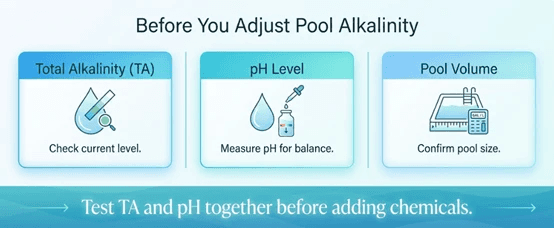
Test your pool’s total alkalinity and pH first. If alkalinity is below your desired range, calculate the required amount of sodium bicarbonate based on pool volume and the number of ppm you need to increase.
A commonly used residential target for total alkalinity is approximately 80–120 ppm, although the best operating target can vary with sanitizer type and the way an individual pool’s pH behaves. Leslie’s likewise uses 80–120 ppm as its recommended range for general pool alkalinity management.
For dosing, use this reference:
Pool Volume | Baking Soda for +10 ppm TA |
|---|---|
5,000 gal | 0.7 lb |
10,000 gal | 1.4 lb |
15,000 gal | 2.1 lb |
20,000 gal | 2.8 lb |
25,000 gal | 3.5 lb |
30,000 gal | 4.2 lb |
These are calculated from the CDC benchmark of approximately 1.4 lb per 10,000 gallons for a 10 ppm increase.
If you're unsure of the pool volume, calculate that first. An inaccurate gallon estimate means an inaccurate chemical dose.
PURILY Pool Volume Calculator →
What Is Total Alkalinity in a Pool?
Total alkalinity, usually abbreviated as TA, measures the water’s ability to neutralize acid and resist rapid changes in pH.
It is not the same as pH.
A useful way to think about the difference is:
pH tells you where the water is now. Alkalinity tells you how resistant that pH is to change.
When total alkalinity becomes too low, the pool has less buffering capacity. That means relatively small additions of acid, chlorine products, rainwater, or other substances can result in larger-than-expected pH movement.
CDC guidance specifically notes that when total alkalinity is too low, pH can change rapidly when chemicals or impurities enter the water, potentially contributing to corrosive conditions.
That is why alkalinity is not just another number to check—it helps make the rest of the pool chemistry easier to control.
What Is the Ideal Total Alkalinity Level?
For many residential pools, 80–120 ppm is a practical general target.
Total Alkalinity | General Interpretation |
|---|---|
Below 60 ppm | Very low; pH stability may be poor |
60–79 ppm | Low for many pools |
80–120 ppm | Common operating range |
Above 120 ppm | Higher alkalinity; evaluate pH behavior and overall balance |
The ideal number is not necessarily exactly 100 ppm.
Different sanitizer systems, CYA concentrations, aeration levels, pool surfaces, and operating conditions can change what works best for an individual pool.
The goal should be stable overall water balance, rather than constantly adding chemicals simply to force one test value to a particular number.
Why Does Low Pool Alkalinity Matter?
Low alkalinity means the water has less capacity to buffer acids.
As a result, pH can become more difficult to maintain. A pool owner may lower pH one day, see it move again after another treatment, and begin “chasing” the pH with repeated chemical additions.
CDC’s MAHC Annex warns that low total alkalinity can allow rapid pH changes and that acidic conditions can contribute to etching and corrosion.
Low TA therefore may be associated with problems such as unstable pH, more frequent chemical corrections, and an increased risk of corrosive water when pH is also low.
If you are dealing with corrosion or scaling rather than TA alone, check the complete water balance with the PURILY Pool Saturation Index Calculator.
Why Is Baking Soda Used to Raise Pool Alkalinity?
Baking soda is sodium bicarbonate, NaHCO₃.
Sodium bicarbonate adds bicarbonate alkalinity to the water, which makes it very useful when you want to raise TA without producing the much stronger pH increase associated with soda ash.
CDC specifically identifies bicarbonate of soda—sodium bicarbonate or baking soda—as a method for raising total alkalinity.
Commercial alkalinity increasers often use the same active ingredient. Leslie’s current Alkalinity Up product, for example, identifies its active ingredient as sodium bicarbonate and gives a dosage of approximately 1.5 lb per 10,000 gallons for a 10 ppm TA increase.
So chemically:
Baking soda = sodium bicarbonate
and many:
Pool alkalinity increasers = sodium bicarbonate
However, always check the product label. The ingredient and concentration matter more than the marketing name on the front of the package.
How Much Baking Soda Should You Add to a Pool?
For sodium bicarbonate, a useful calculation is:
Baking soda needed (lb) ≈ 1.4 × (Pool gallons ÷ 10,000) × (Desired TA increase ÷ 10)
For metric calculations:
635 g per 37,854 L raises TA by approximately 10 ppm.
Here is a larger dosing table that users can save or reference directly.
Pool Volume | +10 ppm | +20 ppm | +30 ppm | +40 ppm |
|---|---|---|---|---|
5,000 gal | 0.7 lb | 1.4 lb | 2.1 lb | 2.8 lb |
10,000 gal | 1.4 lb | 2.8 lb | 4.2 lb | 5.6 lb |
15,000 gal | 2.1 lb | 4.2 lb | 6.3 lb | 8.4 lb |
20,000 gal | 2.8 lb | 5.6 lb | 8.4 lb | 11.2 lb |
25,000 gal | 3.5 lb | 7.0 lb | 10.5 lb | 14.0 lb |
30,000 gal | 4.2 lb | 8.4 lb | 12.6 lb | 16.8 lb |
These are theoretical approximate doses based on sodium bicarbonate, not instructions to add the entire amount in one application. Product labels and actual water response should always take priority.
Example: Raising Alkalinity from 60 to 90 ppm
Suppose you have:
Parameter | Value |
|---|---|
Pool volume | 15,000 gallons |
Current TA | 60 ppm |
Target TA | 90 ppm |
Increase required | 30 ppm |
The calculation is:
1.4 × (15,000 ÷ 10,000) × (30 ÷ 10)
= 1.4 × 1.5 × 3
= 6.3 lb
So the theoretical sodium bicarbonate requirement is approximately 6.3 lb.
For your own pool, using an automatic calculation is easier than doing this manually every time.
Use the PURILY Pool Chemical Calculator →
How to Raise Pool Alkalinity with Baking Soda Step by Step
Step 1: Test Total Alkalinity and pH
Do not add baking soda just because pH is unstable.
Test both TA and pH first.
Low alkalinity and low pH require a different balancing strategy from low alkalinity with already-high pH.
CDC recommends keeping pool pH in the 7.0–7.8 range to balance disinfectant performance, equipment life, and swimmer comfort.
If your TA is already within an appropriate range and only pH is low, baking soda may not be the chemical you actually need.
For that situation, see:
Soda Ash vs Baking Soda for Pools: What’s the Difference?
Step 2: Confirm the Pool Volume
Chemical doses scale directly with the amount of water being treated.
If the pool contains 20,000 gallons but you calculate the dose for 10,000 gallons, your correction will be only about half of what you expected.
If you think the pool contains 20,000 gallons but it actually holds 10,000, you risk adding far more chemical than necessary.
Before dosing an unfamiliar pool, calculate the water volume accurately.
Try the PURILY Pool Volume Calculator →
Step 3: Determine How Many ppm You Need to Raise TA
Subtract the current alkalinity from the desired alkalinity.
For example:
Target TA: 90 ppm
Current TA: 60 ppm
Required increase: 30 ppm
Do not automatically aim for the top of the general 80–120 ppm range.
If 90 ppm gives you stable water, there may be little reason to push TA all the way to 120 ppm.
Step 4: Calculate the Baking Soda Dose
Use:
1.4 lb × pool-volume factor × TA-increase factor
For a 20,000-gallon pool that needs a 20 ppm increase:
1.4 × 2 × 2 = 5.6 lb
For an easier calculation, use PURILY’s Pool Chemical Calculator.
Step 5: Add Baking Soda According to the Product Label
Keep the circulation system operating if the product instructions call for it, and distribute the sodium bicarbonate according to the manufacturer’s directions rather than dumping a large amount into one small area.
Current pool-care guides commonly recommend broadcasting sodium bicarbonate over the pool surface with circulation running rather than concentrating it in one spot.
For a large required correction, it is reasonable to avoid immediately assuming the entire calculated theoretical dose must be added at once. Real pool volume estimates, test accuracy, and product composition can all introduce error.
Step 6: Allow the Water to Circulate
Give the treatment enough time to mix throughout the pool.
Several current pool-care guides recommend allowing roughly six hours or more of circulation before retesting, but your product’s own label should determine the required application and waiting procedure.
Testing immediately after adding the chemical may simply measure water from an area that has not yet reached equilibrium with the rest of the pool.
Step 7: Retest Total Alkalinity and pH
After sufficient circulation, test:
Total Alkalinity + pH
If TA is still below your target, calculate the remaining correction rather than automatically repeating the original dose.
Once alkalinity is reasonably stable, make any final pH correction that is still required.
Should You Add the Entire Baking Soda Dose at Once?
For small corrections, follow the specific dosing directions on the product you are using.
For larger calculated corrections, a staged approach can reduce the chance of overshooting your target.
Current guides from Aiper and Swim University similarly recommend partial or split additions for larger corrections, followed by circulation and retesting.
This matters because your theoretical calculation assumes several things are accurate:
pool volume, test result, target TA, and product composition.
In the real world, one or more of those values may be slightly wrong.
Correcting gradually gives you the opportunity to measure the actual response of the water.
Does Baking Soda Raise Pool pH?
Yes—but its primary use is to raise total alkalinity.
This is an important distinction.
Baking soda is mildly alkaline, so pH can move upward somewhat after sodium bicarbonate is added. But it generally produces a much smaller pH increase than soda ash.
Leslie’s likewise states that its sodium-bicarbonate alkalinity increaser can increase pH, but not significantly compared with its main effect on TA.
So:
Low TA + normal pH → baking soda is often appropriate.
But:
Normal TA + significantly low pH → do not keep adding baking soda just to chase pH upward.
That may leave you with excessive alkalinity.
Should You Raise Alkalinity or pH First?
If TA is clearly low, correcting alkalinity first is often the more practical sequence because TA affects how resistant pH is to change.
A useful workflow is:
Test → Correct TA → Circulate → Retest → Fine-tune pH
However, avoid treating “alkalinity first” as an absolute rule that replaces looking at the actual numbers.
For example, if TA is already satisfactory and only pH is low, there is no reason to deliberately raise TA further.
For a detailed breakdown of the different combinations, see:
Pool Alkalinity vs pH: How They Interact and Which to Fix First
Can You Use Grocery Store Baking Soda in a Pool?
From a chemistry standpoint, sodium bicarbonate is sodium bicarbonate.
Many pool alkalinity increasers use the same compound as household baking soda. Leslie’s current product, for example, identifies the active ingredient in Alkalinity Up as 100% sodium bicarbonate.
However, do not assume every household product is suitable simply because the package says “baking soda.”
Check the ingredient label.
If the product is being used for pool chemistry, you want to know exactly what you are adding and follow appropriate handling and dosing instructions.
For large pools, dedicated pool alkalinity products may also be more practical because they are available in larger quantities.
Baking Soda vs Pool Alkalinity Increaser
If both products contain sodium bicarbonate at comparable purity, their basic chemistry is the same.
Feature | Baking Soda | Pool Alkalinity Increaser |
|---|---|---|
Typical active ingredient | Sodium bicarbonate | Sodium bicarbonate |
Primary purpose | General household use | Pool TA adjustment |
Raises alkalinity | Yes | Yes |
Large package sizes | Varies | Common |
Pool-specific instructions | Usually no | Usually yes |
Dosing label for pools | Usually no | Yes |
This means the most important question is not necessarily the name on the bag.
It is:
What is the active ingredient and how much sodium bicarbonate are you actually adding?
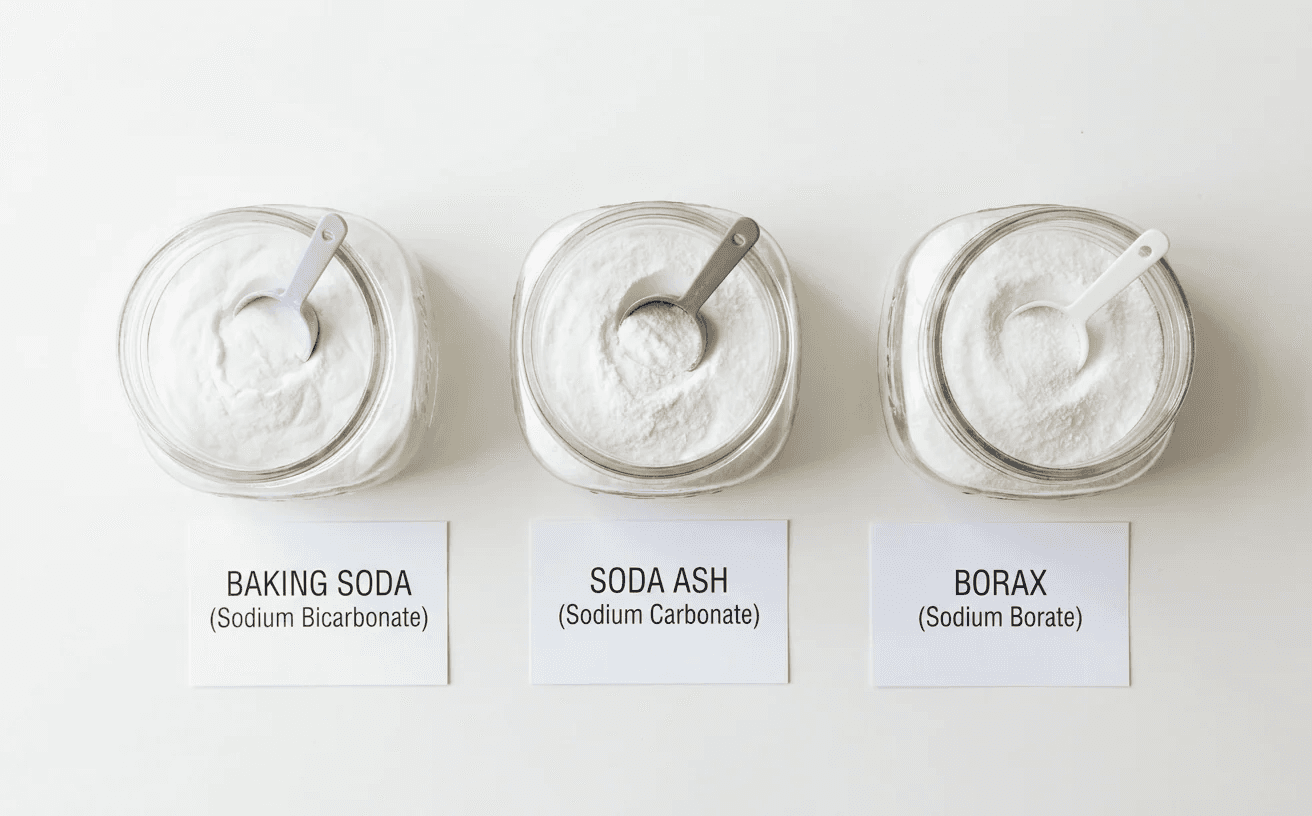
Baking Soda vs Soda Ash for Low Alkalinity
This distinction causes a lot of unnecessary pool chemistry problems.
Baking soda = sodium bicarbonate
Soda ash = sodium carbonate
Baking soda is usually preferred when your primary goal is raising total alkalinity.
Soda ash is usually selected when the primary goal is raising pH, although it can also raise alkalinity.
If you use soda ash aggressively in a pool with low TA but already-acceptable pH, you may raise pH more than desired.
If you use baking soda repeatedly when TA is already good but pH is too low, you may push alkalinity unnecessarily high.
See the full comparison in:
Soda Ash vs Baking Soda for Pools: What’s the Difference?
What Causes Low Alkalinity in a Pool?
Low alkalinity rarely appears for no reason.
It may develop after repeated acid additions, dilution with lower-alkalinity water, heavy rainfall and overflow, water replacement, or the continued use of acidic treatment products.
CDC specifically notes that net-acidic chlorine sources and other acidic chemicals can contribute to declining pH when alkalinity is low.
If TA repeatedly falls after you correct it, investigate the underlying reason rather than simply adding bicarbonate every week.
Repeated chemical corrections often indicate that another part of the water-management strategy deserves attention.
What Happens If You Add Too Much Baking Soda?
Adding more baking soda than the water needs can push total alkalinity above your intended range.
When TA becomes too high, pH becomes more resistant to downward adjustment. CDC notes that excessive alkalinity can make pH difficult to adjust and may be associated with high pH, cloudy water, reduced disinfectant effectiveness and scale-related problems.
If you overshoot slightly, do not immediately start adding multiple corrective chemicals.
Test the complete water chemistry first.
If alkalinity is genuinely too high and needs active reduction, acid can reduce TA—but acid also lowers pH, so lowering alkalinity needs to be managed carefully. CDC describes acid addition as the method used to reduce excess alkalinity.
Can High Alkalinity Make a Pool Cloudy?
It can contribute, but TA should not be evaluated by itself.
Clouding and calcium scale depend on the interaction of several parameters, especially:
pH
Calcium hardness
Total alkalinity
Temperature
CYA
Overall saturation balance
This is why a pool with TA of 130 ppm is not automatically “scaling,” while another pool with the same TA may be strongly scale-forming because its pH and calcium hardness are also high.
If cloudiness or calcium scale is part of the problem, use the PURILY Pool Saturation Index Calculator rather than relying on TA alone.
Can You Swim After Adding Baking Soda?
Do not use one universal waiting time for every product and every pool.
Follow the product label, ensure the chemical has dissolved and circulated as directed, and confirm that the pool’s chemistry is back in an appropriate range before swimming.
For pH specifically, CDC recommends maintaining pool water at 7.0–7.8.
The important point is that “baking soda was added” does not by itself tell you whether the water is ready. The resulting chemistry and the instructions for the particular product matter.
How Long Does It Take Baking Soda to Raise Alkalinity?
The sodium bicarbonate begins affecting the water as it dissolves, but you should not judge the final result from an immediate test taken next to the addition point.
Pool-care guides commonly recommend several hours of circulation before retesting; six hours is a frequent recommendation.
Follow the chemical manufacturer’s instructions and test only after the water has had adequate time to mix.
If the result is still low, calculate the remaining adjustment rather than automatically adding the original amount again.
How Often Should You Test Pool Alkalinity?
Total alkalinity does not usually need the same testing frequency as sanitizer in a well-managed residential pool, but it should be checked regularly and whenever pH becomes difficult to control.
Check TA especially after significant dilution, heavy rain and overflow, major acid treatments, refilling, or persistent unexplained pH changes.
For sanitizer and pH, CDC recommends routine testing and emphasizes that maintaining the correct pH range is important for disinfection, equipment life, and swimmer comfort.
A Better Way to Calculate Pool Alkalinity Adjustments
Generic charts are useful, but they still require you to do the math.
A better workflow is to enter:
Pool Volume → Current TA → Target TA → Chemical Type
and let the calculator determine the estimated amount.
For example:
Pool Volume | Current TA | Target TA | Approx. Baking Soda |
|---|---|---|---|
10,000 gal | 70 ppm | 90 ppm | 2.8 lb |
15,000 gal | 60 ppm | 90 ppm | 6.3 lb |
20,000 gal | 70 ppm | 100 ppm | 8.4 lb |
25,000 gal | 80 ppm | 100 ppm | 7.0 lb |
30,000 gal | 60 ppm | 100 ppm | 16.8 lb |
These values use the CDC reference dose of 1.4 lb per 10,000 gallons for each 10 ppm TA increase.
Calculate Your Dose with PURILY
Instead of working through the formula manually, use the PURILY Pool Chemical Calculator.
Enter your pool volume, current alkalinity and target alkalinity to estimate how much alkalinity increaser your pool needs.
If you do not know your gallons yet, start with the PURILY Pool Volume Calculator.
Common Mistakes When Raising Pool Alkalinity
The biggest errors are usually not complicated chemistry—they are incorrect measurements or overcorrection.
Common mistakes include using an estimated pool volume that is far from the real value, confusing baking soda with soda ash, treating low pH as automatically meaning low alkalinity, adding a very large theoretical dose without retesting, testing immediately after chemical addition, and continuing to add bicarbonate even after TA has reached an appropriate range.
The simple solution is to make every adjustment from measured data:
Know the gallons. Know the current TA. Know the target. Calculate the difference. Treat. Circulate. Retest.
Pool Alkalinity and Baking Soda FAQ
How much baking soda raises pool alkalinity by 10 ppm?
Approximately 1.4 lb of sodium bicarbonate per 10,000 gallons raises total alkalinity by about 10 ppm, according to CDC MAHC guidance.
How much baking soda do I need for a 10,000-gallon pool?
For every approximately 10 ppm increase in TA, use about 1.4 lb of sodium bicarbonate as the calculation benchmark. A 30 ppm increase would therefore be about 4.2 lb before accounting for product-specific directions and staged dosing.
How much baking soda for a 20,000-gallon pool?
Approximately 2.8 lb raises TA by 10 ppm in 20,000 gallons. A 30 ppm increase calculates to about 8.4 lb.
Does baking soda increase alkalinity?
Yes. Sodium bicarbonate is specifically used to raise total alkalinity.
Will baking soda raise pool pH?
It can raise pH somewhat, but its principal use in pool chemistry is increasing alkalinity. Commercial sodium-bicarbonate alkalinity increasers likewise primarily target TA.
Is baking soda the same as alkalinity increaser?
Many alkalinity increaser products use sodium bicarbonate, the same chemical compound as baking soda. Always check the active ingredient on the label.
Can I use soda ash instead of baking soda?
They are not direct substitutes. Soda ash is sodium carbonate and has a much stronger pH-raising effect. Baking soda is generally better suited to a dedicated TA increase.
What if both alkalinity and pH are low?
Evaluate both readings rather than treating pH alone. Raising low TA first often makes subsequent pH control easier. After the alkalinity correction circulates, retest pH before making another adjustment.
What if alkalinity is low but pH is high?
Do not assume you should fix both numbers simultaneously with different chemicals. Correct TA cautiously, circulate, retest, and evaluate why pH is high. Aeration and CO₂ loss can also cause pH to rise.
Can you add too much baking soda?
Yes. Excess sodium bicarbonate can push TA higher than intended, making pH more resistant to adjustment and potentially contributing to poor overall water balance.
Final Takeaway
Raising pool alkalinity with baking soda is straightforward once you know three numbers:
your pool volume, your current TA, and your target TA.
For pure sodium bicarbonate, the most useful reference is:
1.4 lb per 10,000 gallons ≈ +10 ppm total alkalinity.
From there, calculate the required dose, follow the product instructions, allow the water to circulate, and retest before making another large correction.
Most importantly, do not treat alkalinity as an isolated number. If pH is unstable, calcium scale is forming, or the pool repeatedly needs adjustment, test the complete water chemistry.
For easier calculations, use the PURILY Pool Chemical Calculator, and use the Pool Volume Calculator first if you are unsure how much water your pool contains.