Pool Alkalinity vs pH: Which Should You Fix First? | PURILY
Pool Alkalinity vs pH

If your pool’s pH seems impossible to keep stable, the problem may not be pH itself. Total alkalinity plays a major role in how easily pH changes, which is why repeatedly adding pH increaser or reducer without checking alkalinity can turn pool care into a frustrating cycle.
The simple rule is:
In most cases, balance total alkalinity first, then retest and adjust pH.
A commonly used target for residential pools is 80–120 ppm total alkalinity and roughly 7.4–7.6 pH, although CDC guidance considers a pH range of 7.0–7.8 appropriate for maintaining effective disinfection, swimmer comfort, and equipment protection.
This guide explains the difference between pool alkalinity and pH, how they affect each other, which one to correct first, and what to do when the numbers seem to conflict.
Quick Answer: Should You Adjust Alkalinity or pH First?
For most pools, adjust total alkalinity first. Total alkalinity helps buffer the water against rapid pH changes, and chemicals used to raise or lower alkalinity can also affect pH. After bringing alkalinity into range, allow the water to circulate, test again, and then make the final pH adjustment. Pool-care guidance from Leslie’s likewise recommends correcting total alkalinity before pH.
Your Test Results | What to Adjust First |
|---|---|
Low alkalinity + low pH | Raise alkalinity first |
Low alkalinity + normal pH | Raise alkalinity first |
High alkalinity + high pH | Lower alkalinity gradually |
Normal alkalinity + low pH | Adjust pH |
Normal alkalinity + high pH | Adjust pH |
Both in range | No adjustment needed |
The important word is usually. Pool chemistry is interconnected, so unusual combinations may require a more careful approach.
What Is Pool pH?
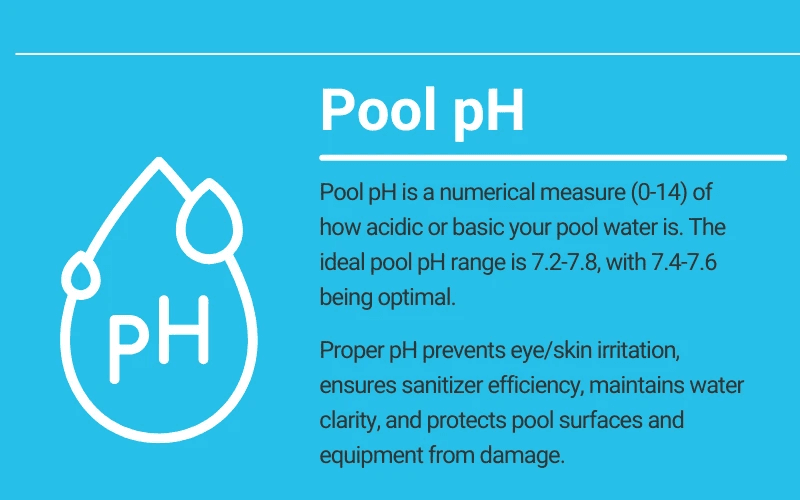
pH tells you how acidic or basic your pool water is at that moment.
The scale runs from 0 to 14:
Below 7 is acidic.
7 is neutral.
Above 7 is basic or alkaline.
For swimming pools, you do not want neutral water at exactly 7.0 as the normal operating target. A slightly alkaline pH is generally preferred.
Many pool-care programs target approximately 7.4–7.6, while the CDC recommends maintaining pool pH between 7.0 and 7.8. As pH rises above the recommended range, chlorine becomes less effective at killing germs; excessively low pH can contribute to corrosion and equipment damage.
Think of pH as a snapshot:
pH tells you where your water is right now.
What Is Total Alkalinity?
Total alkalinity, usually abbreviated TA, measures the water’s ability to neutralize acids and resist rapid changes in pH.
In swimming pools, bicarbonate is typically the largest contributor to alkalinity. Rather than telling you whether the water is simply “alkaline,” TA tells you how strongly the water can resist a change in pH.
A common target range is:
80–120 ppm Total Alkalinity
Leslie’s recommends this range and specifically notes that alkalinity helps keep pH more stable.
An easy way to remember the difference is:
pH tells you where the water is. Total alkalinity tells you how easily the pH can move.
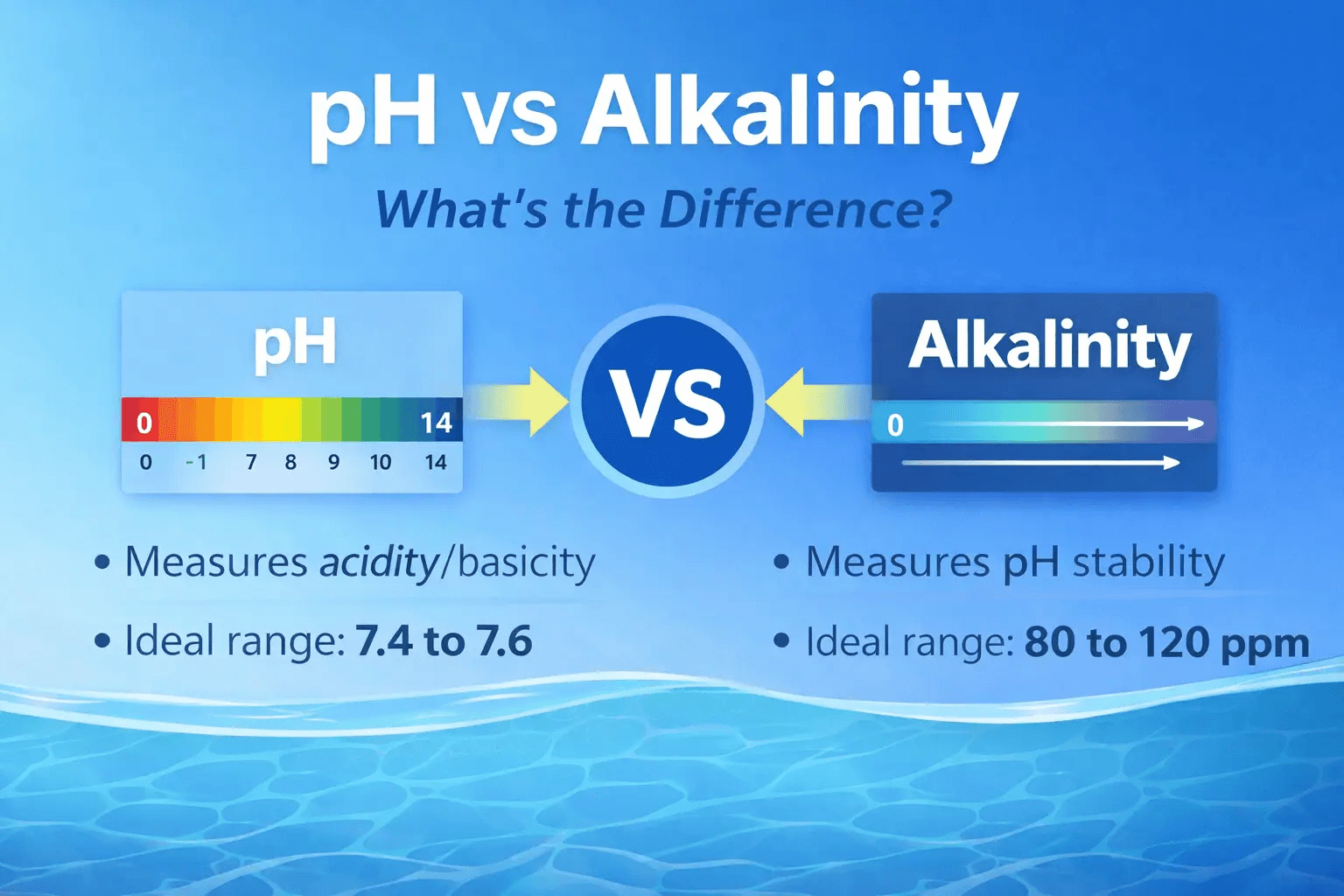
Pool Alkalinity vs pH: What’s the Difference?
Although pH and alkalinity are closely connected, they are not the same measurement.
pH | Total Alkalinity |
|---|---|
Measures acidity/basicity | Measures acid-buffering capacity |
Uses the pH scale | Measured in ppm |
Can change relatively quickly | Helps stabilize pH |
Directly affects sanitizer performance | Influences how easily pH changes |
Common target: 7.4–7.6 | Common target: 80–120 ppm |
This distinction explains why a pool can have a reasonable pH reading while its alkalinity is too low—or have high alkalinity while the pH appears normal.
A single “good” pH test does not necessarily mean the water is fully balanced.
How Does Alkalinity Affect Pool pH?
Total alkalinity acts as a chemical buffer.
When alkalinity is too low, the pool has less resistance to changes in pH. Adding acid, fresh water, chemicals, contaminants, or receiving heavy rainfall may cause pH to change more rapidly.
When alkalinity is higher, more acid is generally required to produce the same pH change. This can make a high-pH pool seem difficult to correct.
However, describing high alkalinity as “locking” pH is not quite accurate.
A better explanation is:
Higher alkalinity increases the water’s resistance to acid-driven pH changes and can contribute to persistent upward pH behavior.
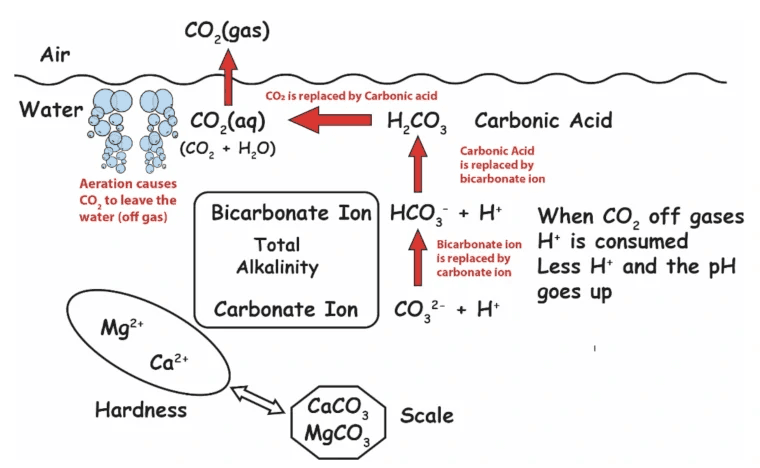
This relationship is also tied to carbon dioxide in the water.
Why Does Pool pH Keep Rising?
One of the most misunderstood causes of rising pool pH is carbon dioxide loss.
Pool water naturally contains dissolved carbon dioxide. When CO₂ leaves the water, pH rises.
More dissolved CO₂ → lower pH
Less dissolved CO₂ → higher pH
Aeration speeds up this process. Waterfalls, spa spillovers, fountains, return jets disturbing the surface, swimmers, and other forms of turbulence can accelerate CO₂ loss and therefore cause pH to rise.
This is why some pools experience recurring pH rise even when owners keep adding acid.
Higher carbonate alkalinity can also provide a larger reservoir of dissolved carbonate species that contributes to this behavior.
So if you find yourself lowering pH every few days, the solution may not simply be “add more acid.” Check:
Total alkalinity
Aeration
Water features
Source water
Chlorine type
Calcium hardness
Cyanuric acid
Overall saturation balance
For a more complete view of scaling and corrosion risk, use the PURILY Pool Saturation Index Calculator.
Which Should You Fix First: Alkalinity or pH?
In most cases, fix total alkalinity first.
There is a practical reason for this.
Many chemicals used to adjust TA also influence pH. If you perfectly adjust the pH first and then make a large alkalinity correction, you may immediately move the pH again.
A better sequence is:
Test → Adjust alkalinity → Circulate → Retest → Fine-tune pH
Leslie’s pool-opening guidance follows this sequence, recommending that alkalinity be brought into the 80–120 ppm range before final pH adjustment.
Let's look at the most common combinations.
Low Alkalinity and Low pH
If both TA and pH are low:
Adjust alkalinity first.
Low alkalinity means the water has limited buffering capacity, while low pH means the water is acidic.
A common alkalinity increaser is sodium bicarbonate, often sold as “alkalinity increaser.”
Raise alkalinity toward the recommended range using the product label and a dose calculated for your actual pool volume.
Then allow the water to circulate and test the pH again.
You may find that the pH has moved somewhat during the alkalinity correction.
Recommended order
Measure your pool volume.
Test TA and pH.
Raise TA gradually.
Circulate the water.
Retest.
Correct the remaining pH difference.
Use the PURILY Pool Chemical Calculator to estimate an adjustment based on your pool volume and current water reading.
Low Alkalinity but Normal pH
This combination can be misleading.
The pH looks fine today, but low alkalinity means it may not stay there very easily.
Correct the alkalinity first.
Afterward, retest pH.
You are not correcting TA because the current pH is necessarily wrong—you are improving the pool’s ability to maintain a more stable pH.
Ignoring low alkalinity simply because today's pH reading looks good can lead to more frequent chemical adjustments later.
High Alkalinity and High pH
This is another common combination.
High alkalinity increases acid demand, while high pH can contribute to scaling, cloudy water, and less efficient chlorine disinfection.
Lower alkalinity gradually.
Acid lowers both pH and alkalinity. In the carbonate system, acid converts bicarbonate toward carbonic acid/CO₂, reducing alkalinity.
After the alkalinity has been lowered appropriately, pH can sometimes be allowed or encouraged to rise through normal aeration without restoring the alkalinity that was removed.
Conceptually:
Add acid → pH falls + TA falls → Aeration releases CO₂ → pH rises
The key is to make gradual corrections rather than trying to solve a large alkalinity problem with one oversized chemical dose.
Always follow the chemical manufacturer's instructions and avoid combining concentrated pool chemicals.
Normal Alkalinity but High pH
If TA is already in your desired range but the pH is high, you normally do not need to intentionally change alkalinity first.
Adjust the pH.
Use an appropriate pH-reducing product according to its label and your pool volume.
After circulating the water, test both pH and TA again because acid can lower alkalinity as well as pH.
If high pH repeatedly returns, investigate CO₂ loss and aeration rather than continually treating the symptom.
Normal Alkalinity but Low pH
If TA is already where you want it but pH is too low:
Correct the pH.
A pH-increasing product may be appropriate depending on the situation.
Again, avoid treating a single reading in isolation. Retest after circulation and monitor whether TA also changes.
Persistently low pH may point to other factors such as acidic source water, certain sanitizers, excessive acid addition, or low buffering.
Pool pH and Alkalinity Troubleshooting Chart
Use this table as a quick starting point.
Total Alkalinity | pH | What It May Mean | First Step |
|---|---|---|---|
Low | Low | Weak buffering and acidic water | Raise TA |
Low | Normal | pH may become unstable | Raise TA |
Low | High | Unusual but possible | Correct TA carefully, then retest |
Normal | Low | TA probably isn't the main problem | Raise pH |
Normal | High | TA probably isn't the main problem | Lower pH |
High | Low | Possibly recent acid treatment | Circulate and retest |
High | Normal | High acid demand / future pH issues possible | Evaluate whether TA needs lowering |
High | High | Higher scale risk and persistent pH rise | Lower TA gradually |
Normal | Normal | Water is within common targets | Maintain and monitor |
This is a troubleshooting guide—not a substitute for a complete water test.
Calcium hardness, CYA, temperature, and sanitizer levels also influence the condition of the pool.
What Happens When Pool Alkalinity Is Too Low?
Low alkalinity reduces the water’s buffering capacity.
Common problems can include:
Rapid pH movement
Difficulty maintaining a consistent pH
Greater risk of acidic conditions
Potential corrosion if pH falls too low
More frequent chemical adjustments
In practical terms, you may feel like the pH is “bouncing” around every time something changes in the water.
If you're constantly adjusting pH in both directions, test TA before adding another pH product.
What Happens When Pool Alkalinity Is Too High?
High alkalinity can create a different problem.
Possible symptoms include:
More acid required to lower pH
Persistent pH rise
Increased scaling tendency when calcium and pH are also high
Cloudy water in some conditions
More difficult water balancing
But alkalinity should not be judged by itself.
A pool with higher TA does not automatically scale. Scale formation depends on the combined effects of pH, calcium hardness, temperature, alkalinity, CYA, and total dissolved solids.
That is why the Langelier Saturation Index (LSI) is useful.
Use the PURILY Pool Saturation Index Calculator if you want to evaluate the overall scaling or corrosion tendency instead of looking at TA alone.
Can Pool pH Be High While Alkalinity Is Low?
Yes.
pH and total alkalinity are related, but they measure different things.
A pool can temporarily have:
High pH + Low TA
or:
Low pH + High TA
This often confuses pool owners because they assume high alkalinity always means high pH.
It does not.
pH is influenced strongly by the amount of dissolved CO₂ in the water, while alkalinity measures acid-neutralizing capacity.
This is another reason to test both values before making a chemical correction.
Does Raising Alkalinity Raise pH?
It can, but the effect depends on the chemical used and the starting water conditions.
Sodium bicarbonate is primarily used to increase total alkalinity and generally has a more limited effect on pH than soda ash.
Soda ash can raise both pH and alkalinity more aggressively.
This is why you should not automatically substitute one product for another simply because both are alkaline materials.
Choose a product based on both your TA and pH readings, and follow its label instructions.
Does Lowering pH Lower Alkalinity?
Usually, yes.
Acid reduces pH and also consumes alkalinity.
That means repeatedly adding acid to manage a rising pH will gradually reduce TA over time.
This is another reason to monitor TA instead of treating pH indefinitely without testing the rest of the water.
Does Aeration Raise Alkalinity?
No—not under normal pool conditions.
Aeration primarily raises pH by accelerating the loss of CO₂ from the water.
It does not add bicarbonate alkalinity back into the pool.
That distinction is useful when lowering high alkalinity:
Acid can lower both TA and pH, while aeration can then help pH recover without undoing the alkalinity reduction.
CO₂ loss raising pH is well established in the pool carbonate system.
Does Cyanuric Acid Affect Alkalinity?
Yes, and this becomes especially important when evaluating water balance.
The total alkalinity number from a pool test does not always represent carbonate alkalinity alone. Cyanurate contributes to measured alkalinity when CYA is present.
For routine pool care, the standard TA reading is useful.
For more detailed saturation-index calculations, however, a correction may be made to estimate the carbonate alkalinity that actually contributes to calcium carbonate saturation.
If your pool has:
High CYA
Scaling
Calcium deposits
Etching
Persistent cloudy water
Unusual LSI readings
it is better to look at the complete chemistry rather than pH and TA alone.
Try the PURILY Pool Saturation Index Calculator →
What Are the Ideal Pool pH and Alkalinity Levels?
For a typical residential pool, a useful operating target is:
Parameter | Common Target |
|---|---|
Total Alkalinity | 80–120 ppm |
pH | 7.4–7.6 |
CDC pH operating guidance | 7.0–7.8 |
Leslie’s commonly recommends TA of 80–120 ppm and pH around 7.4–7.6, while CDC guidance uses a broader 7.0–7.8 pH range.
The exact TA target may vary according to sanitizer, pool surface, equipment, and the pH behavior of the individual pool.
Don't treat 100 ppm as a magic number that every pool must hit exactly.
A stable pool with appropriate overall saturation balance is more important than chasing a single perfect reading.
How to Test Pool pH and Alkalinity Correctly
Before adjusting either parameter:
Make sure the pool water is circulating.
Collect the sample away from return jets and chemical feeders.
Test pH and total alkalinity.
Record both values.
Compare them with your desired ranges.
Calculate the amount of adjustment needed.
Add chemicals according to product instructions.
Allow sufficient circulation.
Test the water again before making another major correction.
For more accurate routine testing, CDC notes that DPD-based testing is more accurate than test strips for chlorine and pH, though strips can still be useful for convenient checks.
If a reading seems completely inconsistent with how your water has been behaving, verify it before adding a large dose of chemicals.
Don't Adjust pH and Alkalinity at the Same Time
One of the easiest ways to create confusing test results is to add several balancing products in rapid succession.
For example:
Add alkalinity increaser.
Immediately add pH reducer.
Add shock.
Test five minutes later.
The result may tell you very little about where the water will stabilize.
Instead, make corrections in sequence.
Better approach
1. Test
Get TA and pH readings.
2. Correct alkalinity
If TA is outside your target range.
3. Circulate
Give the product time to disperse according to its instructions.
4. Retest
Check the new TA and pH.
5. Fine-tune pH
Only after seeing how the alkalinity correction affected it.
This is also why established pool-maintenance guidance recommends balancing TA before making the final pH adjustment.
How Much Alkalinity or pH Adjuster Does Your Pool Need?
There is no universal dose that works for every pool.
The correct amount depends on factors including:
Pool volume
Current TA
Target TA
Current pH
Target pH
Product concentration
Product chemistry
CYA
Source-water chemistry
Before dosing, first confirm your pool's actual volume.
Don't know your pool volume?
Use the PURILY Pool Volume Calculator to calculate gallons, liters, or cubic meters based on your pool shape and dimensions.
Know your readings?
Use the PURILY Pool Chemical Calculator to estimate the chemical adjustment required.
This is safer and more accurate than using a generic “one bag treats one pool” rule.
A Simple Pool Water Balancing Order
If you're starting with a full water test, a practical order is:
1. Test the water
Check:
Total alkalinity
pH
Free chlorine
CYA
Calcium hardness
2. Correct total alkalinity
Bring TA toward an appropriate operating range.
3. Retest pH
Alkalinity adjustment may have changed it.
4. Adjust pH
Fine-tune pH after TA is reasonably stable.
5. Balance sanitizer
Maintain chlorine appropriate for your pool and stabilizer level.
6. Check calcium and overall saturation balance
Especially for plaster, concrete, or other calcium-containing surfaces.
7. Monitor rather than chase numbers
A stable pool is usually easier to maintain than one subjected to constant large chemical corrections.
Pool Alkalinity vs pH FAQ
Should I adjust alkalinity or pH first?
In most routine balancing situations, correct total alkalinity first, allow the pool to circulate, retest, and then make the final pH adjustment.
Can pH be normal if alkalinity is low?
Yes. A normal pH reading can occur while TA is low. The concern is that the pH may be less stable and more vulnerable to future changes.
Can alkalinity be high while pH is low?
Yes. TA and pH measure different properties, so unusual combinations are possible, particularly after chemical treatments.
Will baking soda raise pool pH?
Sodium bicarbonate primarily increases total alkalinity. It can also influence pH, but typically less aggressively than soda ash.
Why does my pool pH keep rising?
CO₂ loss is a common cause. Aeration from water features, returns, spas, and turbulence allows dissolved CO₂ to escape; as CO₂ falls, pH rises.
Is high alkalinity dangerous?
High TA is primarily a water-balance problem rather than a standalone indicator of swimmer safety. It can increase acid demand and contribute to scaling conditions when combined with high pH, calcium hardness, and other factors.
What is the best alkalinity level for a pool?
A commonly recommended range is 80–120 ppm, but the best target for an individual pool depends on sanitizer type, surface, pH behavior, CYA, and overall saturation balance.
What pH should a swimming pool have?
Many pool-care programs target about 7.4–7.6. CDC recommends maintaining pool pH within 7.0–7.8.
Final Takeaway
Pool alkalinity and pH are closely connected, but they are not interchangeable.
pH tells you how acidic or basic the water is right now. Total alkalinity tells you how resistant that pH is to change.
If both need correction, the best approach in most cases is:
Balance alkalinity → circulate → retest → adjust pH.
If your pH still rises constantly after TA is under control, investigate aeration and CO₂ loss rather than continuing to add acid blindly.
And if you're dealing with scaling, corrosion, high calcium, or high CYA, don't evaluate pH and alkalinity by themselves. Check the pool's complete saturation balance.