Soda Ash vs Baking Soda for Pools: What’s the Difference?
Soda ash and baking soda may look similar, but they do very different jobs in swimming pool chemistry.
The simplest way to remember the difference is:
Baking soda is mainly used to raise total alkalinity. Soda ash is mainly used to raise pH.
That difference matters because using the wrong product can fix one reading while pushing another one out of range.
For example, if your pool’s alkalinity is already normal but the pH is too low, adding a large amount of baking soda may increase alkalinity more than necessary without raising pH enough. On the other hand, if alkalinity is low and you add soda ash aggressively, pH may rise too quickly.
This guide explains how soda ash and baking soda work, which one to use for different water conditions, how much to add, and what mistakes to avoid.
Soda Ash vs Baking Soda: Quick Comparison
Feature | Baking Soda | Soda Ash |
|---|---|---|
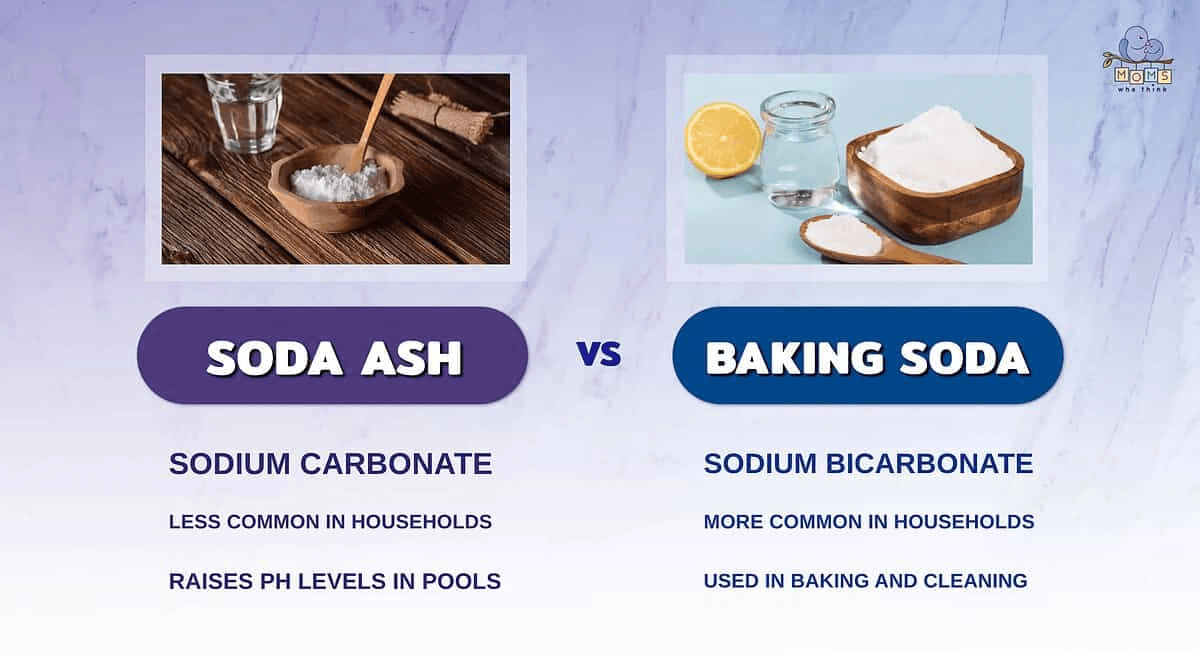
Chemical name | Sodium bicarbonate | Sodium carbonate |
Chemical formula | NaHCO₃ | Na₂CO₃ |
Main pool use | Raise total alkalinity | Raise pH |
Effect on pH | Mild | Strong |
Effect on alkalinity | Strong | Also increases alkalinity |
Best when | TA is low | pH is low |
Common pool-product name | Alkalinity Increaser | pH Up / pH Increaser |
Clouding risk | Usually lower | Higher if overdosed or calcium is high |
CDC guidance specifically identifies sodium bicarbonate, or baking soda, as a chemical used to increase total alkalinity. Soda ash products, by contrast, are commonly sold specifically as pool pH increasers.
What Is Baking Soda Used for in a Pool?
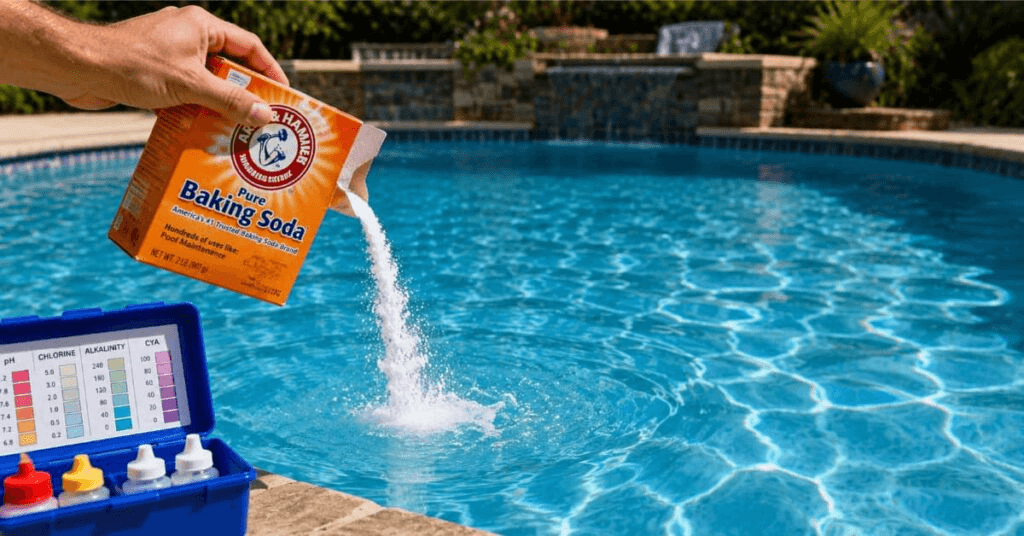
Baking soda is sodium bicarbonate.
Its main role in pool water is to increase total alkalinity, often abbreviated as TA.
Total alkalinity measures how well the water can resist sudden changes in pH. If TA is too low, even a relatively small chemical addition can cause pH to move more quickly than expected.
CDC’s Model Aquatic Health Code notes that low alkalinity can cause pH to change rapidly when chemicals or impurities enter the water. It also specifically recommends bicarbonate of soda for increasing alkalinity.
Baking soda can influence pH, but that is not its main purpose.
Use baking soda when:
Your total alkalinity is too low, while pH is already reasonably close to the desired range.
It is especially useful when the goal is to strengthen the pool’s buffering capacity without causing a large pH increase.
What Is Soda Ash Used for in a Pool?
Soda ash is sodium carbonate.
In pool maintenance, its primary role is to raise pH.
You will often see it sold under names such as:
pH Up, pH Increaser, or simply Soda Ash.
Leslie’s current soda ash product is 100% sodium carbonate and is specifically marketed to increase pH while also increasing total alkalinity.
This second effect is important.
Soda ash does not only change pH. If you repeatedly add it to a pool that already has high alkalinity, TA may rise further.
Which Raises pH More: Soda Ash or Baking Soda?
Soda ash raises pH much more strongly than baking soda.
This is why soda ash is normally the better choice when the primary problem is low pH and the alkalinity level is already acceptable.
For example:
Reading | Example |
|---|---|
pH | 7.0 |
Total Alkalinity | 100 ppm |
In this situation, alkalinity is not the main problem.
The pool primarily needs a pH correction, so soda ash may be more appropriate than baking soda.
Using baking soda instead could increase TA unnecessarily while producing a relatively limited pH increase.
Which Raises Total Alkalinity Better?
For deliberate total alkalinity correction, baking soda is normally the preferred choice.
CDC provides a useful dosing benchmark:
About 1.4 lb of sodium bicarbonate per 10,000 gallons raises total alkalinity by approximately 10 ppm.
That gives us this useful reference:
Desired TA Increase | Approx. Baking Soda per 10,000 gal |
|---|---|
10 ppm | 1.4 lb |
20 ppm | 2.8 lb |
30 ppm | 4.2 lb |
40 ppm | 5.6 lb |
50 ppm | 7.0 lb |
These numbers are estimates. Actual product strength and instructions can vary, so always check the label.
For a more accurate dose, calculate based on your actual pool volume and starting alkalinity rather than using a generic quantity.
Should You Use Soda Ash or Baking Soda?
The right choice depends on both pH and total alkalinity.
Pool Condition | Better Choice |
|---|---|
Low alkalinity + normal pH | Baking soda |
Low alkalinity + slightly low pH | Baking soda first, then retest |
Normal alkalinity + low pH | Soda ash |
Low alkalinity + very low pH | Correct gradually and retest |
High alkalinity + low pH | Be cautious with both |
High alkalinity + high pH | Neither; acid reduction may be required |
Normal alkalinity + normal pH | Neither |
This is why you should always test both pH and alkalinity before adding either product.
What If Both pH and Alkalinity Are Low?
This is one of the most common situations where pool owners get confused.
Suppose your pool test shows:
Parameter | Reading |
|---|---|
pH | 7.0 |
TA | 50 ppm |
Both are low.
In many cases, it makes sense to correct the alkalinity first because TA helps stabilize pH.
You can add the appropriate amount of baking soda, allow the water to circulate, and then retest.
After the alkalinity correction, the pH may have shifted slightly. You can then decide whether a separate pH adjustment is still necessary.
This approach prevents you from making two large chemical corrections at the same time.
Does Baking Soda Raise Pool pH?
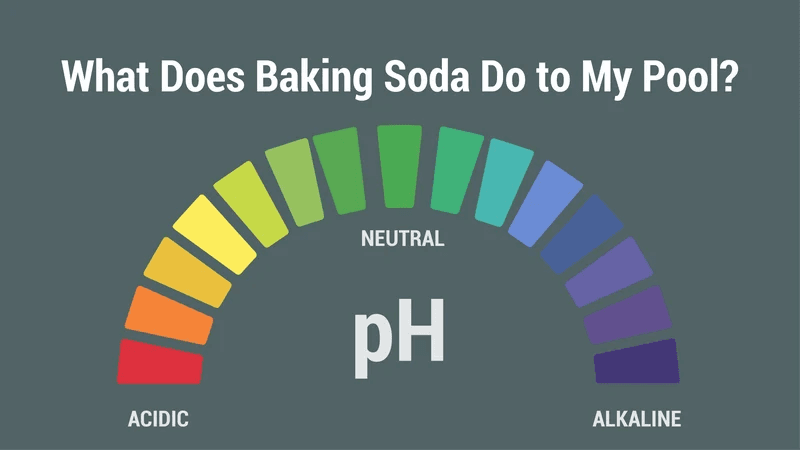
Yes, but usually not dramatically.
Baking soda is alkaline, so it is incorrect to say that it has absolutely no effect on pH.
However, in practical pool maintenance, its strongest effect is on total alkalinity, not pH.
That is why baking soda should not normally be used as the primary pH increaser when alkalinity is already adequate.
Think of it this way:
Baking soda = alkalinity correction first, pH effect second.
Does Soda Ash Raise Total Alkalinity?
Yes.
Soda ash raises both pH and total alkalinity.
That is why it should not be added blindly.
If your TA is already high and pH is only slightly low, repeatedly adding soda ash may eventually make alkalinity harder to control.
CDC notes that high alkalinity makes pH more resistant to adjustment and can contribute to high-pH-related problems such as scale and cloudy water.
Why Did Soda Ash Make My Pool Cloudy?
This is a very common problem.
Soda ash can create a very high pH in the immediate area where it enters the water.
If the pool also contains enough calcium, that temporary local condition can cause calcium carbonate to precipitate, producing a white or gray cloudy appearance.
Orenda describes this as carbonate clouding and explains that soda ash can introduce carbonate ions that react with available calcium to form calcium carbonate.
This is more likely when:
Calcium hardness is high.
pH is already elevated.
The pool has a high saturation index.
Too much soda ash is added at once.
Soda ash is added too quickly in one location.
Clouding does not necessarily mean the pool is contaminated. In some cases, it is a water-balance issue rather than an algae or filtration issue.
If this happens repeatedly, it is worth checking the pool’s LSI or saturation balance.
How Much Soda Ash Should You Add?
Soda ash dosing is more complicated than baking soda dosing because pH response is not perfectly linear.
The amount required depends on:
Pool volume
Current pH
Target pH
Total alkalinity
CYA
Product concentration
Overall water chemistry
As one commercial reference, Leslie’s currently recommends about 1 lb of soda ash per 10,000 gallons when pH is below 7.2, followed by retesting. Their instructions also caution against making excessively large single additions.
That does not mean 1 lb is automatically correct for every pool.
A 7,000-gallon pool and a 30,000-gallon pool should obviously not receive the same treatment.
The better approach is to calculate based on the pool's actual volume and chemistry.
How Much Baking Soda Should You Add?
Baking soda dosing is easier to estimate because the relationship with alkalinity is more predictable.
Using CDC’s benchmark:
1.4 lb per 10,000 gallons ≈ +10 ppm TA.
For example, if you have a 20,000-gallon pool and want to increase TA by 20 ppm:
10 ppm increase in 10,000 gal = 1.4 lb.
For 20,000 gal, double it:
2.8 lb for +10 ppm.
Then double again for +20 ppm:
≈ 5.6 lb baking soda.
For larger corrections, it is still wise to add the chemical gradually, circulate the water, and retest.
Can You Use Baking Soda Instead of Soda Ash?
Not as a direct substitute.
If your pool pH is clearly too low but the alkalinity is already normal, baking soda may not raise pH enough before TA becomes too high.
You could end up with:
pH still too low + alkalinity now too high.
That creates a new balancing problem.
If low pH is the primary issue and TA is acceptable, soda ash is generally the more appropriate chemistry.
Can You Use Soda Ash Instead of Baking Soda?
Soda ash can raise alkalinity, but it is usually not the best choice if your only goal is to increase TA.
Because soda ash raises pH much more strongly, it can push pH higher than desired before you achieve the full alkalinity increase you wanted.
If TA is the main problem, sodium bicarbonate is normally easier to control.
CDC specifically recommends bicarbonate of soda for increasing total alkalinity.
Is Pool Alkalinity Increaser Just Baking Soda?
Many alkalinity-increasing pool products use sodium bicarbonate as the active ingredient.
Chemically, that is baking soda.
However, you should still check the ingredient list rather than assuming every product is identical.
A pool product may differ in packaging, purity specification, instructions, or formulation.
The key ingredient to look for is:
Sodium Bicarbonate — NaHCO₃
Is Soda Ash the Same as Washing Soda?
Pure washing soda and soda ash are both forms of sodium carbonate.
But that does not mean every household laundry product should automatically be added to a swimming pool.
Some consumer products may contain:
Fragrance
Surfactants
Additives
Dyes
Other cleaning ingredients
If using a product not specifically marketed for pools, the ingredient label matters.
For predictable chemistry, pool-grade sodium carbonate is usually the simpler choice.
What Are the Ideal Pool pH and Alkalinity Levels?
There is no single target that works perfectly for every pool, but common residential targets are:
Parameter | Common Target |
|---|---|
pH | About 7.4–7.6 |
Total Alkalinity | About 80–120 ppm |
CDC recommends maintaining pool pH between 7.0 and 7.8. It notes that higher pH reduces chlorine’s ability to kill germs, while very low pH can increase corrosion risk.
The best alkalinity target can vary depending on sanitizer type, CYA, surface material, aeration, and the way an individual pool’s pH behaves.
So instead of chasing one perfect number, aim for stable water chemistry.
Baking Soda vs Soda Ash for Common Pool Problems
Low Alkalinity, Normal pH
Use baking soda.
The goal is to raise TA without causing a major pH increase.
Low pH, Normal Alkalinity
Use soda ash or another appropriate pH increaser.
The goal is to increase pH without unnecessarily adding a large amount of bicarbonate.
Low pH and Low Alkalinity
Correct alkalinity gradually first, circulate, then retest pH.
High pH and High Alkalinity
Neither soda ash nor baking soda is appropriate.
An acid-based correction may be required.
Pool Turns White After Soda Ash
Check pH, calcium hardness, and saturation balance. Calcium carbonate precipitation may be causing the cloudiness.
Common Mistakes When Using Soda Ash or Baking Soda
The most common mistake is treating soda ash and baking soda as interchangeable chemicals.
Another common mistake is dosing without knowing the actual pool volume.
A chemical amount intended for 20,000 gallons can significantly overshoot a much smaller pool.
Large one-time corrections can also create problems. It is usually better to make a controlled correction, circulate the pool, and then retest before adding more.
Never mix concentrated pool chemicals together. Add them separately according to their individual product labels.
Soda Ash vs Baking Soda for Saltwater Pools
The same chemistry applies in saltwater pools.
A saltwater pool is still a chlorine pool—the chlorine is simply generated from salt.
Many saltwater pools tend to experience regular upward pH drift, so they may not need soda ash very often.
If alkalinity becomes too low, baking soda can still be used.
The correct product should be chosen based on the actual test results, not simply whether the pool is saltwater or traditionally chlorinated.
How to Choose the Right Product in 30 Seconds
Use this quick rule:
Your Main Problem | Use |
|---|---|
Total alkalinity too low | Baking soda |
pH too low, TA normal | Soda ash |
Both low | Correct gradually, usually TA first |
TA already high | Avoid unnecessary baking soda |
pH and TA both high | Neither |
If you are not sure which condition applies, test again before adding chemicals.
Why Pool Volume Matters Before Dosing
Chemical dosing is directly tied to water volume.
If you think your pool holds 10,000 gallons but it actually holds 15,000 gallons, your chemical correction may be too small.
If the pool actually holds only 7,000 gallons, the same dose may overshoot.
Before calculating soda ash or baking soda, confirm your pool volume with a reliable measurement.
For irregular shapes such as kidney, oval, L-shaped, or Roman pools, an automated volume calculator can be much more convenient than estimating manually.
Calculate Instead of Guessing
For PURILY, this is where your calculator ecosystem should come in.
Use the Pool Chemical Calculator to estimate pH and alkalinity adjustments based on your current readings and pool volume.
Use the Pool Volume Calculator if you are not sure how many gallons or liters your pool contains.
Use the Pool Saturation Index Calculator if you are experiencing scale, calcium deposits, cloudy water, or corrosion concerns.
This turns the article from a simple explanation into a practical decision tool.
Soda Ash vs Baking Soda for Pools FAQ
Is soda ash the same as baking soda?
No. Soda ash is sodium carbonate, while baking soda is sodium bicarbonate. Their effects on pool chemistry are different.
Does baking soda raise pH?
Yes, but generally only modestly. Its main use in pool care is raising total alkalinity.
Does soda ash raise alkalinity?
Yes. Soda ash raises pH strongly and also increases alkalinity.
How much baking soda raises alkalinity by 10 ppm?
CDC guidance gives an estimate of about 1.4 lb per 10,000 gallons for a 10 ppm increase in total alkalinity.
How much soda ash should I add to a pool?
The exact dose depends on pool volume, starting pH, alkalinity, and product instructions. One current commercial guideline uses approximately 1 lb per 10,000 gallons when pH is below 7.2, followed by retesting.
Can I use baking soda instead of pH Up?
Not always. If pH is low but alkalinity is already normal, baking soda may raise TA too much without increasing pH enough.
Can soda ash make pool water cloudy?
Yes. Soda ash can create localized high-pH conditions that cause calcium carbonate to precipitate, especially when calcium or the saturation index is already high.
Which should I adjust first, pH or alkalinity?
If alkalinity is significantly low, correct TA first, circulate, and retest before making the final pH adjustment.
Final Takeaway
Soda ash and baking soda are both useful pool chemicals, but they are not interchangeable.
The easiest way to remember the difference is:
Baking soda → mainly raises total alkalinity.
Soda ash → mainly raises pH and also raises alkalinity.
Before adding either one, test both pH and TA, confirm your pool volume, calculate the appropriate dose, add the chemical according to its label, circulate the water, and retest.
That approach helps prevent the common cycle of correcting one parameter only to push another one out of range.