How to Get Rid of Pollen in Your Pool (and Keep It From Coming Back)
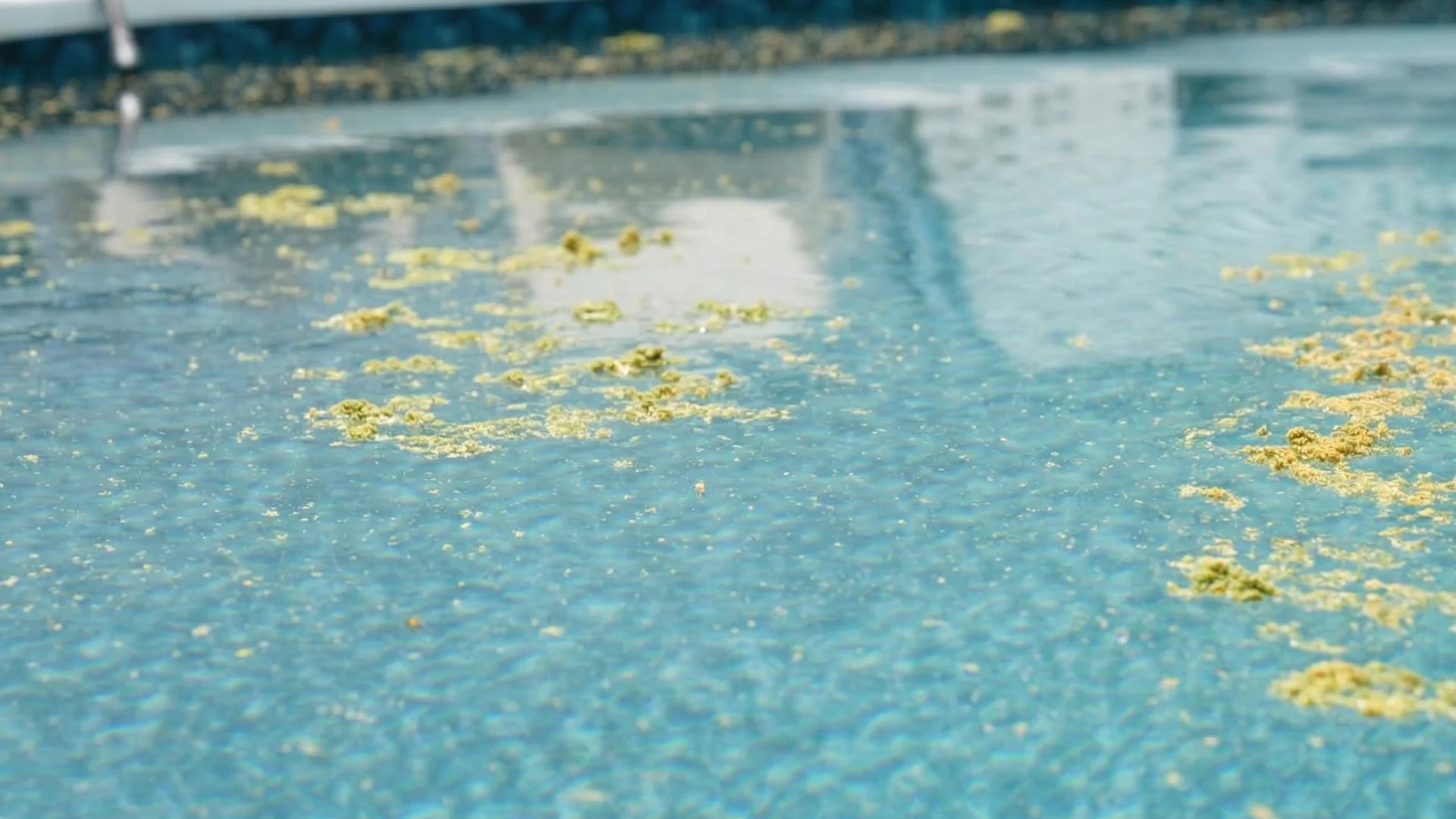
Spring and early summer bring warmer weather, blooming landscapes, and unfortunately, a persistent yellowish-green film floating on your pool's surface. Dealing with pool pollen is one of the most common frustrations for pool owners.
If you find yourself constantly skimming, only to see the yellow haze return the very next day, you are not alone. In this comprehensive guide, we will examine the mechanics of why pollen is so difficult to eliminate and provide a professional, step-by-step strategy to restore your pool to crystal-clear perfection.
Why Does Pollen Keep Coming Back to Your Pool?
To effectively treat a pollen problem, it is essential to understand why standard maintenance routines often fail.
1. The Microscopic Challenge
Pollen grains are incredibly small, typically measuring between 10 and 100 microns. Standard pool filtration systems—especially older sand filters—are often designed to capture larger debris like leaves, bugs, and twigs. When pollen enters the skimmer, it simply passes through the filter media and is pumped right back into the pool through the return jets.
2. Relentless Environmental Factors
As long as trees, grasses, and flowers are blooming, the wind will act as a continuous delivery system for pollen. Even if you completely clear your pool surface by 10:00 AM, an afternoon breeze can completely undo your hard work by 2:00 PM.
3. The "Mustard Algae" Confusion
Many pool owners mistake pollen for mustard algae (or vice versa), leading to ineffective chemical treatments. The easiest way to distinguish the two is by location and texture:
Pollen: Floats on the water's surface, accumulates at the waterline, and is easily blown around by the wind.
Mustard Algae: Clings stubbornly to the pool walls and floor, often in shaded areas, and feels slimy to the touch.
A Professional 5-Step Guide to Eradicating Pool Pollen
Eradicating pollen requires a multi-layered approach that addresses both surface accumulation and micro-filtration.
Step 1: Run Your Filtration System Continuously
During peak pollen season, stagnant water is your worst enemy. Keep your pool pump running 24 hours a day, or at a minimum, 12 to 18 hours. Continuous circulation ensures that surface pollen is constantly pushed toward your skimmers before it has a chance to sink and decay.
Step 2: Equip Skimmer Socks
Since standard skimmer baskets cannot catch micro-particles, you need to add a secondary filtration layer. A skimmer sock—a fine mesh net that stretches over your skimmer basket—acts as a highly effective pre-filter. It will trap the microscopic pollen before it reaches your primary filter, preventing clogs and recirculation. Check and rinse the skimmer sock daily during heavy pollen drops.
Step 3: Utilize a Pool Clarifier or Flocculant
When mechanical filtration isn't enough, rely on pool chemistry.
Clarifiers work by coagulating microscopic pollen grains into larger clumps, making them big enough for your standard filter to catch.
Flocculants (Floc) bind the particles together until they become heavy enough to sink to the pool floor, where they must be manually vacuumed to waste.
Step 4: Daily Surface Skimming and Waterline Scrubbing
Pollen contains organic matter that can stain your pool tiles and vinyl liners if left unaddressed. Use a skimming net with an ultra-fine mesh to manually remove surface pollen. Follow up by scrubbing the waterline with a pool brush and a specialized tile cleaner to break down the sticky, oily residue that pollen leaves behind.
Step 5: Deploy an Advanced Robotic Pool Cleaner
Manual skimming and vacuuming are exhausting, especially when pollen falls daily. Upgrading to an intelligent robotic pool cleaner is the most efficient way to maintain a pristine pool without the daily manual labor.
When dealing with micro-debris, it is crucial to use a robotic cleaner equipped with an Easy-Clean Filter Basket and a Dual-Drive Motor System. Industry-leading automated cleaners, like the Hydrarobo, utilize powerful dual-engine suction to pull in fine dust, sand, and sunken pollen that settles on the floor. Furthermore, advanced models offer Custom Cleaning Routes via a mobile app, allowing you to deploy the robot for targeted spot cleaning exactly where the pollen has congregated, saving both time and energy.