How to Get Rid of Black Algae in a Pool: Treatment & Prevention
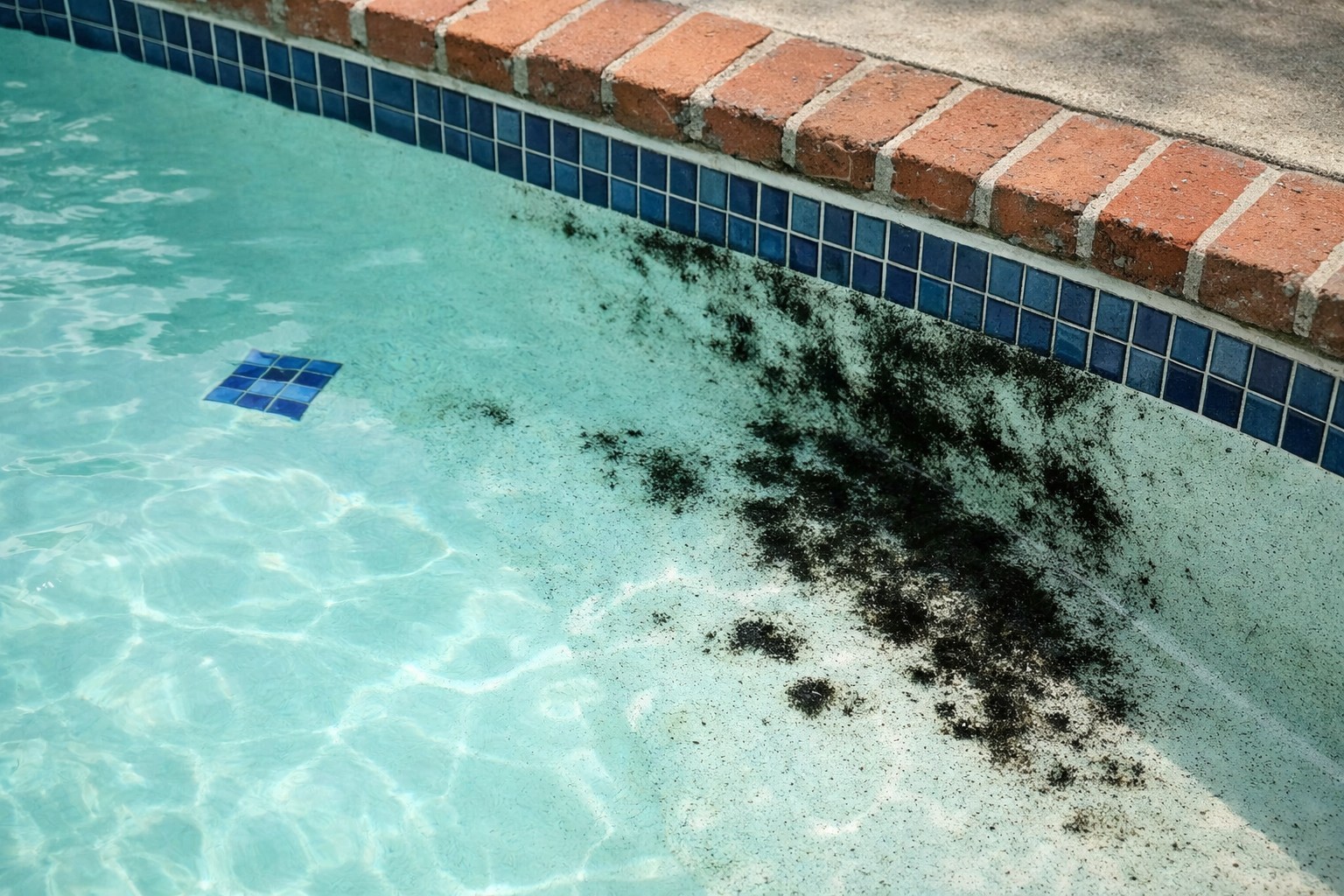
Black spots on a pool wall can be frustrating because they often seem unaffected by normal chlorine levels, brushing, or a routine shock treatment.
The reason is that what pool owners commonly call black algae is generally cyanobacteria, not the typical green algae that turns pool water cloudy or green. It can form dense, protective colonies on rough or porous surfaces, making it much harder for sanitizer to reach the organisms underneath. Aiper likewise describes black algae as cyanobacteria with a protective surface layer that makes routine chlorination alone less effective.
The key to removing it is not simply adding more chemicals.
Successful treatment usually requires:
correct identification → aggressive but surface-safe brushing → appropriate chlorination → continuous circulation and filtration → repeated cleaning → prevention
This guide explains how to do that without damaging the pool surface or endlessly adding shock to a problem that may not even be black algae.
Quick Answer: How Do You Kill Black Algae in a Pool?
Black algae treatment works best when mechanical cleaning and sanitation are combined.
Brushing breaks up the protective surface of the colony so sanitizer can reach it. Chlorine then has a better chance of oxidizing the exposed organisms. Leslie's black-algae treatment guidance likewise instructs pool owners to brush affected areas before treatment and continue brushing afterward if necessary.
A practical sequence is:
Step | What to Do |
|---|---|
1 | Confirm the black spots are actually black algae |
2 | Test pH, free chlorine, CYA and other water chemistry |
3 | Correct pH before intensive chlorination |
4 | Brush each affected area with a surface-safe brush |
5 | Apply chlorine/shock according to pool volume, CYA and product instructions |
6 | Run circulation and filtration continuously during treatment |
7 | Brush the affected areas again |
8 | Vacuum/remove loosened debris |
9 | Clean or backwash the filter |
10 | Sanitize pool-maintenance equipment and monitor for recurrence |
The mistake many pool owners make is doing only Step 5.
Shock without brushing may leave the protective colony largely intact.
What Is Black Algae in a Pool?
Despite the common name, black algae in swimming pools is generally considered a type of cyanobacterial growth.
It typically appears as small, dark patches ranging from blue-black to dark green or almost brown.
Unlike a typical green algae bloom, black algae often does not make the entire pool water green.
Instead, you may notice individual spots on:
Plaster
Concrete
Gunite
Grout
Rough or deteriorated surfaces
Steps and corners
Areas with weaker circulation
Aiper notes that black algae is encountered primarily on plaster or concrete-type surfaces rather than smooth vinyl because rough, porous surfaces give colonies more places to establish themselves.
That surface relationship is important.
If black spots are appearing on a perfectly smooth vinyl liner, fiberglass shell, or nonporous fitting, do not automatically assume black algae.
A stain may be more likely.
What Does Black Algae Look Like?
Black algae is commonly described as:
dark, irregular spots or clusters attached firmly to the pool surface.
It often looks different from loose dirt because it does not simply disappear when the pool is vacuumed.
It also differs from green algae, which usually forms a softer coating that brushes away relatively easily.
A useful first test is to brush the suspected area.
If it is a biological growth, vigorous brushing may disturb the outer layer even if the entire spot does not disappear immediately.
If the mark remains completely unchanged, investigate whether you are dealing with a metal stain, mineral deposit, organic stain, damaged plaster, or another surface problem.
Leslie's specifically warns that certain metal stains can resemble black algae.
Black Algae vs Pool Stains: How Can You Tell?
This distinction matters because treating a metal stain with repeated shock can waste chemicals and potentially worsen discoloration.
Black Algae | Pool Stain |
|---|---|
Often forms irregular colonies | Often appears flat |
Common on rough/porous surfaces | Can occur on many surfaces |
May respond somewhat to brushing | Often does not brush away |
Can recur in the same location | Usually remains static |
Biological treatment required | May require stain-specific diagnosis |
Common in poorly sanitized areas | May be caused by iron, copper, organics or surface damage |
If you are uncertain, diagnose before increasing chemical levels.
Black spots that never change after brushing and sanitation deserve further stain investigation.
Why Is Black Algae So Hard to Kill?
The difficulty is largely physical.
Established colonies can develop a dense outer biofilm-like layer that protects organisms underneath from normal sanitizer exposure.
That means free chlorine present in the water does not necessarily reach every organism effectively.
Aiper highlights this protective layer as one reason normal chlorine levels may fail to eliminate established black algae.
This creates the basic treatment principle:
First disrupt the colony physically. Then let sanitizer reach the exposed growth.
If you reverse the order and simply pour in shock, the treatment may look successful temporarily while enough of the colony survives to return later.
Why Doesn't Normal Chlorine Kill Black Algae?
Routine chlorine levels are designed to keep a properly maintained pool sanitized and prevent growth from becoming established.
An existing black-algae colony is a different problem.
The sanitizer must penetrate a mature, attached colony rather than simply neutralize organisms suspended in water.
Chlorine effectiveness is also influenced by water chemistry.
The CDC recommends maintaining pool pH between 7.0 and 7.8 and at least 1 ppm free chlorine in pools, or at least 2 ppm when cyanuric acid or stabilized chlorine products are used. Higher pH reduces chlorine's germ-killing effectiveness.
This is why treatment should start with testing—not automatically adding another bag of shock.
If pH, CYA, or sanitizer conditions are badly out of balance, chlorine performance can be compromised.
How to Get Rid of Black Algae Step by Step
Step 1: Confirm That It Is Actually Black Algae
Inspect the location, texture and response to brushing.
Black algae is more likely when the growth:
Appears in irregular dark patches
Is strongly attached
Occurs on plaster, concrete, gunite or grout
Returns repeatedly in the same area
Does not vacuum away like dirt
If the discoloration is completely flat and brushing makes no difference, investigate staining before escalating treatment.
Step 2: Test the Pool Water
Before treatment, measure at least:
Free Chlorine
pH
Total Alkalinity
CYA
Calcium hardness is also useful for evaluating the overall water balance.
This matters because simply knowing that “there is algae” does not tell you how much chlorine product to add.
Required treatment depends on:
pool volume + current FC + target FC + CYA + chlorine product concentration
For PURILY, this is a perfect internal link:
Use the Pool Chlorine Calculator →
or:
Use the Pool Shock Calculator →
Step 3: Correct pH Before Heavy Chlorination
Chlorine effectiveness depends partly on pH.
CDC notes that chlorine becomes less effective as pH rises, especially above 8.0.
For many pool products, treatment instructions call for pH to be brought into the normal operating range first. Leslie's black-algae product instructions, for example, specify pH 7.2–7.8 before treatment.
Do not aggressively lower pH beyond an appropriate operating range simply because you are treating algae.
Test it. Adjust it. Then move to the next step.
Step 4: Brush the Black Algae Thoroughly
This is one of the most important steps.
Your goal is not merely cosmetic removal.
You are trying to break open the protective surface of the colony.
Brush each affected patch thoroughly.
The correct brush depends on the pool surface.
Pool Surface | Brush Approach |
|---|---|
Plaster / concrete / gunite | A more aggressive pool brush may be appropriate |
Tile / grout | Use a brush suitable for the tile and grout |
Fiberglass | Use non-abrasive brushes |
Vinyl | Use a soft vinyl-safe brush |
Painted surface | Follow coating manufacturer's guidance |
Do not automatically use a stainless-steel brush or pumice stone on every pool.
Those tools may be appropriate for some hard plaster surfaces but can scratch, tear, dull, or permanently damage vinyl, fiberglass, painted surfaces, or certain finishes.
Step 5: Shock or Superchlorinate the Pool Correctly
After brushing, sanitizer has better access to the affected areas.
This is where you increase chlorine according to the treatment being used.
However, there is no single shock dose that is correct for every pool.
The correct amount depends on:
Pool volume
Current free chlorine
CYA
Target chlorine level
Type of chlorine
Product strength
That is why PURILY should avoid giving users a universal statement such as:
“Add one pound of shock per 10,000 gallons and the black algae will die.”
That may be insufficient for one pool and excessive for another.
Instead:
Calculate the chlorine requirement from your actual water chemistry and follow the shock manufacturer's label.
Use the PURILY Pool Shock Calculator to estimate the required amount based on pool volume, current FC, target FC and shock product.
If you are unsure how many gallons the pool contains, use the Pool Volume Calculator first.
Step 6: Keep the Pump and Filter Running
Treatment creates loosened organic matter that needs to be moved into the filtration system rather than allowed to settle back onto surfaces.
Keep the circulation system operating according to the shock/treatment instructions.
Pay particular attention to:
Steps
Corners
Behind ladders
Benches
Return areas
Low-circulation zones
Weak circulation creates areas where sanitizer delivery may be poorer and debris can accumulate.
Step 7: Brush the Spots Again
Black algae treatment is rarely a one-brush process.
After the chlorine has circulated, inspect the patches again and repeat brushing.
Leslie's instructions for black-algae treatment specifically recommend brushing before application and, when necessary, brushing daily for the following two days.
The exact schedule should follow the treatment product you use, but the principle is important:
physical disruption needs to continue while the sanitizer is working.
Step 8: Vacuum the Pool
Remove dead material and loosened debris instead of allowing it to remain on the pool floor.
If the outbreak is severe and your equipment allows it, your pool professional or equipment manual may recommend vacuuming certain debris to waste rather than sending everything through the filter.
The appropriate method depends on your filtration system.
Step 9: Clean or Backwash the Filter
Do not treat an algae outbreak and then ignore the filtration system.
For a sand or DE filter, follow the manufacturer instructions for backwashing or cleaning.
For a cartridge filter, rinse or deep-clean the cartridges according to the manufacturer's guidance.
A dirty filter reduces circulation and can leave large amounts of captured organic material in the system.
Step 10: Clean the Equipment That Was in the Pool
Brushes, nets, hoses, vacuum heads and other equipment that contacted affected surfaces should also be cleaned appropriately.
Aiper specifically emphasizes equipment hygiene as part of preventing black-algae recurrence.
Otherwise, it is possible to clean the pool and then continue using dirty equipment throughout it.
Follow equipment and sanitizer instructions rather than mixing concentrated chemicals into an improvised cleaning solution.
How Long Does It Take to Get Rid of Black Algae?
There is no reliable universal number of hours.
A small, newly established patch may respond relatively quickly.
A mature colony embedded in rough, aging plaster may require repeated brushing and treatment over multiple days.
What matters more than the clock is the response:
Are the spots shrinking?
Are they becoming easier to brush?
Are new spots appearing?
Is free chlorine holding?
If there is no meaningful change despite properly balanced chemistry, correct chlorination, thorough brushing and filtration, reconsider the diagnosis.
You may be looking at a stain or damaged surface instead of active algae.
Why Does Black Algae Keep Coming Back?
Recurrence usually means at least one part of the original problem remains.
Possible reasons include poor brushing, inadequate sanitizer exposure, rough porous surfaces, low-circulation areas, dirty equipment, filtration problems or water chemistry that repeatedly falls out of range.
Aiper similarly notes that recurring spots often occur on rough or porous pool surfaces and stresses regular brushing and consistent chlorination as preventive measures.
A recurring patch in exactly the same location deserves extra attention.
The surface itself may provide a protected area where growth continues to re-establish.
Can Black Algae Grow in a Vinyl Pool?
It is much more commonly associated with rough plaster, gunite or concrete surfaces.
Aiper notes that black algae is comparatively uncommon on vinyl because the smooth surface provides fewer porous areas for established colonies.
So if you see black marks on a vinyl liner, consider several alternatives:
organic staining, metal staining, liner discoloration, mold or contamination behind the liner, or other surface damage.
Do not attack a vinyl liner with a steel brush or pumice stone in an attempt to remove an unconfirmed algae problem.
That can permanently damage it.
Black Algae vs Green Algae
These problems should not be treated as identical.
Black Algae | Green Algae |
|---|---|
Usually appears in attached dark spots | Often coats surfaces or turns water green |
Common on rough surfaces | Can occur throughout the pool |
Strongly attached | Usually easier to brush |
Protective colony makes treatment harder | Often responds faster to normal algae treatment |
Mechanical brushing is critical | Brushing is still useful but typically easier |
Recurrence from established patches is common | Often tied to sanitizer/circulation failure |
If your entire pool has turned green, a typical green-algae outbreak is generally more likely than black algae.
Black Algae vs Mustard Algae
Mustard algae usually appears yellow, tan, brownish or dust-like.
It frequently forms in shaded areas and may brush away much more easily than black algae, only to return.
Black algae tends to form darker, more firmly attached patches.
Correct identification matters because the treatment approach and persistence can differ.
Can You Swim in a Pool With Black Algae?
The safer approach is to keep swimmers out while an active contamination problem is being treated, especially during shock or superchlorination.
The presence of visible biological growth also suggests that pool sanitation has not been consistently controlled.
CDC emphasizes maintaining proper chlorine and pH because those are the first defenses against organisms that can make swimmers sick.
Do not reopen the pool simply because the visible black patches look smaller.
Wait until treatment is complete and water chemistry has returned to the appropriate operating range specified by your sanitizer/product guidance.
How Much Chlorine Do You Need for Black Algae?
This is one area where PURILY should be better than generic pool blogs.
Do not calculate the amount only from the words “black algae.”
Dose depends on:
Pool Volume
Current Free Chlorine
Target Free Chlorine
CYA
Chlorine Type
Product Concentration
For example, the required weight of cal-hypo will not be the same as the amount of liquid chlorine required to achieve the same FC increase.
So rather than publishing one universal dose:
Does Algaecide Kill Black Algae?
Black-algae-specific algaecides are available, and some product manufacturers recommend them as part of a treatment program.
For example, Leslie's sells a product formulated specifically for black algae and instructs users to brush the algae first, balance pH and apply the product according to pool volume.
But algaecide should not be viewed as a substitute for:
correct sanitizer levels + brushing + circulation + filtration
If the underlying sanitation problem remains, simply adding another product may not prevent recurrence.
Always follow the actual product label rather than applying a dosage from another brand's instructions.
Should You Rub a Chlorine Tablet on Black Algae?
You will sometimes see advice recommending rubbing a trichlor tablet directly against stubborn black-algae spots.
Aiper currently includes that technique for hard plaster/concrete-type surfaces.
However, this should not be treated as a universal method.
Concentrated chlorine is acidic and can bleach, etch or damage certain pool surfaces.
Never automatically rub chlorine tablets directly onto:
vinyl liners, fiberglass finishes, painted pools or surfaces whose manufacturer does not permit direct tablet contact.
For uncertain surfaces, use the chemical and surface manufacturer's instructions.
Can You Use a Pumice Stone on Black Algae?
Only on surfaces that can safely tolerate pumice.
Pumice may sometimes be used on appropriate hard mineral/plaster surfaces, but it can scratch softer finishes.
Never assume “black algae = pumice stone.”
The surface material comes first.
If you do not know what the finish is, use a safer brush and confirm the material before escalating abrasiveness.
Does a Saltwater Pool Get Black Algae?
Yes.
A saltwater pool is still sanitized with chlorine—the salt cell simply generates the chlorine.
If sanitizer production becomes inadequate, circulation is poor, the cell is not operating properly, or chemistry is out of balance, biological growth can still establish itself.
The treatment principle is therefore similar:
test → brush → correct sanitation → circulate/filter → repeat as needed
Also inspect the salt cell and confirm that chlorine production is actually meeting the pool's demand.
How to Prevent Black Algae From Coming Back
Prevention is considerably easier than repeatedly removing established colonies.
Focus on four things:
consistent sanitizer levels, proper pH, regular brushing and good circulation.
CDC recommends routinely monitoring chlorine and pH and maintaining pH at 7.0–7.8; it also recommends at least 1 ppm chlorine in ordinary pools and at least 2 ppm where CYA/stabilized chlorine is being used.
Regular brushing is especially important on rough surfaces, steps, corners and areas with weak circulation.
Also maintain the filtration system and do not let dirty maintenance equipment become part of your normal cleaning routine.
Common Black Algae Treatment Mistakes
The most frequent mistakes are treating every black mark as algae, shocking without brushing first, using an abrasive tool on the wrong pool surface, adding chemicals without testing CYA and pH, using the same shock dose for every pool size, ignoring filtration, stopping treatment as soon as the spots look faded, and failing to clean equipment that was used on affected surfaces.
A better rule is:
Identify first. Break up the colony. Sanitize based on actual water chemistry. Filter and clean. Then monitor for recurrence.
When Should You Call a Pool Professional?
Consider professional diagnosis when black patches continue returning despite correct treatment, cover a large proportion of the pool, appear to extend into deteriorating plaster, or cannot clearly be distinguished from staining.
Professional help is also sensible when the treatment would require aggressive abrasive cleaning on an expensive finish.
At that point, the cost of damaging the surface can be much higher than the cost of diagnosing the problem properly.
Black Algae Pool FAQ
Is black algae really algae?
Pool “black algae” is generally described as cyanobacterial growth rather than a typical true algae. Its dense protective colony is one reason it can be unusually difficult to remove.
Will shock alone kill black algae?
It may not eliminate an established colony effectively if the protective surface has not first been disrupted. Brushing is an important part of black-algae treatment.
What kills black algae in a swimming pool?
Successful treatment generally combines mechanical brushing, appropriate chlorination/sanitization, circulation, filtration and repeated cleaning rather than relying on one product alone.
Why won't black algae brush off?
Established colonies can attach strongly to rough or porous surfaces and form protective layers. Repeated surface-safe brushing combined with appropriate sanitation is usually required.
How much shock should I use for black algae?
There is no one correct amount for every pool. Dose should account for pool volume, current free chlorine, target chlorine, CYA and the active chlorine concentration in the product.
Can black algae come back after shocking?
Yes. Surviving colonies, poor circulation, rough surfaces, inadequate sanitation or contaminated equipment can contribute to recurrence.
Can black algae damage a pool?
The visible growth itself can be difficult to remove, while aggressive attempts to remove it can damage a finish if the wrong brush, abrasive or concentrated chemical is used. Correct surface identification is important.
Is a black spot always black algae?
No. Metal stains, organic staining, damaged plaster and other surface discolorations may look similar. If a spot does not respond at all to brushing and appropriate treatment, investigate staining.
Can black algae grow in saltwater pools?
Yes. Saltwater pools still rely on chlorine sanitation and can develop biological growth when chlorine production or overall water management is inadequate.
Should I drain my pool to remove black algae?
Usually not as the first response. Draining a pool can create structural risks in some conditions, and many black-algae cases can be treated without draining. If resurfacing or draining is being considered, consult an experienced pool professional.
Final Takeaway
Black algae is difficult to remove because established colonies can protect themselves from routine sanitizer exposure and attach strongly to rough pool surfaces.