How Long Does Chlorine Stay in Your Hair After Swimming?

If your hair still smells like the pool, feels unusually dry, or becomes rough after swimming, you may wonder: How long does chlorine actually stay in your hair?
There is no scientifically established countdown such as “chlorine remains in hair for exactly 24 hours.”
The more useful answer is this:
Pool-water residue can remain on and within wet hair until you rinse and wash it away, while the drying or structural effects of repeated chlorine exposure can last much longer than the chlorine exposure itself.
That is why dermatologists recommend rinsing hair with fresh water as soon as possible after swimming rather than waiting for the chlorine smell or dry feeling to disappear on its own. Cleveland Clinic specifically advises an immediate freshwater rinse because longer exposure increases the opportunity for chlorine to dry and damage hair.
For occasional swimmers, one pool session is unlikely to destroy healthy hair. But frequent swimming—especially with bleached, dyed, highlighted, chemically treated, curly, dry, or already damaged hair—can gradually make the hair more brittle and prone to breakage.
Quick Answer: How Long Does Chlorine Stay in Hair?
There is no reliable universal number of hours.
How much pool residue remains depends on:
How long you stayed in the water
Chlorine and overall pool-water chemistry
Whether your hair was already wet before entering
Hair porosity and previous chemical damage
Whether you wore a swim cap
How quickly you rinsed afterward
Whether minerals such as copper are present in the water
The best practice is therefore not to ask how long you can safely wait.
Instead:
Rinse your hair with fresh water as soon as you finish swimming.
AAD recommends that swimmers rinse immediately after swimming, then wash with a shampoo formulated for swimmers and follow with conditioner.
What Does Chlorine Actually Do to Your Hair?
Hair is made primarily of keratin proteins and is protected by overlapping outer cuticle layers and surface lipids.
Chlorinated pool water can disturb that protective system.
The American Academy of Dermatology explains that chlorine can dissolve protective hair lipids and contribute to breakdown of chemical bonds in hair proteins. The result can be hair that becomes:
Dry
Rough
Frizzy
Dull
More vulnerable to split ends
More susceptible to breakage
A scientific review of environmental effects on hair similarly reports that chlorine-containing pool water can contribute to oxidative damage, cuticle deterioration, keratin degradation and eventual hair breakage with repeated exposure.
So when someone says, “chlorine stayed in my hair and damaged it,” two different issues are often being combined:
Residue/exposure can be removed.
Damage already caused to the hair fiber does not simply rinse away.
Why Does Hair Still Smell Like a Pool After Swimming?
That familiar “chlorine smell” is more complicated than most people realize.
Chlorine disinfectants react with substances swimmers introduce into the water, including:
Sweat
Dirt
Skin cells
Urine
Cosmetics
Other organic material
This reaction can form chloramines, also called combined chlorine.
According to the CDC, the strong chemical odor people often associate with an over-chlorinated pool may actually indicate chloramines rather than unusually high free chlorine.
Hair can also retain pool water, minerals and chemical residues temporarily, especially when it is porous.
That is one reason hair may continue to smell “pool-like” even after you leave the water.
But a lingering smell does not provide a scientifically precise measurement of how many milligrams of chlorine remain in the hair.
Does Chlorine Stay in Hair for 24 Hours?
There is no good scientific basis for saying that chlorine always remains in hair for exactly 24 hours.
Likewise, claims that it automatically remains for “several days” or “a week” should be treated cautiously unless the claim refers specifically to mineral buildup or cumulative hair damage rather than free chlorine itself.
The practical recommendation is much simpler:
Don't wait for pool residues to disappear naturally. Rinse promptly after swimming.
Cleveland Clinic recommends a freshwater rinse immediately after leaving the pool and notes that occasional clarifying shampoo may be useful for frequent swimmers, although using clarifying shampoo too frequently can itself be drying.
What Happens If You Don't Wash Chlorine Out of Your Hair?
If you leave pool water in your hair and allow it to dry repeatedly, you extend contact between the hair fiber and chlorinated water.
Over time, this can contribute to:
Loss of natural oils
Increased dryness
Rough texture
Reduced shine
Increased tangling
Split ends
Greater breakage risk
Faster fading of some hair colors
Cleveland Clinic notes that chlorine removes natural oils that normally protect the hair and that repeated contact can leave it dry, dull and more susceptible to breaking.
Baylor dermatologists also note that chlorinated water can be particularly hard on chemically treated hair, including dyed or permed hair.
Is It Bad to Leave Chlorine in Your Hair Overnight?
It is better to rinse your hair before going to bed after swimming.
The concern is not that your hair suddenly becomes unsafe after a specific number of hours.
Rather, allowing chlorinated pool water to dry on the hair unnecessarily extends exposure and may worsen dryness.
A better routine is:
Swim → freshwater rinse → gentle cleansing as needed → conditioner → dry gently
If you swim late in the evening and don't want to shampoo every time, at minimum rinse the hair thoroughly with clean water.
Frequent swimmers can then adjust shampoo frequency based on hair type and how much buildup they experience.
How to Get Chlorine Out of Your Hair After Swimming
You do not need an elaborate seven-product routine after every swim.
For most swimmers, start with these steps.
1. Rinse Immediately With Fresh Water
This is the most important step.
Do it as soon as you leave the pool rather than waiting until you get home several hours later.
AAD specifically recommends rinsing immediately after swimming.
2. Wash Your Hair
Use a gentle shampoo after swimming when appropriate for your hair type and swimming frequency.
If you swim frequently or experience noticeable mineral/product buildup, an occasional swimmer's or clarifying shampoo may help remove buildup.
Cleveland Clinic cautions that clarifying products should not necessarily be used daily because they can also dry hair.
3. Use Conditioner
Conditioning is especially important after chlorine exposure because pool water can remove protective lipids and moisture.
AAD recommends following a swimmer's shampoo with a deep conditioner.
4. Reduce Additional Stress
Hair is more vulnerable when wet.
Avoid aggressively rubbing it dry with a towel.
AAD recommends wrapping hair gently in a towel to absorb water and minimizing damaging hair-care practices.
Should You Use Clarifying Shampoo After Every Swim?
Not necessarily.
Clarifying shampoo is designed to remove buildup more aggressively than many everyday shampoos.
That can be useful for regular swimmers, but excessive clarifying can also remove oils and worsen dryness.
Cleveland Clinic recommends using clarifying shampoo occasionally for frequent swimmers rather than automatically using it every day.
A more balanced routine may be:
Swimming Frequency | Possible Hair-Care Approach |
|---|---|
Occasional | Rinse immediately + normal shampoo/conditioner |
Several times weekly | Rinse after every swim + gentle shampoo + periodic clarifying |
Daily swimmer | Freshwater rinse every time + individualized cleansing + regular conditioning |
Color-treated hair | Gentle/color-safe products + extra conditioning |
Very dry/curly hair | Focus strongly on moisture replacement |
There is no perfect shampoo schedule for every hair type.
Does Regular Shampoo Remove Chlorine?
Regular shampoo can remove pool-water residue, oils and contaminants, especially when combined with immediate rinsing.
However, frequent swimmers may develop mineral or product buildup that a more specialized swimmer's or clarifying shampoo removes more effectively.
That is why AAD specifically recommends swimmer's shampoo for people dealing with regular pool exposure.
But stronger is not always better.
If your hair already feels brittle, repeated aggressive clarifying may make it feel worse.
Should You Wet Your Hair Before Swimming?
Yes.
This is one of the easiest prevention methods.
Cleveland Clinic recommends soaking hair with fresh water before entering a chlorinated pool because hair that is already saturated absorbs less pool water.
Think of a hair strand somewhat like an absorbent fiber.
If it is already holding clean water, there is less opportunity for it to take up additional pool water immediately.
A good pre-swim routine can therefore be:
Freshwater rinse → leave-in conditioner if suitable → swim cap
Does Leave-In Conditioner Protect Hair From Chlorine?
It can help form an additional physical barrier between the hair and pool water.
AAD recommends applying an oil or leave-in conditioner before entering the pool to help protect the hair from chlorine exposure.
Cleveland Clinic gives similar advice, recommending leave-in conditioner or hair oil before swimming.
You do not need to saturate your hair with large amounts of product.
A light coating appropriate for your hair type is usually more practical.
Does a Swim Cap Keep Chlorine Out of Your Hair?
A swim cap can reduce exposure, but most swim caps are not perfectly watertight.
Water can still enter near the hairline, ears and neck.
The main advantages of a cap are that it reduces direct water contact, controls hair while swimming and may reduce repeated friction and chemical exposure.
Cleveland Clinic recommends a well-fitted swim cap as one layer of protection, particularly for frequent swimmers and people with color-treated or chemically processed hair.
For better protection:
Wet hair first + apply appropriate conditioner + wear a cap
rather than relying on the cap alone.
Does Chlorine Turn Blonde Hair Green?
This is one of the biggest swimming-pool hair myths.
Chlorine itself is not usually what makes hair green.
The green color is primarily associated with copper deposition in the hair.
A classic clinical study found abnormally high copper levels in swimmers with acquired green hair.
More recent medical literature describes chlorotrichosis, or swimmer's green hair, as an accumulation of exogenous copper, particularly in lighter-colored and previously damaged hair.
Chlorinated water can still play an indirect role.
Hair damaged by chemical treatments or repeated chlorinated-water exposure may become more porous, making copper deposition easier. Earlier experimental research found that cuticle damage from chlorinated water increased copper binding to hair.
So the simplified equation is:
Green hair = primarily copper deposition, not “too much green chlorine.”
Why Does Blonde or Bleached Hair Turn Green More Easily?
Light-colored hair simply makes green discoloration easier to see.
But visibility is only part of the story.
Previously damaged hair can also absorb more copper.
Published case reports identify light-colored hair and preexisting structural damage as major risk factors for swimming-pool-related green hair.
Bleaching, highlighting, chemical straightening, perming, UV exposure and repeated swimming can all increase hair porosity or cuticle damage.
That makes prevention particularly important for chemically treated blonde hair.
How Do You Remove Green Pool Hair?
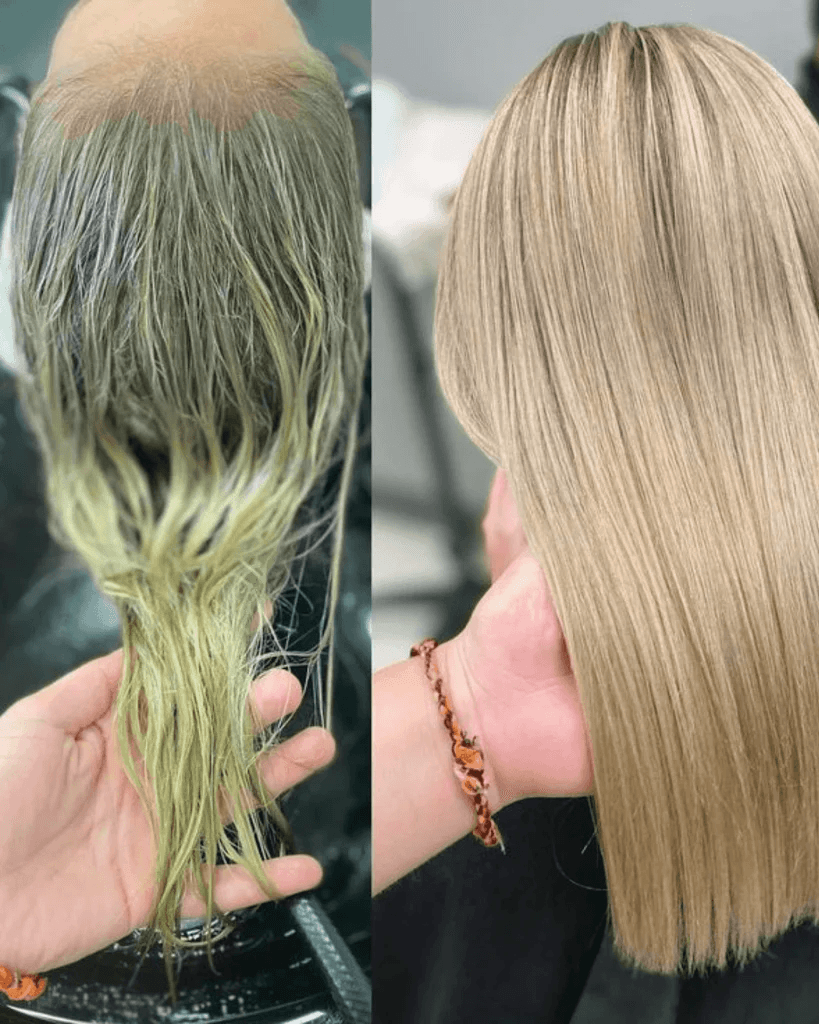
Because copper—not chlorine—is usually responsible for the green color, endlessly shampooing for “chlorine” may not solve the problem.
Medical literature has documented improvement with EDTA-containing shampoos, which can chelate metals such as copper.
If the discoloration is substantial or persists, a hairstylist or dermatologist can help distinguish mineral buildup from color-treatment damage.
Avoid repeatedly bleaching already damaged hair just to cover a green tint, because additional chemical processing may further weaken the cuticle.
Who Is Most Likely to Get Chlorine-Damaged Hair?
Anyone can experience dry hair after swimming, but some people should take extra precautions.
Higher-risk groups include:
Competitive swimmers
Daily swimmers
People with bleached hair
Highlighted hair
Color-treated hair
Permed or chemically straightened hair
Naturally dry hair
Curly/coily hair prone to moisture loss
Hair already damaged by heat styling
Long hair with older, weathered ends
Baylor dermatologists specifically warn that chemically treated hair can be more vulnerable to damage from chlorine exposure.
How Can Daily Swimmers Protect Their Hair?
If you swim every day, prevention matters more than repeatedly trying to repair severe dryness afterward.
A practical routine is:
Before Swimming
Wet the hair thoroughly with fresh water.
Apply a suitable leave-in conditioner or protective hair product.
Wear a well-fitted swim cap.
Immediately After Swimming
Rinse thoroughly.
During Washing
Use a gentle shampoo suited to your hair.
Use clarifying/swimmer's shampoo periodically if buildup develops.
After Washing
Condition thoroughly.
Use deeper conditioning periodically if the hair is becoming dry.
Outside the Pool
Limit unnecessary heat styling or harsh chemical processing during periods of heavy swimming.
These recommendations are broadly consistent with dermatologist guidance from AAD and Cleveland Clinic.
What About Saltwater Pools?
A saltwater swimming pool is still a chlorinated pool.
A salt chlorine generator converts dissolved salt into chlorine compounds that sanitize the water.
So switching from a traditionally chlorinated pool to a saltwater chlorination system does not mean your hair suddenly has zero chlorine exposure.
UAB dermatology guidance notes that saltwater pools use salt that is converted into chlorine by the pool's generator.
Pre- and post-swim hair protection therefore still makes sense.
Does More Chlorine Mean More Hair Damage?
Higher or more prolonged chemical exposure can increase hair stress, but pool owners should not deliberately under-chlorinate a pool to protect swimmers' hair.
Chlorine is there to control pathogens.
Hair protection should come from:
Properly balanced pool chemistry
Freshwater rinsing
Swim caps
Appropriate conditioning
Good hair-care habits
—not from reducing sanitizer below safe operating levels.
CDC recommends maintaining at least 1 ppm free chlorine in pools, or at least 2 ppm when cyanuric acid or stabilized chlorine products are being used, along with pH between 7.0 and 7.8.
For PURILY pool owners, this provides a natural place to use the Pool Chlorine Calculator instead of estimating chlorine levels by smell or appearance.
Does a Strong Chlorine Smell Mean the Pool Has Too Much Chlorine?
Not necessarily.
This is another important misconception.
CDC explains that the strong odor people often call a “chlorine smell” is frequently associated with chloramines, which form when chlorine reacts with swimmer waste and organic contaminants.
A strong odor can therefore indicate poor water or air management rather than simply “too much clean chlorine.”
For pool owners, monitor:
Free chlorine
Total chlorine
Combined chlorine
pH
Combined chlorine can be calculated as:
Total Chlorine − Free Chlorine = Combined Chlorine
CDC notes that many health departments use 0.4 ppm or less as a combined-chlorine limit.
Chlorine Hair Myths: What Is Actually True?
Claim | Reality |
|---|---|
Chlorine always stays in hair for 24 hours | No fixed scientific duration exists |
Hair turns green because chlorine is green | False — copper deposition is usually responsible |
A swim cap keeps hair completely dry | Usually false |
You must clarify after every swim | Not necessarily |
Wetting hair before swimming helps | Yes |
Pool chlorine can dry hair | Yes |
Frequent exposure can contribute to breakage | Yes |
Strong pool smell means too much free chlorine | Not necessarily; chloramines may be responsible |
This distinction makes the article more useful than simply repeating common swimming-pool myths.
When Should You Be Concerned About Hair or Scalp Problems?
Dryness after an occasional swim is usually manageable with basic hair care.
Consider professional advice if you develop:
Persistent scalp redness
Significant itching or burning
Open or weeping skin
Sudden substantial hair breakage
Hair loss that continues outside swim exposure
Severe discoloration
Symptoms that do not improve despite avoiding the pool
Hair shedding or scalp disease can have many causes unrelated to swimming, so persistent problems should not automatically be blamed on chlorine.
How Pool Owners Can Reduce Unnecessary Swimmer Irritation
Swimmers control only part of the problem.
Good pool maintenance matters too.
CDC recommends preventing chloramine buildup by:
Maintaining proper disinfection
Monitoring combined chlorine
Encouraging swimmers to shower before entering
Maintaining adequate ventilation in indoor pools
Addressing elevated combined chlorine
Chlorine and Hair FAQ
How long can chlorine stay in your hair?
There is no medically established fixed number of hours. Pool-water residue remains until it is rinsed or washed away, while dryness or structural damage caused by repeated exposure can persist afterward. Dermatologists recommend rinsing promptly after swimming.
Is it OK to leave chlorine in your hair overnight?
It is better to rinse your hair after swimming rather than allowing chlorinated pool water to dry in it overnight. Longer contact can contribute to dryness.
Does water alone remove chlorine from hair?
A thorough freshwater rinse helps remove pool water and surface residue and is strongly recommended immediately after swimming. Frequent swimmers who experience buildup may also benefit from appropriate shampooing.
Do I need shampoo every time I swim?
Not necessarily for every person. It depends on swimming frequency, scalp condition and hair type. However, rinsing with fresh water after every swim is a good baseline habit.
Should I use clarifying shampoo every day?
Usually not. Cleveland Clinic warns that clarifying shampoo itself can be drying and recommends occasional use for frequent swimmers.
Why does my hair still smell like chlorine after washing?
Pool-water residues, chloramines, minerals or absorbed odors may contribute. A lingering odor alone cannot tell you exactly how much chlorine remains in the hair.
Does chlorine make hair green?
Copper is the primary cause of swimming-pool-related green hair, particularly in blond or damaged hair. Clinical studies have confirmed elevated copper concentrations in affected hair.
Does chlorine cause hair loss?
Chlorine can dry and weaken the hair shaft, making breakage more likely with repeated exposure. That is different from proving that ordinary pool chlorine causes hair to stop growing from the follicle. Persistent true hair loss should be evaluated separately.
Should I wet my hair before entering the pool?
Yes. Dermatologists recommend pre-wetting hair because saturated hair absorbs less chlorinated pool water.
What is the best way to protect color-treated hair?
Pre-wet the hair, use an appropriate leave-in conditioner or protective product, wear a swim cap, rinse immediately afterward and minimize additional chemical/heat damage. Color-treated hair can be more vulnerable to chlorine-related dryness and breakage.
Is a saltwater pool better for your hair?
Saltwater pools still generate chlorine for sanitation, so hair can still be exposed to chlorinated water.
Final Takeaway
So, how long does chlorine stay in your hair after swimming?
There isn't a reliable universal answer such as 12 hours, 24 hours or three days.
What matters more is what you do immediately after leaving the pool.
For most swimmers, the best routine is:
Wet hair before swimming → reduce exposure with conditioner/cap → rinse immediately afterward → cleanse appropriately → condition and moisturize.
And remember two important points:
Green swimmer hair is usually associated with copper, not chlorine itself.
A strong “chlorine” smell often points to chloramines rather than simply an excessive amount of free chlorine.
For pool owners, the answer is not to reduce sanitizer below appropriate levels. Maintain balanced water and use accurate calculations instead of guessing chemical doses.