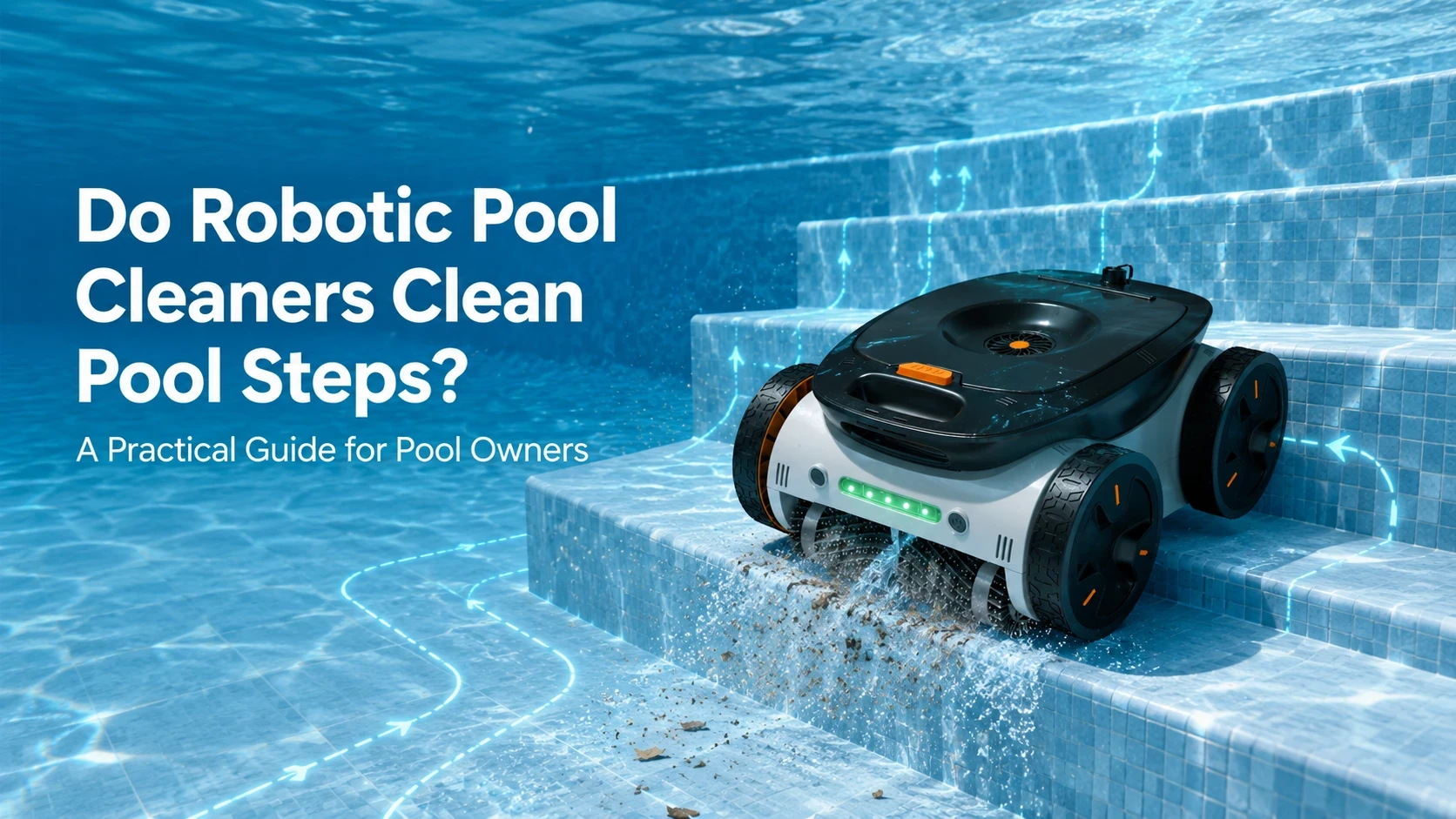
Do Robotic Pool Cleaners Clean Pool Steps? A Practical Guide for Pool Owners
Introduction
Robotic pool cleaners have changed the way pool owners maintain their swimming pools. Instead of spending hours brushing, vacuuming, and removing debris manually, pool owners can now use an automatic pool robot to clean the pool floor, collect leaves, filter fine dirt, and reduce daily maintenance work.
But there is one question many pool owners still ask before buying a pool robot:
Can a robotic pool cleaner clean pool steps?
The short answer is: some robotic pool cleaners can clean certain pool steps, but not every pool robot can clean every step perfectly. Step cleaning depends on several factors, including water depth, step width, step shape, pool surface, robot size, traction, brush contact, suction power, and navigation intelligence.
This is important because pool steps are one of the most difficult areas for any robotic pool cleaner. A robot may clean the pool floor very well, climb walls effectively, and still leave some dirt on narrow or shallow steps. That does not always mean the robot is defective. In many cases, the step design simply makes automatic cleaning more difficult.
In this guide, we will explain why pool steps are challenging, what types of steps are easier for robotic pool cleaners, when manual brushing may still be needed, and how a smart robotic pool cleaner like PURILY can help improve cleaning coverage in pools with steps, slopes, walls, and complex shapes.
Can a Robotic Pool Cleaner Clean Pool Steps?
A robotic pool cleaner may clean pool steps if the steps are wide enough, deep enough, and accessible for the robot to move safely. However, most robotic pool cleaners cannot guarantee perfect cleaning on every step design.
For example, a wide submerged bench-style step may be easier for a pool robot to clean because the robot has enough space to land, move, turn, and maintain brush contact. On the other hand, a very narrow top step with only a few inches of water may be too shallow for many robotic cleaners.
Pool steps are different from the main pool floor. The floor is usually open, flat, and easy for the robot to navigate. Steps are smaller, higher, more irregular, and often located in shallow water. This makes step cleaning more complex.
A good way to understand this is:
Pool floor cleaning is usually the easiest task.
Wall climbing is more difficult.
Waterline cleaning requires better traction and suction.
Step cleaning is one of the most challenging tasks because it combines shallow water, limited space, edges, corners, and sudden height changes.
So, if you want a robotic pool cleaner for a pool with steps, you should not only ask whether the robot can clean “the pool.” You should ask whether the robot can handle your specific step design.
Why Pool Steps Are Difficult for Robotic Pool Cleaners
Pool steps look simple to humans, but they create several mechanical and navigation challenges for robots. Even advanced pool robots may have difficulty cleaning all step areas completely.
1. Pool Steps Are Often Too Shallow
Robotic pool cleaners are designed to work underwater. They need enough water to stay submerged, maintain suction, keep the brushes in contact with the surface, and allow the drive system to move correctly.
Many pool steps, especially the top step, are very shallow. If the water is not deep enough to cover the robot properly, the cleaner may not operate as intended. It may lose suction, slip, stop moving, or turn back toward deeper water.
This is why water depth is one of the most important factors in step cleaning. Even if a robot has strong suction and smart navigation, it still needs enough water to work properly.
2. Steps May Be Too Narrow
A pool robot needs space to move. It must be able to position itself, rotate, change direction, and maintain stable surface contact. Many pool steps are too narrow for this.
If the step is narrower than the robot body, the cleaner may not be able to climb onto it or clean it properly. If the step is only slightly wider than the robot, the robot may still have trouble turning around or following a stable path.
This is one reason why some robots can clean large benches or wide submerged platforms but struggle with traditional narrow pool stairs.
3. Step Edges Can Interrupt Movement
Pool steps have edges, corners, and height changes. These features can interrupt the robot’s movement.
When a robotic pool cleaner detects an edge, it may interpret it as a wall, obstacle, or boundary. Depending on the robot’s navigation system, it may turn away from the step instead of climbing onto it. In other cases, the robot may attempt to climb but lose traction.
Sharp step transitions are especially difficult. A smooth slope is usually easier for a robot than a sudden vertical edge.
4. Dirt Collects in Step Corners
Pool steps often collect sand, dust, small leaves, algae film, sunscreen residue, and body oils. These materials can settle in step corners and along edges.
Even if a robot reaches the step, the brush and suction inlet may not reach every corner. Some debris may remain in tight areas that require manual brushing.
This is why pool owners often notice that the main pool floor looks clean, while step corners still have fine dirt.
5. Water Flow May Be Less Stable on Steps
Robotic pool cleaners depend on water flow to collect debris. In shallow or uneven areas, the suction inlet may not stay in the best position. If the robot is partly lifted, tilted, or near the surface, cleaning efficiency may decrease.
This can make step cleaning less consistent than floor cleaning.
What Types of Pool Steps Are Easier for Robots to Clean?
Not all pool steps are the same. Some designs are much easier for a robotic pool cleaner than others.
Step Type | Cleaning Difficulty | Why |
|---|---|---|
Wide submerged steps | Easier | More room for robot movement |
Bench-style steps | Easier to moderate | Large surface area, usually deeper |
Deep entry platforms | Moderate | Can work if water depth is enough |
Narrow stairs | Difficult | Limited turning space |
Very shallow top steps | Difficult | May not meet minimum water depth |
Curved steps | Moderate to difficult | Irregular path and edges |
Beach-entry slopes | Depends | Smooth slopes may be easier than sharp steps |
Tanning ledges | Often difficult | Usually too shallow for many robots |
The easiest steps for a pool robot are wide, flat, submerged, and accessible. The hardest steps are shallow, narrow, curved, and sharply edged.
Can a PURILY Robotic Pool Cleaner Clean Pool Steps?
A PURILY robotic pool cleaner may help clean accessible pool steps when the step design allows the robot to move safely, stay submerged, and maintain brush contact. Like all robotic pool cleaners, performance depends on the actual pool structure and the specific model being used.
PURILY focuses on smart robotic pool cleaning solutions designed for efficient movement, intelligent navigation, and powerful cleaning. Features such as intelligent path planning, ultrasonic sensing, four-wheel drive, dual intake filtration, high-flow suction, app control, and smart escape design can help improve cleaning efficiency in complex pool environments.
For pools with steps, these features are valuable because the robot needs to detect boundaries, avoid getting stuck, maintain traction, and continue cleaning without repeating the same area unnecessarily.
However, even with advanced technology, very shallow, narrow, or sharply angled steps may still need occasional manual brushing. A professional robotic pool cleaner can reduce manual work, but it may not completely eliminate hand cleaning in every small corner.
A realistic expectation is important: PURILY pool robots can support smarter and easier pool maintenance, but step cleaning still depends on step depth, step width, surface material, and robot access.
Pool Step Cleaning Depends on Water Depth
Water depth is one of the biggest reasons robotic pool cleaners may not clean steps properly.
A pool robot needs enough water to:
Fully submerge the robot body
Maintain stable suction
Keep the brush system in contact with the surface
Support safe motor operation
Allow the drive system to grip the pool surface
Help sensors read the environment correctly
If a step is above the robot’s minimum operating depth, the cleaner may not clean that step effectively. It may avoid the area, stop moving, lose suction, or move back into deeper water.
This is especially common on top steps, shallow shelves, and tanning ledges.
Before expecting a robotic pool cleaner to clean steps, measure the water depth over each step. Then compare the depth with the model’s recommended operating range.
Pool Step Cleaning vs. Wall Cleaning: What Is the Difference?
Many pool owners think that if a robotic pool cleaner can climb walls, it should also be able to clean steps. However, wall cleaning and step cleaning are different.
Wall cleaning means the robot climbs a vertical or curved surface. The wall is usually large, continuous, and underwater. A robot can use suction, traction, and brush contact to move upward.
Step cleaning is more complicated. The robot must move onto a narrow horizontal platform, detect edges, avoid tipping, turn in limited space, and maintain suction in shallow water.
This is why a robot may climb walls but still struggle with steps. Wall climbing ability is important, but it does not automatically mean perfect stair cleaning.
For pools with steps, look for a robotic pool cleaner with strong navigation, good obstacle detection, stable traction, and proper water depth compatibility.
Why Your Pool Robot May Not Clean Steps
If your robotic pool cleaner is not cleaning pool steps, there may be several reasons.
The Step Is Too Shallow
If the water does not fully cover the robot or the suction inlet, the cleaner may not operate properly.
The Step Is Too Narrow
The robot may not have enough room to turn or position itself.
The Robot Is Too Large
A larger robotic pool cleaner may be excellent for the main pool but too big for narrow stairs.
The Step Has Sharp Edges
Sudden height changes may cause the robot to turn away or lose traction.
The Filter Is Dirty
A clogged filter can reduce suction and make climbing or step cleaning more difficult.
Brushes or Wheels Are Worn
Worn brushes, wheels, or tracks can reduce grip and cleaning performance.
The Pool Surface Is Slippery
Algae, biofilm, or sunscreen residue can make steps slippery, especially on tile or fiberglass surfaces.
The Cleaning Mode Is Not Suitable
Some robots have different cleaning modes for floor, wall, or full-pool cleaning. If the wrong mode is selected, step coverage may be limited.
How to Help a Robotic Pool Cleaner Clean Steps Better
While step cleaning depends on robot design and pool structure, there are several ways to improve performance.
1. Keep the Pool Water Level Normal
A pool robot needs the correct water level to operate properly. If the water level is too low, step cleaning becomes more difficult.
2. Brush Step Corners Before Running the Robot
Lightly brushing corners and edges can loosen dirt, making it easier for the robot to collect debris during the cleaning cycle.
3. Remove Large Leaves First
Large leaves or twigs on steps may block movement or reduce suction. Remove them before starting the robot.
4. Clean the Filter After Each Cycle
A clean filter helps maintain suction power. If the filter is full, the robot may struggle to pick up dirt from steps and corners.
5. Check Brushes, Wheels, or Tracks
Worn drive parts reduce traction. If your robot slips or struggles to climb, inspect these parts regularly.
6. Use the Right Cleaning Mode
If your robot supports different modes, choose the one best suited for full coverage or wall cleaning when you want better step-area performance.
7. Run the Robot Regularly
Steps are easier to maintain when dirt does not build up heavily. Regular cleaning prevents algae and debris from becoming stubborn.
8. Do Not Expect Every Corner to Be Perfect
Even advanced robots may not clean every tiny step corner. Occasional manual brushing is normal for many pools.
When Manual Brushing Is Still Needed
A robotic pool cleaner can greatly reduce manual work, but manual brushing may still be useful in certain areas.
You may still need to brush:
Very shallow top steps
Narrow stair corners
Ladder areas
Handrail bases
Tanning ledges
Beach-entry edges
Tight corners
Areas with heavy algae buildup
Areas blocked by obstacles
Manual brushing does not mean the robot is not useful. It simply means that some pool areas are too small, shallow, or irregular for full robotic access.
The best maintenance strategy is to let the robot handle the main cleaning work and use a brush only for difficult details.
How to Choose a Robotic Pool Cleaner for Pools With Steps
If your pool has steps, choose a robotic pool cleaner carefully. Do not only look at price or appearance. Focus on the features that affect real cleaning performance.
Check Step Width
Make sure the robot has enough space to move on the steps. Wide steps are easier to clean than narrow stairs.
Check Water Depth
Measure the water above each step and compare it with the robot’s recommended operating depth.
Look for Strong Traction
A good drive system helps the robot maintain grip on slopes, walls, and step transitions.
Choose Smart Navigation
Smart navigation can improve cleaning coverage and reduce missed areas.
Look for Obstacle Avoidance
Steps, drains, ladders, and corners can interrupt movement. Obstacle detection helps the robot move more intelligently.
Choose Powerful Suction and Good Filtration
Strong suction and efficient filtration help collect sand, leaves, fine dirt, and small debris from step surfaces.
Consider Pool Shape
If your pool has curves, slopes, ledges, or irregular steps, choose a more capable robotic pool cleaner.
Choose a Reliable Manufacturer
For distributors, retailers, and commercial buyers, supplier support matters. Look for product quality, technical support, customization options, and after-sales service.
Why PURILY Is a Smart Choice for Modern Pool Cleaning
PURILY designs robotic pool cleaning solutions for modern residential and commercial pool care. Instead of relying only on random movement, PURILY focuses on intelligent navigation, efficient cleaning paths, powerful suction, dual filtration, and smart control.
For pool owners, this means easier maintenance and more consistent cleaning. For distributors and B2B buyers, it means a product line that can meet different market needs, from home pools to larger commercial facilities.
When dealing with pools that include steps, slopes, walls, and complex shapes, smart robotic design becomes especially important. A pool robot needs more than suction power. It needs stable movement, good sensing, efficient cleaning logic, and reliable filtration.
PURILY robotic pool cleaners are designed to support this type of intelligent pool maintenance.
FAQ: Robotic Pool Cleaners and Pool Steps
Can a robotic pool cleaner clean pool steps?
Some robotic pool cleaners can clean certain pool steps, especially if the steps are wide, submerged, and accessible. However, very shallow or narrow steps may still require manual brushing.
Can a PURILY pool robot clean steps?
A PURILY pool robot may clean accessible steps when the water depth, step width, and pool design allow proper movement and suction. Performance depends on the specific model and pool structure.
Why does my pool robot avoid the steps?
The steps may be too shallow, too narrow, too steep, or outside the robot’s navigation path. The robot may also avoid the area to prevent getting stuck.
Does wall climbing mean the robot can clean steps?
Not always. Wall cleaning and step cleaning are different tasks. A robot may climb walls but still have difficulty with narrow or shallow steps.
Can a pool robot clean a tanning ledge?
Some models may clean wide and sufficiently deep tanning ledges. Very shallow ledges are often difficult for robotic pool cleaners.
Should I still brush my pool steps manually?
Yes, occasional brushing may still be needed for narrow corners, top steps, handrail areas, and shallow shelves.
What should I check before buying a pool robot for steps?
Check the step width, water depth, robot size, traction system, navigation technology, suction power, and recommended pool type.
Final Buying Advice
A robotic pool cleaner can make pool maintenance much easier, but pool owners should have realistic expectations about step cleaning.
If your pool has wide, deep, accessible steps, a capable robotic pool cleaner may help clean them. If your pool has shallow, narrow, or sharply edged steps, the robot may clean only part of the area, and manual brushing may still be needed.
Before buying a pool robot, measure your steps, check the water depth, and review the product specifications. Choose a cleaner with strong movement, smart navigation, effective suction, and reliable filtration.
For homeowners, the right robot can reduce cleaning time and improve pool cleanliness. For distributors and commercial buyers, the right robotic pool cleaner can improve customer satisfaction and support stronger product positioning.
Conclusion
So, can a robotic pool cleaner clean pool steps?
The answer is: sometimes, but it depends on the pool and the robot.
Step cleaning is one of the most challenging tasks for robotic pool cleaners because steps are often shallow, narrow, and full of edges and corners. A robot needs enough water, enough space, stable traction, strong suction, and intelligent navigation to clean them effectively.
PURILY robotic pool cleaners are designed to support smarter pool maintenance through intelligent path planning, advanced sensing, powerful cleaning, and efficient filtration. For pools with steps, slopes, walls, and complex shapes, choosing the right robotic cleaner can make a major difference.
If you are looking for a smart robotic pool cleaner solution for residential or commercial pools, PURILY offers advanced pool cleaning robot options designed for modern pool care, easier maintenance, and better cleaning performance.