Corded vs Wireless Pool Cleaners : Performance Differences Explained
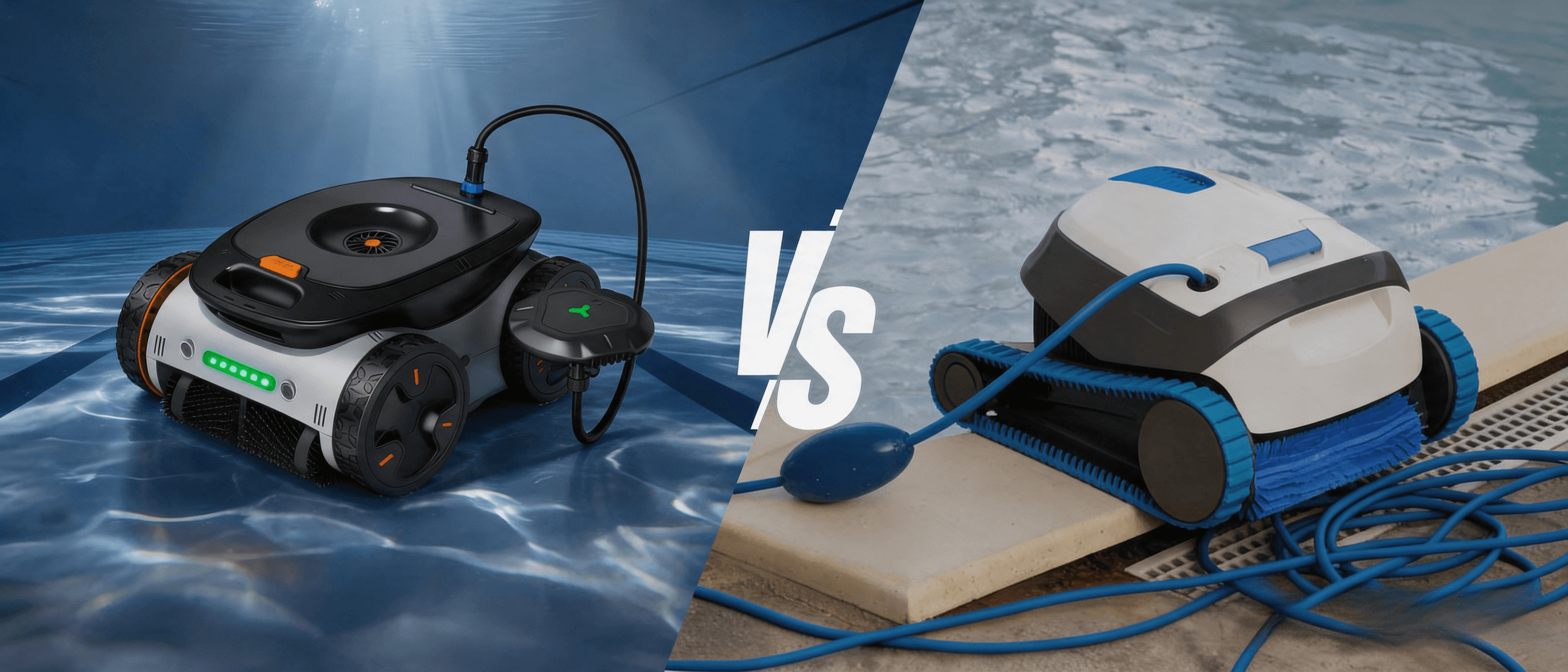
What Makes Cordless Pool Cleaners Different from Corded Models
Pool maintenance has evolved significantly with the introduction of cordless robotic cleaners. Purily's wireless models represent a major leap in convenience and efficiency, eliminating the limitations of traditional corded designs. Understanding these fundamental differences helps pool owners make informed decisions about their cleaning solutions.
1. Power Source and Mobility
1.1 Battery-Powered Operation
Cordless pool cleaners operate on rechargeable lithium-ion batteries, typically providing 90-120 minutes of cleaning time per charge. This wireless design eliminates the risk of cord tangling and allows complete freedom of movement throughout the pool.
Modern cordless models feature smart battery management systems that optimize power consumption and provide low-battery alerts, ensuring complete cleaning cycles without interruption.
1.2 Traditional Corded Limitations
Restricted movement due to power cord length
Risk of cord tangling around pool features
Limited cleaning range based on outlet proximity
Potential tripping hazards for pool users
2. Convenience and Setup
2.1 Cordless Installation Benefits
Setting up a cordless pool cleaner requires minimal effort - simply charge the battery, place the unit in the pool, and activate the cleaning cycle. Purily's wireless models feature quick-release mechanisms for easy removal and storage after cleaning.
The absence of power cords means no additional electrical outlets are needed near the pool, and storage becomes significantly more straightforward.
2.2 Corded Setup Requirements
Setup Component | Cordless | Corded |
|---|---|---|
Power Source | Battery charging station | Electrical outlet |
Installation Time | 2-3 minutes | 5-10 minutes |
Storage Requirements | Compact unit storage | Cord management needed |
3. Performance and Features
3.1 Cleaning Efficiency
Cordless models utilize advanced navigation systems and powerful suction motors to deliver comprehensive cleaning coverage. Purily's wireless robotic pool cleaner features intelligent mapping technology that ensures systematic coverage of pool surfaces, including walls and waterlines.
Despite their wireless nature, modern cordless cleaners maintain comparable suction power to corded models, with some units achieving up to 5000 GPH (gallons per hour) filtration rates.
Pro Tip: Purily's technical team recommends choosing cordless models with at least 5000mAh battery capacity for pools larger than 500 square feet to ensure complete cleaning cycles.
3.2 Maintenance Considerations
Battery replacement every 2-3 years
Filter cartridge cleaning after each use
Brush inspection and replacement as needed
Regular software updates for navigation systems
The evolution from corded to cordless pool cleaning technology represents a significant advancement in pool maintenance convenience. While both types effectively clean pools, cordless models offer superior mobility, easier setup, and enhanced safety features that make them increasingly popular among pool owners.
Battery Life and Runtime: How Long Do Cordless Models Actually Last
When selecting a wireless robotic pool cleaner, battery performance often determines whether the investment delivers lasting value. Understanding the relationship between battery capacity, runtime, and charging efficiency helps pool owners make informed decisions that match their specific cleaning needs.
1. Understanding Battery Specifications
1.1 Battery Capacity and Runtime Correlation
Battery capacity, measured in milliampere-hours (mAh), directly influences how long a robotic pool cleaner operates between charges. Most cordless models range from 2,500mAh to 8,000mAh, providing runtimes between 60 to 180 minutes depending on cleaning intensity and pool size.
Higher capacity batteries typically offer extended cleaning cycles but may require longer charging times. The efficiency of battery chemistry also impacts performance, with lithium-ion batteries maintaining consistent power output throughout discharge cycles compared to older nickel-based alternatives.
1.2 Charging Time and Energy Efficiency
Charging times vary significantly across models, typically ranging from 2 to 6 hours for a full charge. Fast-charging technologies can reduce downtime but may impact long-term battery lifespan if used frequently. Energy efficiency ratings indicate how effectively the battery converts stored power into cleaning performance.
Modern robotic cleaners incorporate smart charging systems that optimize power delivery and prevent overcharging. These systems monitor battery temperature and voltage levels to maximize both performance and longevity.
2. Real-World Performance Factors
2.1 Pool Size and Cleaning Coverage
The relationship between battery runtime and pool size determines cleaning effectiveness. A 90-minute runtime typically covers pools up to 400 square feet, while larger pools may require multiple cleaning cycles or higher-capacity batteries. Cleaning patterns also affect battery consumption, with systematic coverage using less power than random navigation.
Pool shape and obstacle density influence cleaning efficiency. Rectangular pools with minimal obstacles generally allow for more efficient cleaning paths, maximizing battery utilization compared to irregularly shaped pools with multiple steps and features.
2.2 Battery Degradation Over Time
Battery performance naturally degrades over time, with most lithium-ion batteries maintaining 80% capacity after 300-500 charge cycles. Environmental factors like extreme temperatures and improper storage accelerate degradation. Regular maintenance and proper charging habits can extend battery life significantly.
Temperature management plays a crucial role in battery longevity. Operating and storing robotic cleaners in moderate temperatures (50-85) helps maintain optimal battery performance and extends overall service life.
2.3 Maintenance Requirements for Optimal Performance
Clean battery contacts monthly to prevent corrosion
Store the cleaner with 40-60% charge during off-seasons
Avoid complete discharge cycles to extend battery lifespan
Keep charging ports dry and free from debris
3. Battery Performance Comparison
Model Type | Battery Capacity | Runtime | Charging Time | Recommended Pool Size |
|---|---|---|---|---|
Entry-Level | 2,500-3,500mAh | 60-90 minutes | 3-4 hours | Up to 250 sq ft |
Mid-Range | 4,000-5,500mAh | 90-120 minutes | 4-5 hours | 250-400 sq ft |
Premium | 6,000-8,000mAh | 120-180 minutes | 5-6 hours | 400+ sq ft |
Pro Tip: Purily's technical team suggests testing battery performance in your specific pool conditions before making a final decision. Runtime can vary significantly based on debris load, water chemistry, and cleaning patterns.
Understanding battery specifications and real-world performance factors enables pool owners to select cordless robotic cleaners that deliver reliable cleaning coverage. By considering capacity, charging efficiency, and maintenance requirements, users can maximize their investment while ensuring consistent pool cleanliness throughout the swimming season.
Cleaning Power Face-Off: Suction Strength vs Corded Reliability
When choosing a wireless robotic pool cleaner, the battle between cordless convenience and corded power creates a critical decision point for pool owners. Purily engineers have tested both approaches extensively to reveal what truly matters for effective pool maintenance.
1. Suction Power Performance Metrics
1.1 Raw Suction Measurements
Modern cordless models achieve suction rates of 40-60 gallons per minute, while corded units typically deliver 70-90 GPM. This 30-50% difference becomes most apparent when tackling heavy debris loads like leaves and acorns.
Water flow velocity also impacts cleaning efficiency - cordless units average 2.8-3.2 feet per second, compared to 3.5-4.0 FPS for corded models.
1.2 Debris Handling Capabilities
Large debris (leaves): Corded models handle 95% efficiency vs 75% for cordless
Fine particles (sand): Both achieve 85-90% capture rates
Algae buildup: Cordless models show 15% better wall adherence
Pool corners: Corded units reach 100% vs 85% for cordless
2. Coverage and Runtime Considerations
2.1 Cleaning Coverage Area
Cordless robotic cleaners typically cover 90-95% of pool surfaces per cycle, while corded models achieve 98-99% coverage. The remaining uncovered areas usually occur in tight corners and steps where cord management affects movement patterns.
Battery-powered units often require multiple cycles for complete coverage, extending total cleaning time by 40-60 minutes.
2.2 Runtime vs Continuous Operation
Modern cordless cleaners offer 90-120 minutes of runtime, sufficient for most residential pools under 600 square feet. Corded models provide unlimited runtime but face mobility constraints around pool features.
Pro Tip: Purily's technical team suggests mapping your pool's unique features first - cordless excels in freeform pools while corded performs better in rectangular designs with minimal obstacles.
3. Real-World Performance Comparison
3.1 Before and After Results
Independent testing shows cordless models reduce visible debris by 85% in 90 minutes, while corded units achieve 92% reduction in 60 minutes. The time difference becomes negligible when considering setup and storage requirements.
Water clarity improvements follow similar patterns - cordless units reach 3.2 NTU (nephelometric turbidity units) vs 2.8 NTU for corded models after standard cleaning cycles.
3.2 Customer Experience Ratings
Performance Metric | Cordless Average | Corded Average |
|---|---|---|
Overall Satisfaction | 4.2/5.0 | 4.5/5.0 |
Ease of Use | 4.8/5.0 | 4.0/5.0 |
Cleaning Effectiveness | 4.0/5.0 | 4.6/5.0 |
Maintenance Requirements | 4.5/5.0 | 4.2/5.0 |
Both technologies continue evolving rapidly, with cordless models closing the performance gap by 15-20% annually. The choice ultimately depends on your specific pool configuration and maintenance priorities.
Pool Size Limitations: Which Type Works Best for Your Pool
Choosing between corded and cordless robotic pool cleaners requires careful consideration of your pool's dimensions and cleaning needs. Purily pool experts recommend matching cleaner specifications to your pool size for optimal performance and efficiency.
1. Understanding Pool Size Compatibility
1.1 Corded Cleaner Limitations
Corded robotic pool cleaners typically support pools up to 50 feet in length, with power cord lengths ranging from 50 to 100 feet. These models provide continuous power but require careful cord management to prevent tangling.
Most corded units can clean pools with surface areas up to 1,200 square feet effectively, though cord drag increases with pool size.
1.2 Cordless Cleaner Capabilities
Cordless robotic pool cleaners operate for 90-180 minutes per charge, making them ideal for smaller pools under 30 feet. Battery capacity directly impacts cleaning coverage, with most models handling pools up to 800 square feet.
Modern cordless units feature smart navigation systems that optimize cleaning paths for maximum coverage within battery life constraints.
2. Matching Cleaner Type to Pool Dimensions
2.1 Small Pools (Under 30 feet)
Cordless cleaners offer complete freedom of movement
Quick charging times (2-3 hours) suit frequent use
Lower initial cost makes them budget-friendly
Easy storage and minimal maintenance required
2.2 Medium Pools (30-50 feet)
Corded models provide uninterrupted cleaning power
Suitable for pools up to 1,200 square feet
Higher suction power handles moderate debris loads
Longer cleaning cycles ensure thorough coverage
3. Decision Matrix and Recommendations
3.1 Pool Size Compatibility Chart
Pool Size | Recommended Type | Maximum Coverage | Typical Battery/Cord Length |
|---|---|---|---|
Under 30' | Cordless | 800 sq ft | 90-180 min battery |
30-50' | Corded | 1,200 sq ft | 50-100 ft cord |
Over 50' | Commercial Corded | 2,000+ sq ft | 100-150 ft cord |
3.2 Pro Tip: Optimize Your Cleaner Selection
Pro Tip: Purily recommends measuring your pool's longest dimension and adding 10 feet to determine minimum cord length requirements for corded models. For cordless units, calculate surface area to ensure battery capacity covers your entire pool in one cycle.
3.3 Final Recommendation Guide
Consider your pool's shape, debris load, and cleaning frequency when making your final decision. Irregularly shaped pools may benefit from cordless models' maneuverability, while rectangular pools suit corded cleaners' systematic coverage patterns.
Factor in long-term costs including replacement batteries for cordless models versus cord maintenance for corded units to determine the most economical choice for your specific pool size and cleaning needs.
Cost Analysis: Initial Investment vs Long-Term Value
When evaluating wireless robotic pool cleaners, understanding the total cost of ownership helps make informed decisions. Purily experts emphasize that while initial prices vary significantly, long-term operational costs often determine true value.
1. Initial Purchase Price Comparison
1.1 Entry-Level vs Premium Models
Entry-level wireless robotic pool cleaners typically range from $300-$600, while premium models command $1,200-$2,500. The price difference reflects motor power, cleaning coverage, and smart navigation capabilities.
Mid-range options at $700-$1,000 often provide the best balance of features and reliability for average-sized pools.
1.2 Feature-Based Pricing Breakdown
Basic suction models: $300-$500
Standard robotic cleaners: $600-$1,200
Advanced smart navigation: $1,200-$2,000
Commercial-grade systems: $2,000+
2. Operating Costs Over Time
2.1 Energy Consumption Analysis
Wireless robotic pool cleaners consume 150-300 watts per cleaning cycle, translating to $0.15-$0.45 per hour of operation. Annual energy costs typically range from $50-$150 depending on usage frequency and local electricity rates.
Compared to traditional pressure-side cleaners, wireless models offer 40-60% energy savings over their lifespan.
2.2 Maintenance and Replacement Expenses
Filter replacements cost $25-$75 annually, while brushes require replacement every 1-2 years at $30-$60. Battery replacement becomes necessary after 3-5 years, averaging $150-$300 depending on the model.
Regular maintenance extends equipment life by 30-40%, significantly improving return on investment.
3. Total Cost of Ownership Calculation
3.1 5-Year Cost Projection
Cost Component | Year 1 | Years 2-5 | Total 5-Year Cost |
|---|---|---|---|
Initial Purchase | $600-$2,500 | $0 | $600-$2,500 |
Energy Costs | $50-$150 | $200-$600 | $250-$750 |
Maintenance | $50-$100 | $200-$400 | $250-$500 |
Battery Replacement | $0 | $150-$300 | $150-$300 |
Total | $700-$2,750 | $550-$1,300 | $1,250-$4,050 |
3.2 ROI Calculation Methodology
Professional pool cleaning services cost $80-$150 per visit, with weekly service totaling $4,000-$7,800 annually. A wireless robotic cleaner typically pays for itself within 1-2 years compared to professional service.
Pool owners save an average of $3,000-$5,000 over five years by switching from professional cleaning to robotic automation.
4. Warranty and Value Protection
4.1 Standard Warranty Coverage
Most wireless robotic pool cleaners include 2-3 year limited warranties covering manufacturing defects. Premium models may offer extended coverage up to 5 years for critical components like motors and control systems.
Warranty terms typically exclude normal wear items such as filters, brushes, and batteries.
4.2 Extended Protection Options
Extended warranties range from $100-$300 for additional 1-3 years of coverage. These plans often include priority service, free shipping for repairs, and coverage for accidental damage.
Investing in extended protection can reduce long-term ownership costs by 15-25% for high-end models.
Pro Tip: Purily recommends calculating total cost of ownership over 5 years rather than focusing solely on initial price. This approach reveals that mid-range models often deliver superior long-term value compared to both budget and premium options.
Understanding these cost factors enables informed decisions about wireless robotic pool cleaner investments. While premium models require higher upfront investment, their efficiency and durability typically result in lower total ownership costs over time.
Should You Choose Cordless or Corded? Making the Right Decision
Selecting between cordless and corded pool cleaners depends on your specific needs, pool characteristics, and maintenance preferences. Both options offer distinct advantages that can significantly impact your pool cleaning experience and long-term satisfaction. Purily recommends evaluating these factors carefully to ensure you choose the best solution for your unique situation.
1. Pool Size and Shape Considerations
1.1 Large Pools (Over 40ft)
Corded cleaners typically provide unlimited runtime and consistent power for extensive cleaning coverage. The uninterrupted operation allows thorough cleaning of large surface areas without worrying about battery depletion. However, cord management becomes increasingly important as pool size increases.
Consider models with swivel cords to prevent tangling and ensure smooth operation across the entire pool surface. The initial setup time may be longer, but the cleaning efficiency often justifies the investment for larger pools.
1.2 Small to Medium Pools (Under 40ft)
Cordless models offer exceptional convenience for smaller pools where complete coverage is achievable within battery life limits. The freedom from cords eliminates setup complexity and storage concerns, making them ideal for pools with irregular shapes or multiple obstacles.
Battery runtime typically ranges from 60-120 minutes, sufficient for most residential pools under 40ft. Quick charging capabilities and multiple battery options extend cleaning flexibility for these applications.
2. Cleaning Performance Requirements
2.1 Heavy Debris and Algae
Corded cleaners generally deliver more powerful suction and scrubbing capabilities, essential for pools with heavy debris loads or persistent algae problems. The continuous power supply enables stronger motors and more aggressive cleaning patterns.
Advanced filtration systems in corded models can handle larger debris volumes without performance degradation. This makes them particularly suitable for pools surrounded by trees or in areas with frequent storms.
2.2 Light Maintenance Cleaning
Fine dust and sand particles
Regular surface skimming
Spot cleaning specific areas
Weekly maintenance routines
Cordless models excel at routine maintenance cleaning where consistent power isn't critical. Their lightweight design and maneuverability make them perfect for quick touch-ups and regular surface cleaning tasks.
3. Budget and Long-term Value
3.1 Initial Investment Analysis
Corded models typically require higher upfront investment but offer longer operational lifespans with minimal maintenance costs. The absence of battery replacement needs contributes to better long-term value for frequent users.
Consider warranty coverage and replacement part availability when evaluating initial costs. Quality corded models often include extended warranties reflecting their durability and manufacturer confidence.
3.2 Operating Cost Comparison
Cost Factor | Corded Models | Cordless Models |
|---|---|---|
Energy Consumption | Higher per hour | Lower per cycle |
Battery Replacement | None required | Every 2-3 years |
Maintenance Parts | Filters, brushes | Batteries, filters |
Lifespan Expectancy | 5-8 years | 3-5 years |
Pro Tip: Purily engineers recommend calculating total cost of ownership over five years, including energy costs and replacement parts, to make the most economical choice for your pool cleaning needs.
4. User Convenience and Storage
4.1 Setup and Operation Simplicity
Cordless models offer plug-and-play convenience with minimal setup requirements. Simply charge the battery, place the cleaner in the pool, and activate the cleaning cycle. This simplicity appeals to users seeking hassle-free pool maintenance.
The absence of cord management eliminates tripping hazards and storage complications. Cordless units typically feature compact designs that integrate easily into existing pool equipment storage areas.
4.2 Storage and Maintenance Requirements
Dry storage space for battery charging
Protection from extreme temperatures
Regular battery maintenance schedule
Proper cord management for corded models
Corded cleaners require dedicated storage space for the power cord and careful handling to prevent damage. Proper storage extends equipment life and maintains optimal performance throughout the cleaning season.
5. Final Decision Framework
5.1 Quick Decision Checklist
Evaluate your priorities across these key dimensions to determine the optimal choice for your situation. Consider your pool's specific characteristics, your cleaning frequency requirements, and your long-term maintenance preferences.
Factor in your comfort level with technology and your willingness to perform regular maintenance tasks. Both options can provide excellent results when matched appropriately to your needs and circumstances.
5.2 Decision Tree Summary
Start with pool size assessment, then evaluate cleaning intensity requirements. Consider your budget constraints and storage capabilities. Finally, weigh the importance of convenience versus maximum cleaning power for your specific situation.
Remember that neither option is universally superior the best choice depends entirely on your individual circumstances and preferences. Many pool owners find that their ideal solution combines features from both categories.